The Myth That Cats Can't Be Trained
The persistent cultural belief that cats are untrainable is not supported by behavioral science. What's true is that cats are differently motivated - and that distinction has historically been misread as stubbornness or indifference. Cats are obligate solitary hunters by evolutionary background. Unlike dogs, who co-evolved with humans over millennia of cooperative work, cats domesticated on largely their own terms. Their compliance was never hard-wired as a survival strategy.
That doesn't mean they can't learn. It means the training approach has to account for who they actually are. Understanding why positive reinforcement works at a neurological level reveals that the core mechanism - behavior followed by reward strengthens that behavior - applies equally to cats, dogs, and most vertebrates.
Motivation Varies by Individual Cat
Not all cats are equally food-motivated, and some may prefer play or tactile rewards over treats. Identifying your specific cat's highest-value reinforcer is the first practical step in any training program. If your cat is turning away from treats during sessions, it may be full, stressed, or simply uninterested in that particular food - all of which are solvable variables.
The science of animal behavior consistently shows that cats engage readily with training when the motivator is right. The problem is rarely the cat's capacity to learn - it's almost always a mismatch between what the trainer is offering and what the cat actually values.
Where Cat Training Diverges From Dog Training
The most significant practical difference is motivational architecture. Dogs are highly social animals for whom human approval functions as a genuine reward. Many dogs will work enthusiastically for praise alone. Cats will not. For a cat, the reward must have intrinsic value - typically food, play, or access to something desirable.
Attention span is another key variable. Cats show measurably lower frustration tolerance during repetitive tasks. Where a dog might persist through ten failed attempts at a new behavior, a cat is likely to walk away after three or four. This makes session length a structural concern, not just a preference. Sessions should cap at two to five minutes, and always end before the cat disengages.
2-5 min
Ideal cat training session length
Behavioral science guidelines consistently recommend keeping feline training sessions short to maintain engagement and prevent frustration-based disengagement.
~0.5 sec
Maximum reward delay for learning
Research in operant conditioning indicates that rewards delivered within half a second of the target behavior most reliably establish the behavior-consequence association.
3x
More sessions recommended vs. dogs
Because cats disengage faster, multiple brief daily sessions - rather than one longer session - are recommended by feline behavior specialists to build reliable responses.
Environmental distractions also affect cats differently. Because cats process their environment as potential prey habitat, novel stimuli grab attention intensely and often derail focus. Training in a low-distraction space - and only when the cat is alert but calm, not post-nap drowsy - makes a substantial difference. Generalizing behaviors to new environments requires deliberate, gradual exposure for cats just as it does for dogs.
What Transfers Directly From Dog Training Science
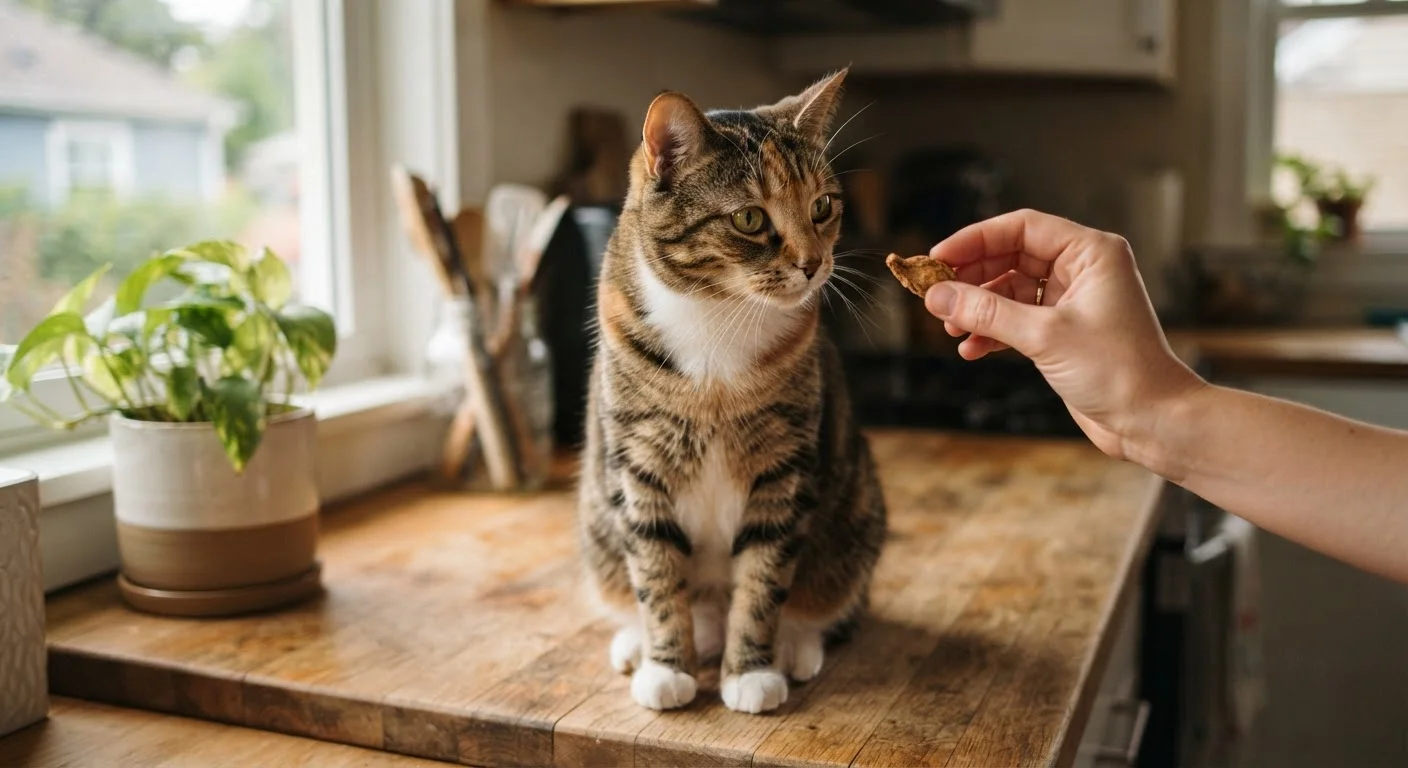
The foundational mechanics of learning are species-agnostic. Timing is everything: the reward must follow the target behavior within roughly half a second to reliably create the association. Waiting two seconds while you fish a treat from a pouch is long enough to accidentally reinforce whatever the cat was doing in that gap.
The three core teaching techniques - shaping, luring, and capturing - all transfer cleanly to cat training. Shaping, luring, and capturing each have their place depending on the behavior being taught and the cat's current engagement level. Luring with a treat or toy works well for movement-based behaviors; capturing is ideal for natural behaviors like sitting or stretching that the cat already offers spontaneously.
Always End on a Win
Before ending any training session, ask for a behavior your cat already knows well, reward it clearly, then stop. This ensures the cat's last memory of the session is a successful, rewarding interaction - making it more likely to engage willingly next time. Never end on a failed attempt or during disengagement.
Punishment - including startling, spraying with water, or physical correction - is counterproductive with cats. Research in animal learning consistently shows that punishment suppresses behavior without teaching an alternative, and with cats specifically, it erodes the trust that makes training possible in the first place. Extinction (simply not rewarding an unwanted behavior) and redirection to an appropriate alternative are far more effective tools.
Why Training Matters Beyond Tricks
Training a cat isn't merely about teaching it to sit on cue. Behavioral enrichment is a recognized component of feline welfare. Cats that engage in regular mental stimulation through training, puzzle feeders, and structured play show lower rates of anxiety-related behaviors like over-grooming or redirected aggression.
From a bonding perspective, training creates a pattern of positive, predictable interaction between cat and owner. The cat learns that engaging with you produces good outcomes. That association generalizes. Play-based training can extend this further, using the cat's predatory drive as a natural motivator. Even understanding why cats behave the way they do can help owners redirect instinct-driven behaviors more effectively than suppressing them.
Training also has practical veterinary benefits. Cats that have been conditioned to accept handling - having their paws touched, being placed in a carrier, tolerating brief restraint - experience less stress during vet visits and are easier to examine. This is a welfare outcome with real health implications, not just a convenience. For a broader view of how learning capacity evolves across a pet's life, see how training needs shift across a lifetime.