Why Generic Enrichment Often Falls Flat
Enrichment has become a buzzword in pet care, but the concept only delivers real welfare benefits when it's grounded in how a specific animal's brain is actually wired. Tossing a ball to a ferret or placing a mirror in a rabbit's enclosure might look like enrichment on paper - but if it doesn't tap into the species' cognitive architecture, it's more noise than signal.
The underlying science draws from ethology - the study of animal behaviour in natural contexts - which identifies a set of species-typical behaviours that animals are strongly motivated to perform. When those behaviours have no appropriate outlet, the motivation doesn't disappear; it redirects into whatever is available, which is often destructive, repetitive, or stress-amplifying. Understanding this is foundational to building a behaviour-aware environment for your pet.
Distinguishing Boredom from Stress
Enrichment addresses under-stimulation, but some repetitive or destructive behaviours signal anxiety rather than boredom - and the interventions differ meaningfully. Before redesigning an enrichment plan, it's worth accurately diagnosing which state your pet is in. Our guide to telling stress and boredom apart walks through the key behavioural markers for each.
Six Enrichment Strategies Matched to Animal Cognition
Start Simple, Then Build Complexity
Introduce new enrichment activities at the easiest difficulty level first. Animals that encounter frustrating challenges before they understand the basic mechanics often disengage entirely - and that disengagement is hard to reverse. Once your pet consistently solves the easy version, incrementally increase difficulty. This mirrors how animals encounter problems in natural environments: gradual escalation rather than sudden complexity.
Scent-Based Foraging for Dogs
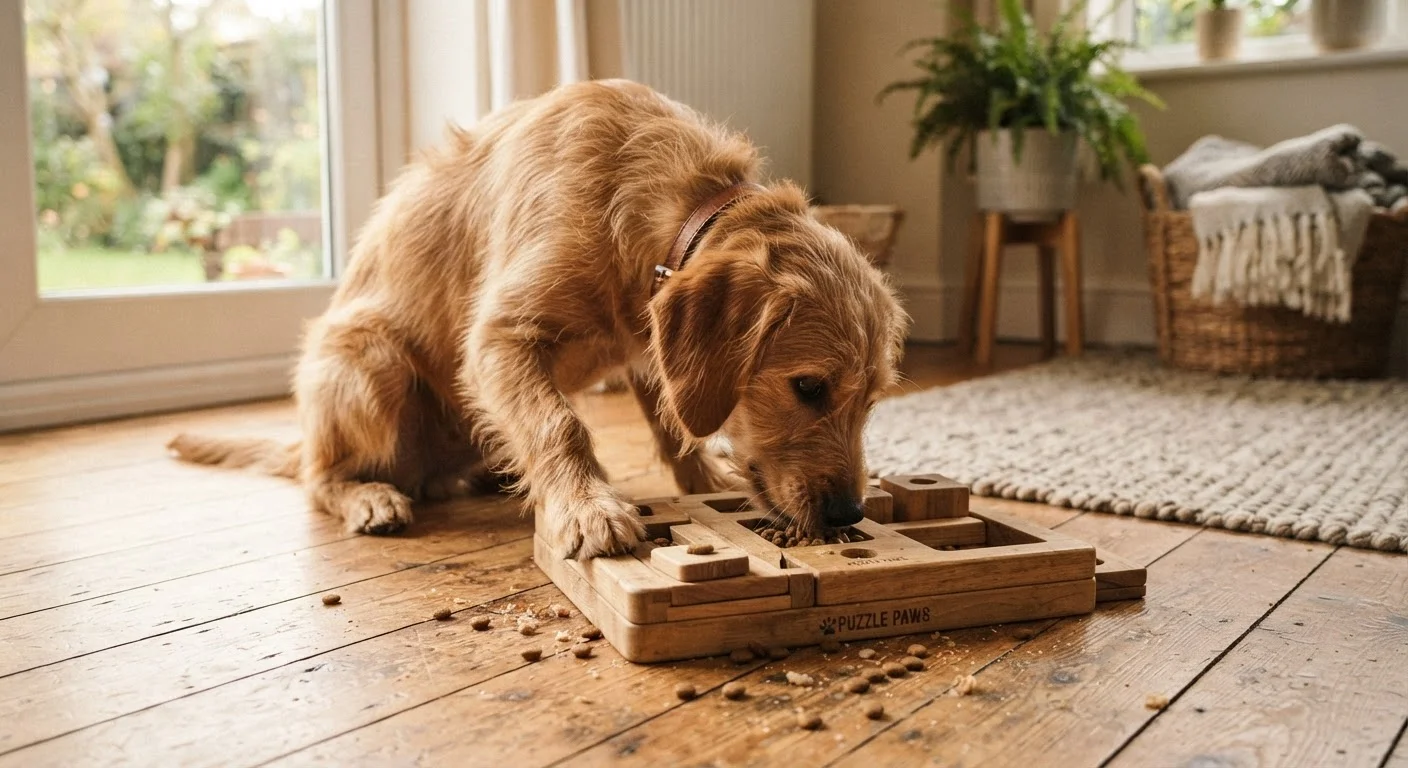
Dogs process the world primarily through smell - their olfactory cortex is proportionally far larger than a human's, and nose-work activates neural pathways that physical exercise alone cannot reach. Scatter feeding in grass, hiding food inside crumpled paper bags, or setting up snuffle mats gives dogs a functional outlet for the same seek-and-find behaviour they'd use to locate prey in the wild.
Research in applied animal behaviour has consistently shown that olfactory enrichment reduces stress indicators in kennelled dogs. For pet dogs at home, even five to ten minutes of structured sniff time can noticeably lower arousal and improve calm settling afterward. The key is making the dog work sequentially - small finds that build toward a larger payoff mirror the cadence of natural foraging.
Nose-work activates neural pathways that physical exercise alone simply cannot reach.
Puzzle Feeding for Cats
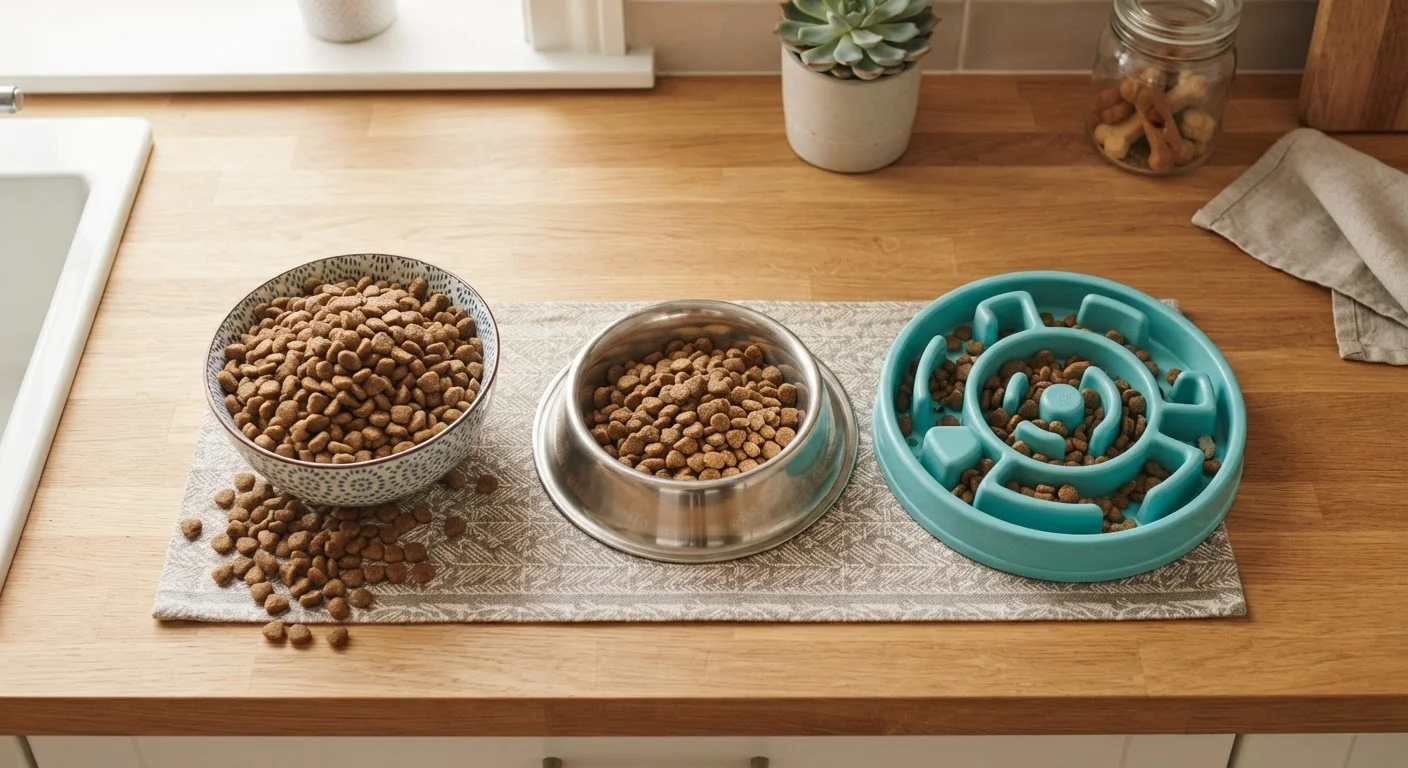
Domestic cats are obligate solitary hunters. A bowl placed on the floor at a fixed time each day satisfies caloric need but bypasses almost every cognitive step the feeding process is designed to involve: stalking, pouncing, problem-solving, and consuming in small, episodic amounts. Puzzle feeders - whether purpose-made or improvised from egg cartons and toilet roll tubes - reintroduce some of that cognitive load.
The evidence behind puzzle feeders suggests benefits including reduced food-guarding, slower eating, and decreased anxiety-related behaviours in indoor cats. Difficulty should be gradually increased; starting too hard leads to frustration and abandonment rather than engagement. See also the broader discussion on enrichment trade-offs for indoor cats.
A food bowl satisfies calories but bypasses almost every cognitive step feeding is designed to involve.
Vertical Space and Territory Mapping
Cats are vertical animals. In multi-level environments, they establish micro-territories at different heights - high perches for surveillance, mid-level shelving for transit, and low spots for rest. Providing this vertical variety is not aesthetic preference; it directly maps to how cats manage perceived safety and social spacing, particularly in multi-cat households.
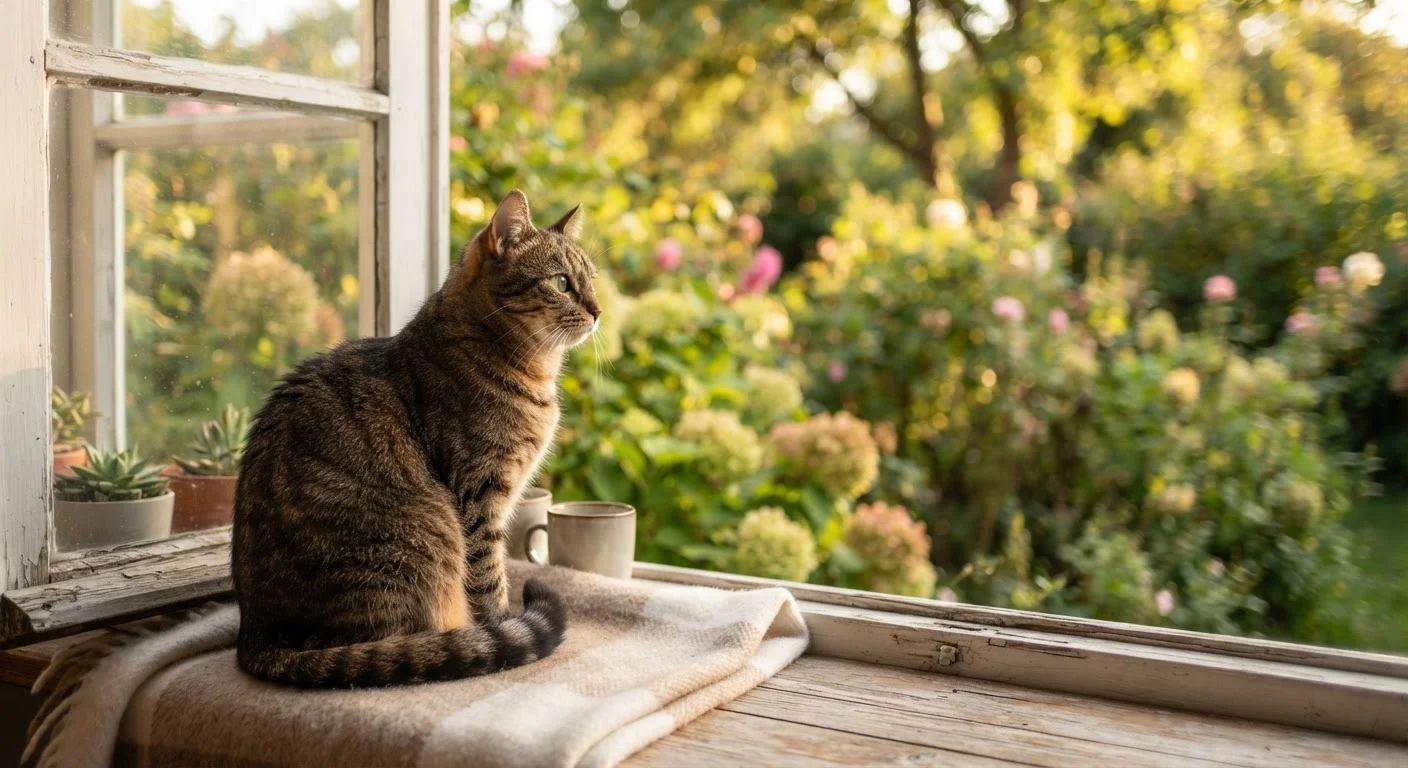
Window ledges with bird feeders positioned outside, wall-mounted shelving at varying heights, and stable cat trees with enclosed top sections all address this territorial logic. The enrichment value is highest when the animal can move between levels without jumping to the floor - continuous elevated pathways allow exploration without the vulnerability of ground exposure.
Vertical variety maps directly to how cats manage perceived safety and social spacing.
Social Play Structured Around Predatory Sequence
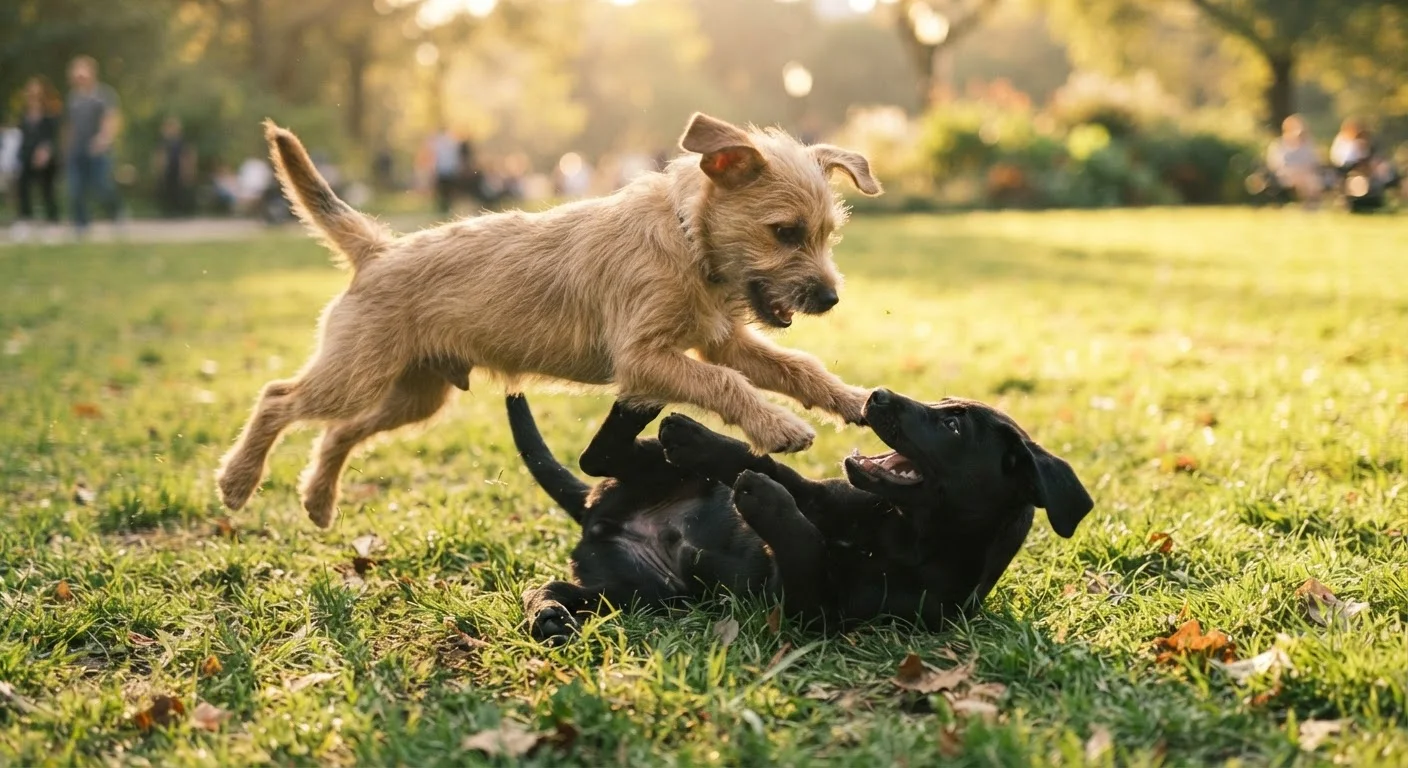
For both cats and dogs, play that mirrors the natural predatory sequence - orient, stalk, chase, grab, kill, consume - is more cognitively satisfying than random motion. A wand toy moved in an erratic, prey-like arc engages a cat more deeply than one dragged in a predictable straight line. For dogs, a game of tug that includes a brief pause (mimicking a prey holding still) activates problem-solving alongside physical drive.
Critically, play sessions should include a resolution phase. Cats need to "catch" their prey periodically; ending every session before a catch leaves arousal unresolved and can increase frustration. The developmental role of play extends well beyond puppyhood and kittenhood - adult animals continue to rely on play for emotional regulation.
Play that mirrors the predatory sequence is more cognitively satisfying than simple random motion.
Novel Object Exploration for Small Mammals and Birds
Rabbits, guinea pigs, rats, and parrots are often under-served by static enclosures. These species share a strong neophilia - a curiosity drive toward novel objects - that can be channelled productively. Introducing new textures, safe objects to manipulate, or rearranged furniture within an enclosure triggers investigative behaviour that reduces stereotypy (repetitive, seemingly purposeless actions that indicate understimulation).
For parrots specifically, foraging puzzles and destructible items like untreated wood or paper engage the beak-and-claw coordination that would otherwise be directed toward perches or cage bars. Rats benefit substantially from object caching - hiding food inside paper tubes or small boxes they must open - which exploits their natural hoarding and problem-solving instincts. Rotate objects regularly; familiarity erodes enrichment value quickly in these cognitively active species.
Novelty drives investigative behaviour that directly reduces stereotypy in understimulated small mammals.
Intermittent Social Contact Tailored to Species Norms
Not all animals are equally social, and enrichment that works for one species can stress another. Dogs are obligate social animals; prolonged isolation is a genuine welfare concern. Cats are facultatively social - they can form bonds but are not harmed by solitary time, and forced social interaction can be a stressor rather than an enrichment. Rabbits are social and typically benefit from companionship, while many reptiles are solitary and may find cage-mate contact threatening rather than enriching.
Understanding whether a species is naturally gregarious shapes how social enrichment should be structured. For dogs, current ethological understanding has moved away from dominance hierarchies toward nuanced social bond models - meaning enrichment through social play with familiar individuals is more valuable than "leadership challenges." Matching social exposure to natural norms prevents the well-meaning enrichment that inadvertently raises baseline stress.
Social enrichment that ignores species norms can raise baseline stress rather than reduce it.
Putting It Into Practice
The most effective enrichment plans share a few structural features: they rotate regularly to prevent habituation, they scale in difficulty as the animal gains proficiency, and they are informed by observation - if a pet consistently disengages from an activity, that's data worth acting on rather than ignoring.
Enrichment also works best as part of a broader reinforcement strategy. The full spectrum of reinforcement includes environmental rewards and play-based interaction that enrichment activities naturally support. If you're also exploring training through play, well-designed enrichment sessions can double as low-pressure skill-building opportunities - making them efficient investments of your time as well as your pet's.