
Why Passive Review Leaves Knowledge Shallow
Most professionals default to re-reading notes, re-watching recordings, or highlighting key passages when they review material. These approaches feel productive - they're low-effort, comfortable, and leave you with the satisfying sense that you've covered the content. The problem is that recognition is not the same as retrieval. When your eyes move over familiar text, your brain matches what it sees to existing memory traces - a much weaker signal than actually reconstructing the information from scratch.
Cognitive science researchers have repeatedly demonstrated what is sometimes called the 'testing effect': retrieving information from memory produces significantly stronger retention than an equivalent period of re-studying the same material. This is not a marginal difference. Studies published in educational psychology journals have found that students who used retrieval practice substantially outperformed those who restudied, even on delayed tests of the same material.
If your current review habits feel comfortable but aren't producing durable knowledge, common signs your study habits are working against you can help you identify exactly where the problem lies. Active recall directly fixes the core issue: it forces retrieval, not recognition.
Start With Just One Question
If active recall feels intimidating, begin each session by writing a single question about what you last learned, then answering it from memory. This low-barrier entry point removes the friction of starting and quickly builds momentum. Over time, one question naturally expands into a productive retrieval practice.
What You Need Before You Start
Active recall requires almost no equipment, which makes it one of the most accessible learning methods available. That said, a few things will make your sessions more effective from the start.
What you will need
Blank notebook or paper
Used for free-recall writing - jotting down everything you remember about a topic without looking at notes.
Flashcard app (e.g., any spaced-repetition tool)
Digitizes retrieval practice and can automate question scheduling based on your performance.
Original study material (textbook, notes, video transcript)
Serves as the verification source after each retrieval attempt.
Timer
Keeps retrieval attempts time-boxed and prevents you from giving up too quickly before checking answers.
One structural decision to make upfront: will you use free-recall (blank page, write everything down) or cued recall (pre-written questions you answer)? Free recall builds broader retrieval networks and is stronger for consolidating complex, interconnected material. Cued recall is faster and more targeted - useful when you have identified specific facts or definitions that need reinforcement. Most learners benefit from using both at different stages.
Executing an Active Recall Session
Follow the steps below for a structured session you can complete in 15-20 minutes. As you build the habit, the process will feel automatic and the time investment will shrink. For your first few sessions, move slowly and pay close attention to the gap-identification step - that is where the real diagnostic value lives.
Choose a clearly defined chunk of material
Select a focused unit of content - one concept, one process, or one chapter section. Active recall works best on bounded material. Trying to recall an entire course at once is overwhelming and counterproductive. If you have been studying a broad topic, break it into sub-topics of roughly 10-15 minutes of original learning each.
Close all reference materials
Before attempting any retrieval, close your notes, hide the slides, and put down the textbook. This step is non-negotiable. The entire value of active recall comes from forcing memory retrieval without visual cues. Even a glance at a heading acts as a prompt that short-circuits the retrieval process.
Write or say everything you can retrieve
Using a blank page or empty document, write down every fact, concept, definition, or relationship you can recall about the chunk. Don't organize as you go - just get it out. This is sometimes called a 'brain dump.' Alternatively, answer specific pre-written questions about the material. Both approaches trigger the same retrieval mechanism; choose whichever fits your learning style.
Compare your recall to the source material
Now reopen your notes or reference text. Check each point you recalled for accuracy. Mark gaps - things you missed entirely - and errors - things you recalled incorrectly. Do not simply highlight what you got right. The gap analysis is where most of the learning happens: it shows you precisely what needs another retrieval cycle.
Re-test gaps within the same session
For each gap or error identified, re-read only that specific piece of information, then close the material again and attempt to recall it once more. This targeted re-retrieval within the same session prevents you from moving on with uncorrected blind spots. Aim for at least two successful retrievals of any item you initially missed before considering it learned.
Schedule the next retrieval before you finish
Before you close your session, write down when you will practice this chunk again. Research on memory consolidation consistently shows that retrieval is most effective when spaced over time. A rough starting schedule might be: 1 day later, then 3 days, then 1 week. Pair this habit with the insights from spaced repetition research for a complete retention system.
Struggle Is Part of the Process
When you attempt to retrieve something and initially fail, that difficulty is not a sign you're doing it wrong - it's a sign the technique is working. Research on the 'desirable difficulties' framework suggests that effortful retrieval, even when incomplete, produces stronger memory consolidation than passive review. Resist the urge to flip back to your notes immediately; give yourself 30-60 seconds of genuine effort first.
Once you've completed a few sessions with a single chunk of material, you can scale this approach across multiple topics in a single week. A useful structure is to rotate two or three chunks per session, retrieving older material alongside newer material. This mimics the interleaving effect, which research suggests can further improve long-term retention compared to blocking all practice on one topic at a time.
Fitting Active Recall Into a Busy Schedule
For young professionals managing tight calendars, the biggest barrier is not understanding the method - it's finding consistent time to apply it. A few structural adjustments make active recall sustainable.
Keep sessions short and frequent. A 15-minute retrieval session three times a week produces better retention than a two-hour session once a week. Shorter sessions are also easier to protect on a busy day. Pair this with a weekly review habit to plan which chunks you'll test each week so you're never deciding in the moment.
Use dead time strategically. Commutes, lunch breaks, and waiting rooms are viable slots for cued-recall practice, especially if you've pre-written your questions. Passive habits like re-watching course videos during these windows feel efficient but rarely produce lasting knowledge - a retrieval attempt over the same material does far more.
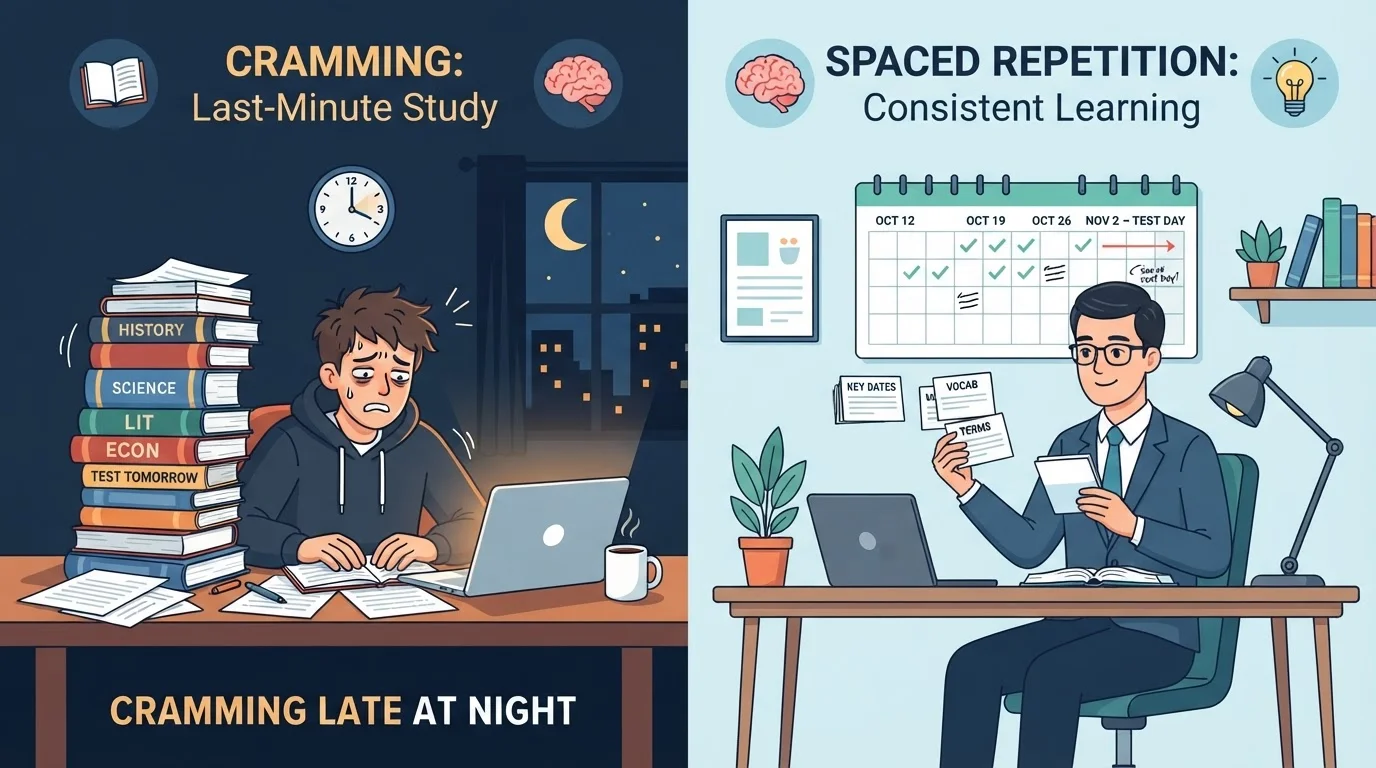
Combine with spaced repetition. Active recall tells you what to retrieve; spaced repetition tells you when to retrieve it. Used together, they form a complete retention system. The research comparing spaced and massed practice makes the case clearly: distributed retrieval is far more efficient than cramming. If you want to apply retrieval even before you've studied something new, pre-topic self-testing is a complementary technique worth exploring.
Don't Skip the Feedback Step
Active recall only works when you verify your answers against a reliable source after retrieving them. Practicing without checking means you may reinforce inaccurate information - a phenomenon researchers call 'confident errors.' Always close the loop by comparing your recalled answer to the correct material before moving on.