
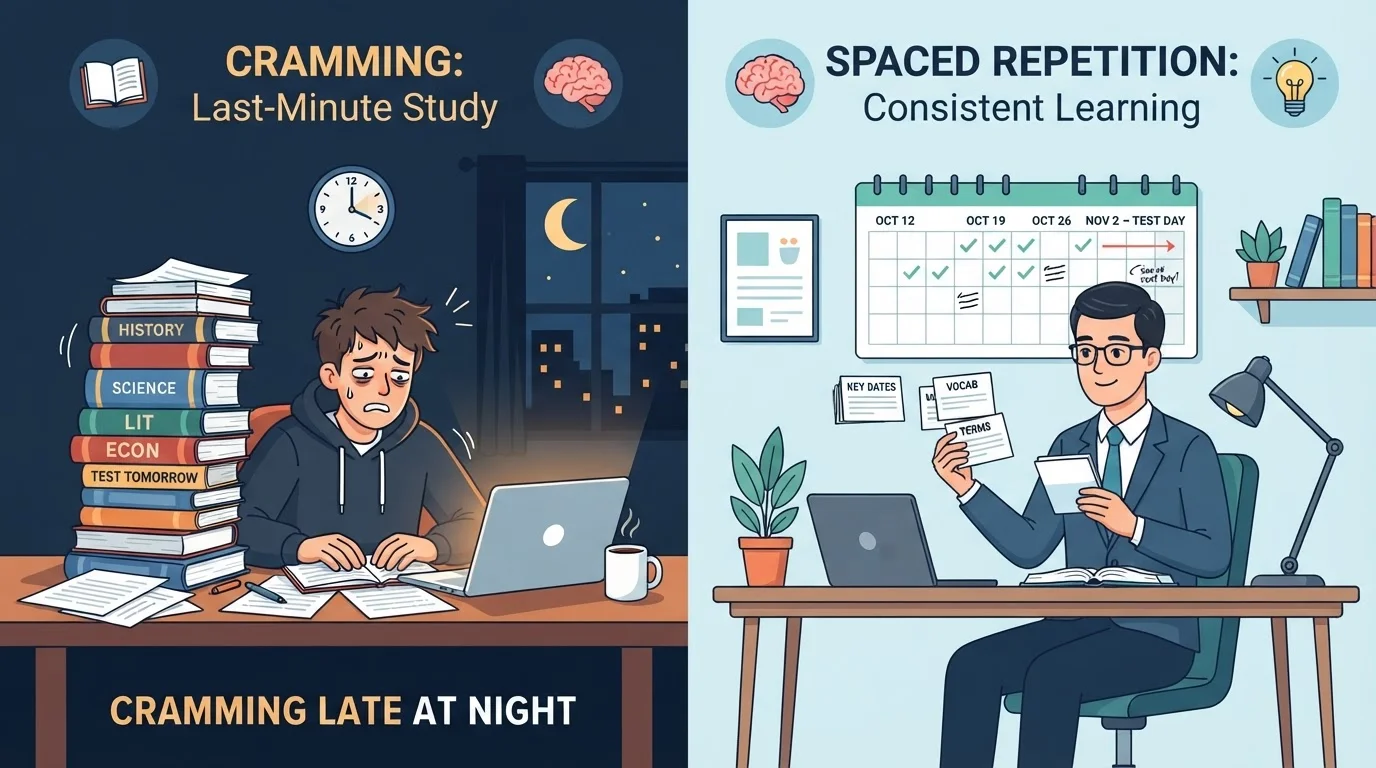
The Core Distinction: Scheduling, Not Effort
Both spaced repetition and massed practice involve the same raw activity - reviewing material - but they differ entirely in when that review happens. Massed practice concentrates exposure in a single session or a short window (what most people recognize as cramming). Spaced repetition distributes review across increasing intervals: you revisit material after a day, then three days, then a week, then a month.
This scheduling difference turns out to matter enormously. Cognitive psychologists have studied the spacing effect for over a century, with foundational work dating back to Hermann Ebbinghaus in the 1880s. His forgetting curve showed that memory decays rapidly after initial encoding - but each spaced review resets and strengthens the trace. Contemporary researchers including Robert Bjork have built on this to explain why spacing works: retrieving information when it has partly faded requires more cognitive effort, and that effortful retrieval is precisely what consolidates the memory.
Massed practice, by contrast, keeps material in working memory. Performance during a cram session feels strong - but that fluency is largely illusory. Once the session ends, the material fades at a predictable rate. This is what researchers call the illusion of knowing: feeling like you've learned something because you just reviewed it, not because you can actually retrieve it later.
See common patterns that erode professional learning progress for how this illusion plays out in everyday habits like passive video rewatching.
What the Research Actually Shows
The evidence for spaced repetition is unusually robust across domains. A widely cited meta-analysis by Cepeda and colleagues (2006), published in Psychological Bulletin, analyzed 254 studies and found that spaced practice reliably outperforms massed practice for long-term retention across age groups, material types, and subject areas.
254
Studies analyzed on spacing effects
A 2006 meta-analysis by Cepeda et al. in Psychological Bulletin synthesized 254 studies confirming the robust spacing advantage for long-term retention.
~200%
Retention improvement over massed practice
Research summaries in cognitive psychology suggest spaced learners can retain roughly twice as much material after a delay compared with massed-practice learners.
1880s
When spacing effects were first documented
Hermann Ebbinghaus's self-experiments on the forgetting curve established the foundational evidence for distributed practice more than 140 years ago.
Medical education has been a particularly productive testing ground. Studies on medical students learning anatomy, pharmacology, and clinical procedures consistently find that spaced review outperforms equivalent time spent in a single session when tested days or weeks later. The advantage compounds over time: the longer the retention interval you're aiming for, the larger the spacing benefit.
The practical implication is counterintuitive: reviewing material when it still feels easy is less effective than waiting until you've partly forgotten it. This is because the retrieval itself - the act of pulling knowledge from memory against some resistance - is what strengthens the memory trace. Pairing this principle with active recall techniques compounds the benefit further, since recall-based review (self-testing, flashcards) is more potent than passive re-reading.
| Criterion | Spaced Repetition | Massed Practice |
|---|---|---|
| Retention after 1 week | Significantly stronger | Rapid decay typical |
| Retention after 1 month | Strong with proper intervals | Mostly lost |
| Short-term fluency (same day) | Moderate | High |
| Time required per session | Short (10-20 min) | Long (1-3+ hrs) |
| Fits a busy schedule | Yes - distributed daily | Difficult - requires blocks |
| Evidence base | Extensive, multi-domain | Weak for long-term goals |
| Risk of illusion of knowing | Low | High |
One important nuance: spacing intervals are not one-size-fits-all. Optimal gaps depend on how well the material is already known and how far away the target recall event is. The general principle is to expand the interval after each successful retrieval - a concept embedded in most digital spaced repetition tools that use algorithms to schedule reviews automatically.
Applying This to a Professional Learning Schedule
Knowing the research is useful; building a workable schedule is the real challenge. The good news is that spaced repetition doesn't require long sessions. A 10-15 minute daily review - done consistently - outperforms a two-hour weekly block for most retention goals. This aligns well with the productivity habits that support sustained professional growth.
A practical starting framework:
- Day 1: Encode new material fully (read, take notes, or complete the lesson).
- Day 2: Review the same material briefly via recall - close your notes and reconstruct the key ideas.
- Day 4-5: Review again, focusing only on what you couldn't retrieve on Day 2.
- Week 2: A single review session of the entire block; note what still feels shaky.
- Month 1: One final review to cement long-term retention.
This schedule isn't rigid - the principle is to let some forgetting occur before each review. Sleep also plays a meaningful role here: memory consolidation during sleep strengthens the traces that spaced retrieval builds. What happens to new knowledge overnight is worth understanding before designing your review timing.
Spacing Works Even With Short Gaps
You don't need weeks between sessions to see a benefit. Research shows that even a 24-hour gap before first review produces meaningfully better retention than reviewing the same material again immediately. If a full spaced schedule isn't feasible, simply sleeping on new material before your next review is a practical first step. Consistency over time matters more than perfect interval calibration.
For those building complex skills - writing, data analysis, strategic thinking - interleaving different problem types within spaced sessions adds another layer of depth, reinforcing the ability to discriminate between concepts rather than just recall them in isolation.