
Why Your Brain Prefers the Hard Way
Most study sessions are organized the way textbooks are organized: finish chapter four, then move to chapter five. This approach - called blocked practice - feels logical and comfortable. Progress feels visible. But comfort during practice is not the same as learning.
A substantial body of cognitive science research demonstrates that when learners mix different problem types or topics in a single session, they perform worse during practice but significantly better on tests taken days or weeks later. This is the central paradox of interleaving: the method that feels least productive tends to produce the most durable understanding.
The mechanism behind this involves discrimination learning - the cognitive work of identifying which strategy or concept applies to a given problem. In blocked practice, the strategy is always obvious because every problem in a set is the same type. In interleaved practice, each new problem requires the learner to first recognize what kind of problem it is before solving it. That extra cognitive step is effortful, but it mirrors exactly how knowledge gets used in professional life.
Start With Two Topics, Not Five
When you first try interleaving, limit yourself to rotating between two related but distinct problem types. Adding too many categories at once can overwhelm working memory before the method has a chance to help. Once the switching feels manageable, gradually expand your rotation.
What the Research Actually Shows
One frequently cited line of research in this area comes from studies on mathematics learning, where students who practiced different equation types in a mixed order consistently outperformed those who used blocked practice on cumulative assessments - despite lower accuracy during practice itself. Similar patterns have appeared in studies involving tennis serves, medical diagnosis training, and category learning tasks.
Interleaving is understood within cognitive psychology as a form of desirable difficulty - a category of conditions that slow initial acquisition but enhance long-term retention and transfer. You can read more about the broader concept in our article on desirable difficulties and why learning should feel a little hard.
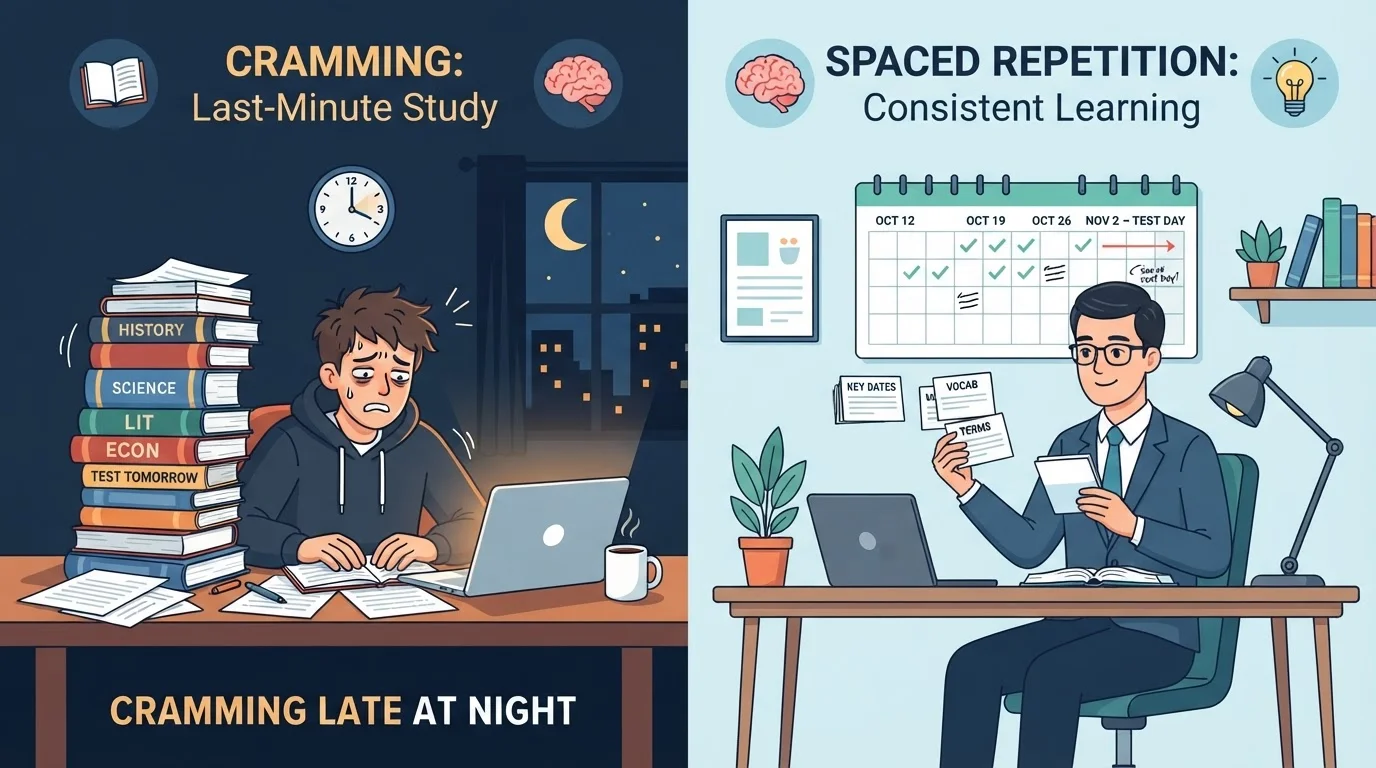
It is worth noting the contrast with massed practice (sometimes called cramming), which produces rapid short-term gains that fade quickly. If you want to understand how scheduling affects retention, spaced repetition vs. massed practice explores that distinction in depth.
~43%
Improvement on delayed tests from interleaving
Research reviewed in cognitive psychology literature suggests interleaved practice has produced test-score improvements of roughly 40-50% over blocked practice on delayed assessments in several math and science studies.
Lower
Accuracy during interleaved practice sessions
Studies consistently show learners score lower during interleaved practice compared to blocked practice - yet outperform blocked-practice learners on retention tests taken days later.
How to Apply Interleaving Practically
The key to implementing interleaving is to sequence your practice problems or topics in a shuffled order, ensuring that no two consecutive items are of the same type. In practical terms:
- In math or quantitative subjects: Instead of doing ten calculus problems followed by ten statistics problems, alternate - calculus, statistics, calculus, statistics - or shuffle all twenty randomly.
- In language learning: Mix vocabulary, grammar drills, and reading comprehension within a single session rather than isolating each skill.
- In professional skills development: If you are studying for a certification, rotate between topic areas rather than mastering one domain before touching another.
One important constraint: interleaving works best when you have at least foundational familiarity with each topic in the mix. Applying it to material you have never encountered before can overwhelm working memory before any learning takes hold. If you are struggling to identify whether your current habits are helping or hindering, reviewing signs your study habits are working against you is a useful starting point.
Combining Interleaving With Other Evidence-Backed Methods
Interleaving doesn't operate in isolation. It stacks well with other research-supported strategies:
Self-testing: Rather than re-reading notes, try answering questions across mixed topics. This turns retrieval practice into interleaved practice simultaneously. Our guide on self-testing before a new topic explains how pre-testing activates prior knowledge before you even begin a new concept.
The Feynman Technique: After an interleaved practice session, try explaining each topic area in plain language to check what actually stuck. The Feynman Technique in practice walks through how to use deliberate simplification to surface gaps in understanding.
One method that does not pair well with interleaving is multitasking during study - splitting attention between content and unrelated tasks cancels out interleaving's benefits by preventing the deep processing the method depends on. What research says about multitasking while studying explains why.
“The difficulties we encounter while learning - the ones that seem to slow us down - are often the very mechanisms that make knowledge stick. Interleaving is a prime example: it imposes a productive struggle that blocked practice simply does not.”
— Robert Bjork, Distinguished Professor of Psychology, UCLA; leading researcher on human learning and memory