Why Age Changes How Pets Learn
Training is not a fixed formula you apply once and maintain forever. The way animals acquire, retain, and generalize new behaviors shifts substantially as they move through life - shaped by neurological development, hormonal cycles, sensory acuity, and physical capacity. Understanding these shifts is what separates owners who get frustrated by their pet's "regression" from those who adapt and continue making progress.
At the core, learning in mammals depends on neural plasticity - the brain's ability to form and reorganize synaptic connections. Younger animals have dramatically higher plasticity, which is why early experiences leave such lasting impressions. As pets age, plasticity narrows but doesn't disappear; it simply requires more deliberate reinforcement strategies to achieve the same effect.
This guide examines each major life stage - puppy, adolescent, adult, and senior - and translates the underlying science into training approaches that actually match where your pet is developmentally. For a broader understanding of animal behavior, it helps to see training as one expression of a pet's entire behavioral profile.
Week 3-14
Primary socialization window in puppies
According to veterinary behaviorists, this sensitive period has the most significant lasting impact on a dog's social temperament.
~28%
Dogs over 11 showing CDS signs
Research published in veterinary behavior literature estimates cognitive dysfunction affects a substantial minority of dogs in their senior years.
1-2 seconds
Optimal reward timing window
Applied behavior science consistently identifies this interval as the threshold for associating a reward with the target behavior across species.
The Puppy Phase: Socialization and Foundation Skills
Puppies undergo a sensitive period for socialization - roughly weeks 3 through 14 - during which exposure to people, animals, sounds, surfaces, and environments shapes their baseline temperament for life. Missing or mishandling this window has consequences that are genuinely difficult to reverse. Our companion piece on socialization windows in puppies and kittens covers the neuroscience behind this in depth.
From a training standpoint, the puppy stage is less about obedience and more about association. Every positive experience in a novel context teaches the brain that novelty is safe. Short, reward-rich sessions (two to five minutes) work better than longer ones because puppy attention spans are genuinely brief - this isn't a discipline problem, it's developmental reality.
Foundation skills worth introducing early include name recognition, sit, down, come, and loose-leash walking - not because puppies will master them, but because early exposure creates neural pathways that make later refinement faster. Luring (guiding behavior with a reward) is particularly effective at this stage. For a full breakdown of technique options, see shaping, luring, and capturing.
During the socialization window, prioritize breadth of positive exposure over depth of obedience training. One new, positive experience per day matters more at this stage than a perfect sit.
Neural pathways formed during the sensitive period are highly stable; associations made here - positive or negative - shape baseline reactivity for life.
When an adolescent pet appears to "forget" a known cue, reduce the difficulty of the ask rather than increasing pressure. Going back to basics with a high reward rate rebuilds reliability faster than repeating commands.
Adolescent brain changes temporarily impair impulse control; escalating demands during this phase can damage the working relationship without improving performance.
Adolescence: The Most Misunderstood Training Stage
Between roughly six and eighteen months (varying by species and breed), pets enter adolescence - and many owners interpret this period as stubbornness or deliberate defiance. Research in animal cognition suggests something more nuanced is happening: hormonal surges during this phase actually reduce prefrontal-equivalent cortical inhibition, meaning impulse control genuinely declines for a period before re-stabilizing.
A 2020 study published in Biology Letters found that dogs became measurably less responsive to known commands during peak adolescence, particularly when their attachment relationship with the owner was insecure - a finding that underscores why the bond matters as much as the technique.
Don't Punish Adolescent 'Regression'
Using punishment or aversive corrections during adolescence is particularly counterproductive. Neurological changes - not willfulness - are responsible for reduced responsiveness. Punitive responses at this stage are associated with increased anxiety and avoidance, which makes training harder, not easier. Redirect energy toward reinforcement of correct behavior instead.
The practical response is to lower the difficulty temporarily - return to high-rate reinforcement schedules, shorten sessions, and prioritize maintenance of existing skills over teaching new ones. Consistency becomes especially critical here: adolescent pets learn from every interaction, including the ones where owners give up.
Adult Pets: Deepening Skills and Generalizing Behavior
Once a pet reaches social maturity - typically one to three years in dogs, slightly earlier in cats - the training landscape changes again. The animal now has more stable neural architecture, better impulse regulation, and a clearer working relationship with their owner. This is the stage where owners often feel training is "done," but it's actually where the most durable learning happens.
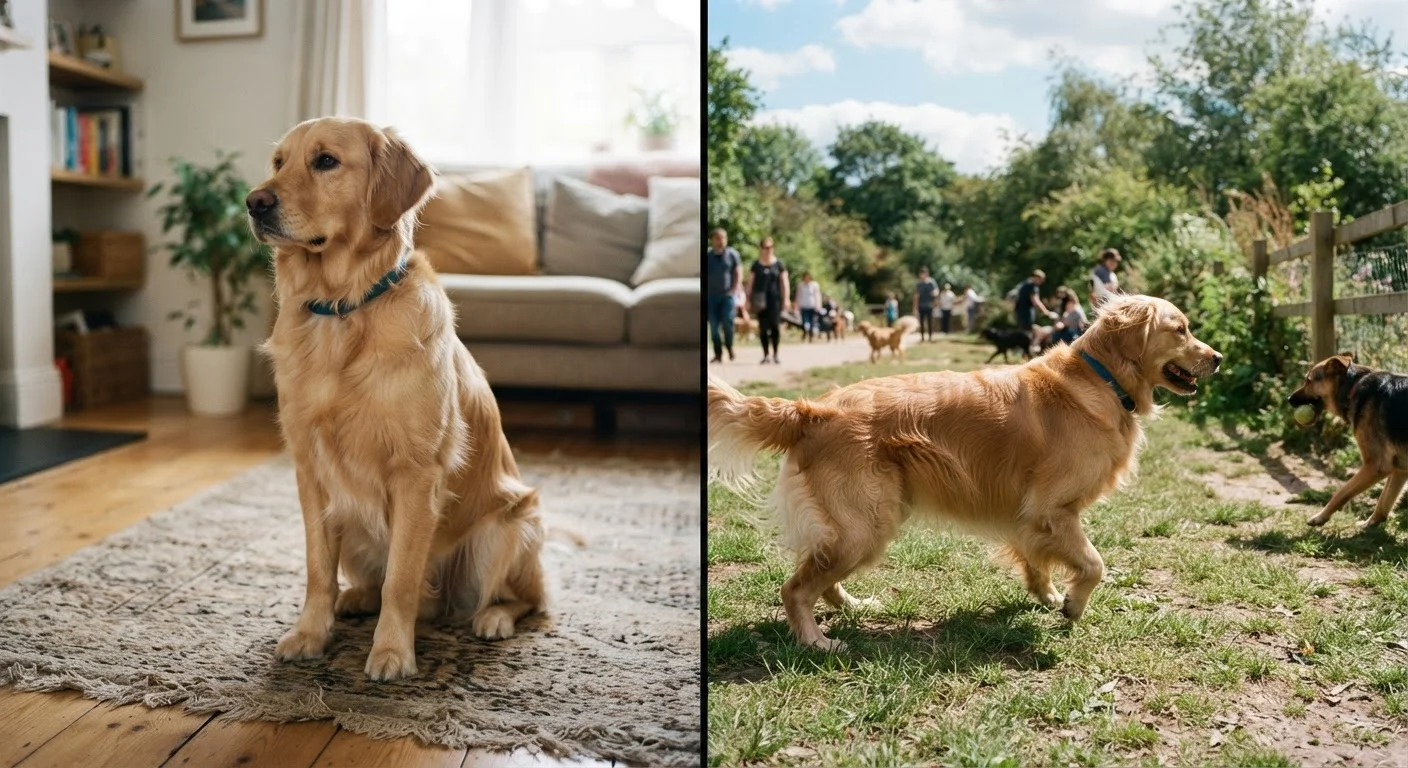
The primary challenge for adult pets is generalization - the ability to perform a learned behavior reliably across different environments, people, and distractions. A dog that sits perfectly at home may appear to forget the cue entirely at the dog park. This isn't failure; it's a predictable gap in training. See why pets obey at home but not elsewhere for a detailed look at how to address this deliberately.
Adult training also benefits from contextual enrichment. Puzzle feeders, nose-work activities, and varied training environments don't just teach new behaviors - they maintain the kind of cognitive engagement that keeps behavior problems from developing. Building a behavior-aware environment is a practical framework for this.
Senior Pets: Adaptation, Enrichment, and Compassionate Goals
Senior pets - generally dogs over seven years, though this varies by size and species - present a distinct training context. Cognitive changes, joint discomfort, reduced hearing or vision, and lower energy levels all require meaningful adaptation. The goal shifts from teaching new complex behaviors to maintaining mental engagement, preserving existing skills, and adjusting expectations with honesty.
Cognitive Dysfunction Syndrome (CDS), a condition analogous to dementia in humans, affects a significant proportion of dogs over ten years of age. Signs include disorientation, altered sleep patterns, and apparent "forgetting" of house-trained habits. If these changes appear, a veterinary evaluation should be the first step - behavioral symptoms in seniors often have medical roots that deserve professional assessment.
Sudden Behavioral Changes in Seniors Need Vet Evaluation
If your senior pet begins house soiling, pacing at night, vocalizing more, or appearing confused, do not assume it is a training problem. These can be signs of Cognitive Dysfunction Syndrome, pain, thyroid imbalance, or other medical conditions. A veterinary examination should always precede any behavioral intervention in older animals. Early diagnosis of underlying conditions can significantly improve quality of life.
That said, senior pets are not beyond learning. Mental stimulation through gentle training sessions - even simple cue-and-reward exchanges - is associated with better cognitive aging in companion animals. Keep sessions to two or three minutes, use high-value rewards, and prioritize low-impact activities that don't strain aging joints. If anxiety is a factor, training pets with fear or anxiety offers humane, pressure-free techniques that translate well to older animals.
Core Principles That Apply at Every Stage
Across all life stages, several evidence-based principles hold consistently:
- Positive reinforcement is the most research-supported approach. It works by increasing the probability of a behavior through rewarding consequences - and this mechanism functions at every age.
- Timing matters more than intensity. A reward delivered within one to two seconds of the behavior is far more instructive than a delayed one.
- Short, frequent sessions outperform long, infrequent ones. Five-minute sessions daily produce more durable learning than a single thirty-minute block per week.
- Progress requires patience calibrated to biology. Expecting adult-level reliability from a puppy, or puppy-level enthusiasm from a senior, leads to frustration on both sides.
Play can also be a powerful training medium - with real caveats. The upsides and limits of training through play is worth reading before leaning heavily on play-based methods, particularly with high-drive or easily over-aroused animals.
“The hallmark of good animal training is the ability to read the animal in front of you - not the one you expected to show up.”
— Karen Pryor, Pioneer of clicker training and operant conditioning in animal behavior
Training across a lifetime isn't a linear curriculum - it's an ongoing conversation between you and your pet, one that needs to adapt as they do. The owners who sustain the strongest bonds are those who remain curious about where their animal is, not just where they want them to be.
This article is for general educational purposes only and does not constitute veterinary advice. If your pet is showing sudden behavioral changes, consult a licensed veterinarian or certified animal behaviorist.