Why the Tail Is a Cat's Primary Emotional Broadcast
Cats communicate through a layered system of vocalizations, facial expressions, ear angles, and body posture - but the tail may be the most readable channel of all. Unlike dogs, whose tail wags are widely understood, cat tail signals are frequently misread. A wagging cat tail does not mean happiness; a low tail does not always mean fear. Getting these distinctions right matters both for your relationship with your cat and for your safety around unfamiliar animals.
Feline tail communication is rooted in evolutionary biology. As both predator and prey, cats developed a rich signaling system to manage social encounters efficiently. Research in animal behavior, including work reviewed in journals such as Applied Animal Behaviour Science, confirms that cats use posture and tail position as primary social signals, particularly with conspecifics (other cats). Understanding these signals gives you a meaningful window into your cat's emotional state in real time.
For a broader look at how this fits into feline and cross-species communication, see our species-by-species body language reference.
| Primary signal channel | Tail position combined with ear and body posture |
| Friendliest tail position | Fully upright, sometimes with a curved tip |
| Most misread signal | Slow tail swish (often mistaken for contentment; typically signals irritation) (Applied Animal Behaviour Science literature) |
| Involuntary tail response | Puffed 'bottle-brush' tail - triggered by the sympathetic nervous system |
| Low tail warrants vet check if | Sudden onset with no social trigger, especially with other behavioral changes |
| Best reading strategy | Always combine tail position with ear angle, pupil size, and overall posture |
The Key Tail Positions and What Each One Means
Each position below represents a distinct emotional state. Importantly, tail signals should always be read alongside ear position, pupil size, and overall body posture for full accuracy - a single signal is a data point, not a complete picture. See our animal communication signals field reference for a wider cross-species breakdown.
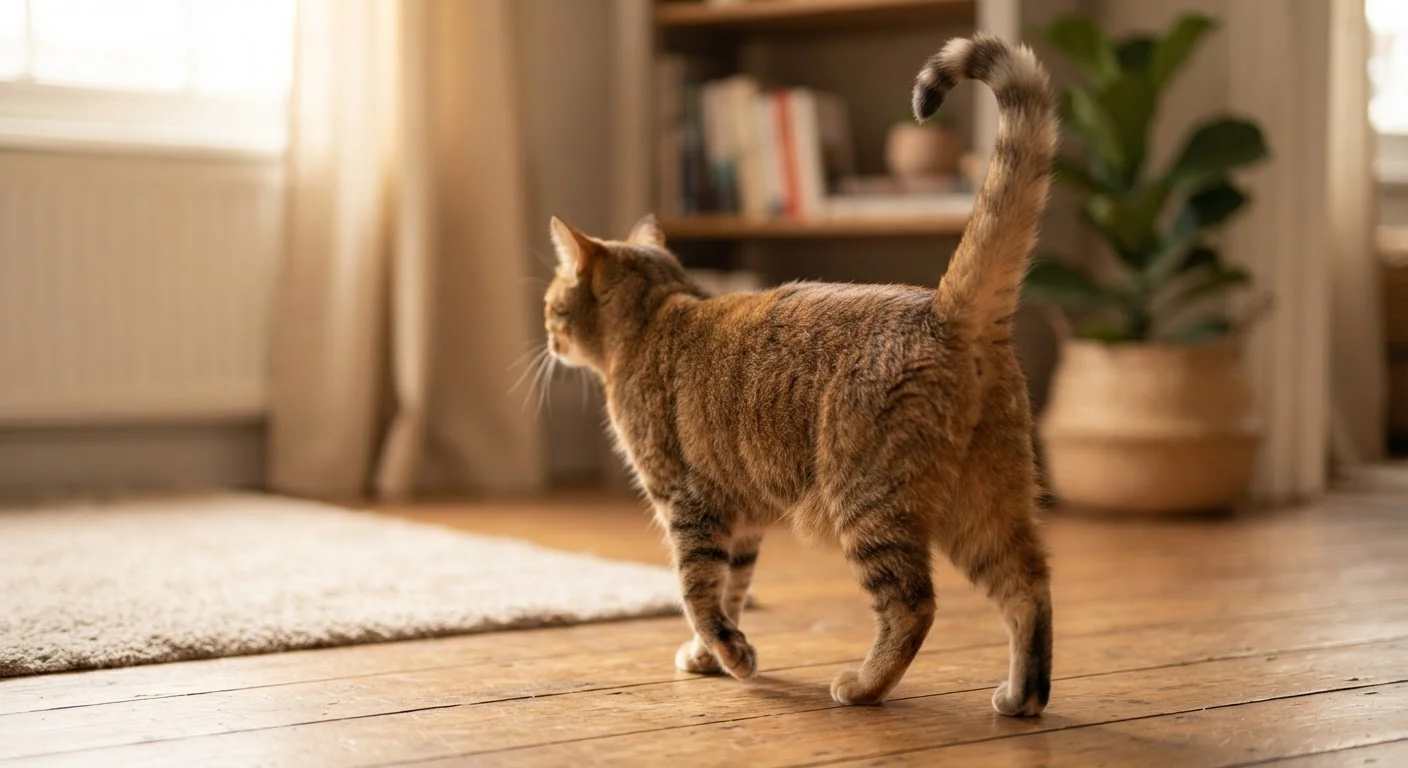
Tail High and Straight Up
A fully vertical tail signals confidence, friendliness, and social openness. Cats typically raise their tails this way when greeting a trusted human or companion animal. It's the equivalent of a relaxed smile.
Question-Mark or Hooked Tip
A high tail with a gentle curve or hook at the very tip indicates a cat that is friendly but carrying a slight undercurrent of curiosity or mild uncertainty. This is commonly seen during play solicitation or when greeting someone new.
Tail Held Horizontally
A tail extended straight back at body level typically indicates a neutral or alert state - the cat is focused but not stressed. Often seen during exploration or low-intensity hunting behavior.
Slow, Deliberate Side-to-Side Swish
Often misread as contentment, a slow swishing tail usually signals growing irritation or intense concentration. If paired with dilated pupils and flattened ears, the cat is escalating toward overstimulation - a cue to give it space.
Rapid Lashing or Thrashing
This is unambiguous: the cat is agitated, overstimulated, or threatened. Continuing to pet or approach a cat with a lashing tail significantly increases the risk of a scratch or bite. This signal is among the most commonly misread - learn which other pet behaviors owners consistently misinterpret.
Puffed or Bottle-Brush Tail
Piloerection - fur standing on end along the tail - is an involuntary fear or threat response driven by the sympathetic nervous system. The cat is trying to appear larger. This is not a behavior to intervene in; give the animal time and space to de-escalate.
Low or Tucked Tail
A tail carried low or tucked toward the belly signals submission, anxiety, or pain. A cat that suddenly begins carrying its tail low without an obvious social trigger - particularly if accompanied by other behavioral changes - warrants a veterinary check, as tail carriage can be affected by injury or illness.
Piloerection
The involuntary raising of fur along the tail or back, caused by activation of the sympathetic nervous system. In cats, it signals fear, threat, or intense arousal and is not under voluntary control.
Conspecific
A member of the same species. Cats use tail signals extensively when communicating with other cats, though they also direct these signals toward humans they've bonded with.
Overstimulation
A state in which a cat's threshold for sensory input is exceeded, often during prolonged petting. It typically manifests as tail lashing, skin twitching, and dilated pupils before escalating to biting or scratching.
Predatory sequence
The chain of behaviors - stalk, stare, pounce - that cats use when hunting. Tail movements during this sequence, such as slow side-to-side swishing, are concentration signals, not emotional distress.
Putting It All Together: Context Is Everything
No tail position exists in isolation. A high tail paired with flattened ears reads very differently from a high tail paired with forward, relaxed ears. Similarly, a slow tail swish during a petting session is a warning, while the same motion during a focused stare at a bird outside the window is simply predatory concentration.
Building fluency in cat body language is a cumulative skill. Start by watching your own cat during clearly positive moments - greeting, relaxed grooming, play - and note what the tail does. That gives you a personal baseline against which ambiguous signals become easier to read. Compared to working with dogs, cats require a more fine-grained observational approach; for contrast, see how dog body posture signals differ in structure and interpretation.
If you're looking to deepen your relationship with your cat beyond observation, understanding these signals is also foundational to training. A cat that's showing a high, relaxed tail is in an optimal state of engagement. Training cats is more effective when sessions are timed to those receptive emotional windows.
When Tail Behavior Changes Suddenly
A cat that abruptly begins carrying its tail differently - especially lower than usual or with signs of stiffness - may be experiencing pain, a neurological issue, or a tail injury. Tail injuries can be surprisingly serious given the concentration of nerves involved. If the change is sudden or persistent, a veterinary evaluation is the appropriate next step rather than a behavioral one.