
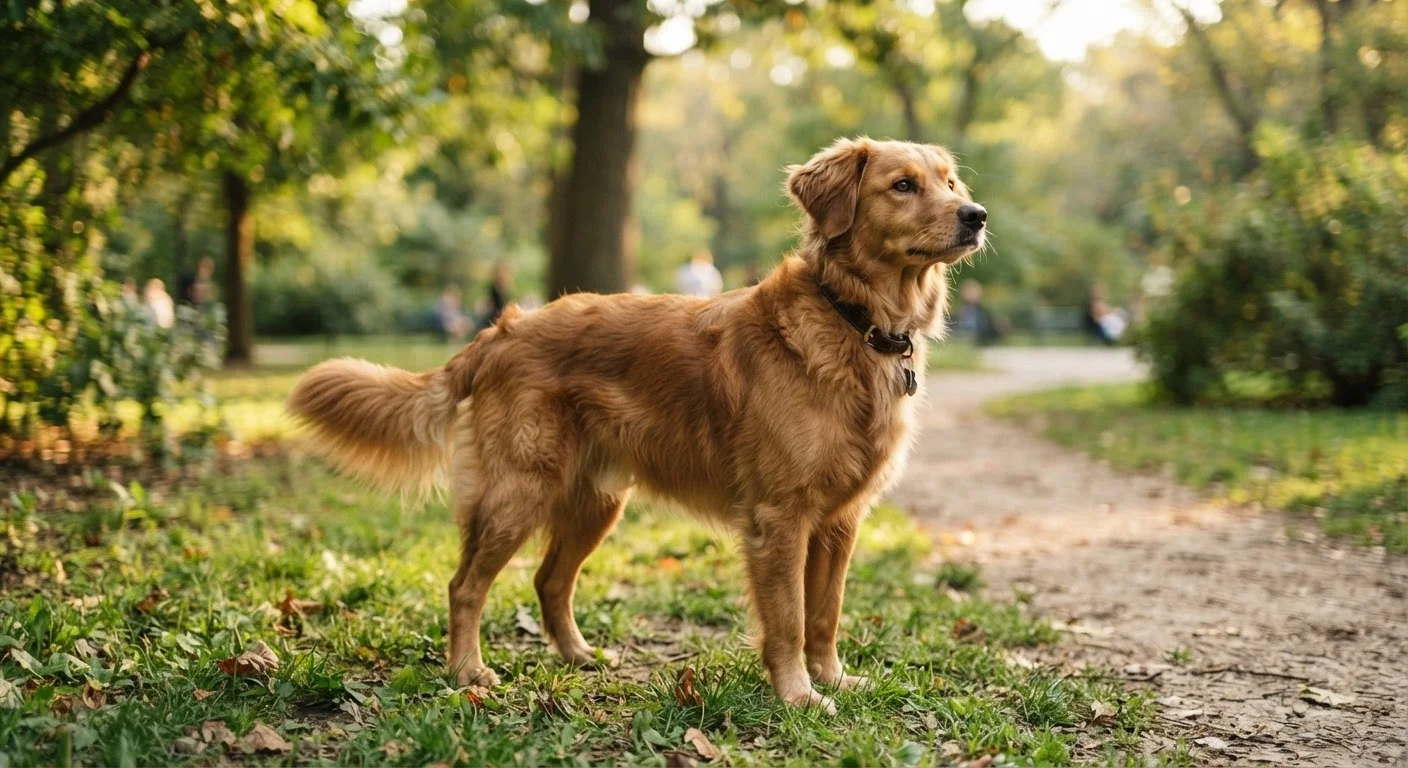
Why Posture Is the Foundation of Canine Communication
Dogs evolved as social animals in hierarchical groups, and long before domestication, the ability to signal intent without escalating to a fight was a survival advantage. Postural communication allowed dogs to negotiate space, resources, and relationships efficiently. That same hardwired system is still running in your living room.
Most owners focus on vocalizations - growls, barks, whines - but posture carries equal or greater informational weight. Research in canine ethology identifies postural signals as primary communicators of emotional state, with vocalizations often serving as amplifiers rather than standalone messages. See our species-by-species body language reference for how this compares across other common pets.
The key insight: no single body part operates alone. Ears, tail, head, spine, and weight distribution form a composite signal. A raised tail means something different on a loose, wiggly body than on a rigid, forward-leaning one.
~100ms
Speed of postural signal processing in dogs
Research in animal cognition suggests dogs process social signals, including body posture from other dogs and humans, within fractions of a second - faster than most conscious human interpretation.
30+
Distinct postural signals identified in dogs
Ethologists studying canine communication have catalogued more than 30 distinguishable body postures and composite signals in domestic dogs, according to peer-reviewed behavioral literature.
74%
Of dog bites preceded by visible warning signals
Studies reviewed in veterinary behavioral literature suggest the large majority of dog bites are preceded by warning postures that went unrecognized by the people involved.
The Four Core Postural Dimensions
1. Weight Distribution
Where a dog places its weight is arguably the most immediate indicator of intent. Weight shifting forward - onto the front legs, with the body angling toward a stimulus - signals confidence, curiosity, or threat, depending on accompanying signals. Weight shifting backward indicates deference, uncertainty, or fear. A dog that freezes with weight evenly distributed is often in an assessment phase, deciding how to respond.
2. Body Height and Spine Position
Dogs make themselves larger to project confidence or dominance and smaller to reduce perceived threat. A dog standing at full height with an arched or stiffened spine is asserting itself. A dog crouching, rounding its back, or tucking its abdomen is communicating appeasement or fear. The play bow - chest dropped to the ground, hindquarters raised - is a unique posture that specifically signals playful intent.
3. Tail Position and Movement
Tail carriage is a reliable emotional gauge when read in context. A tail held high and stiff signals high arousal, often with a forward challenge. A tail tucked between the hind legs signals fear or submission. A tail held at roughly body level and moving in a loose, wide wag correlates with a relaxed, affiliative state. Speed matters too - fast, small wags at high tail positions can accompany aggression rather than friendliness.
4. Ear and Head Position
Forward-rotated ears indicate attentiveness or alertness. Ears pulled flat and back against the skull signal fear or submission, often accompanied by a lowered head. A direct, hard stare with a lowered head is a well-recognized threat posture. Conversely, a slightly turned head with soft eyes signals calm or affiliative intent - sometimes called a "soft face."
Common Composite Signals and What They Mean
Individual signals combine into readable composites. Here are four patterns that are frequently misread:
- The "stiff wag": Tail high, movement rapid and small, body rigid, weight forward. Often misread as excitement or happiness - this configuration more reliably indicates high arousal and possible aggression.
- The appeasement display: Body lowered, ears back, tail low or tucked, possible lip-licking or yawning, gaze averted. Dogs offer this to de-escalate tension. Punishing a dog in this state increases anxiety rather than resolving it.
- Alert curiosity: Weight balanced or slightly forward, ears erect and oriented toward stimulus, tail at mid-height with gentle movement, muscles relaxed. This is assessment without commitment - the dog is gathering information.
- The play solicitation: Play bow, soft open mouth, bouncy or exaggerated movements, frequent breaks in eye contact. Context confirms this as an invitation to engage rather than a threat.
For a broader catalog of signals - including species beyond dogs - our field reference on animal communication signals is a useful companion resource.
Practice Reading in Low-Stakes Moments
Start observing your dog's posture during predictably calm moments - mealtime, post-walk relaxation, greeting a familiar person. Establishing what "relaxed" looks like for your individual dog gives you a reliable baseline. Deviations from that baseline become much easier to spot once you know what normal looks like for your specific dog.
Where Owners Most Often Go Wrong
The most pervasive misreading is interpreting any tail wag as friendliness. Close behind it: treating a belly-up position as always meaning "pet me." A tense, still dog lying on its back with a tucked tail and averted gaze is not relaxed - it may be using appeasement to manage a threatening interaction.
Owners also frequently miss the precursors to stress or aggression: subtle lip tightening, a slight head-turn, weight beginning to shift. By the time a growl or snap occurs, the dog has usually been signaling discomfort for several steps prior. Common pet signals that owners consistently misread extend well beyond posture, and recognizing the full pattern makes a meaningful difference.
Breed morphology adds another layer of complexity. Breeds with docked tails, heavily wrinkled faces, or non-erect ears lose some of the expressiveness those features would otherwise carry. Reading a Bulldog or a Chow Chow requires recalibrating for physical constraints. Once you have a clearer picture of what your dog is communicating, auditing your home environment for behaviour-aware design is a logical next step.
Individual Variation Is Real
General postural guidelines reflect population-level patterns, not universal rules. Individual dogs vary based on genetics, early socialization, and past experience. A dog that was poorly socialized may display atypical or compressed signals. If your dog's body language is consistently difficult to read or unpredictable, a certified applied animal behaviorist (CAAB) or veterinary behaviorist can provide professional assessment.