The Confusion at the Center of 'Decluttering'
Ask ten people what decluttering means and you will get ten different answers. Some describe a purge of old clothes. Others picture a color-coded closet or a freshly styled bookshelf. A few will mention a popular organizational philosophy. The word has been stretched so far by lifestyle content that its practical meaning has become blurry.
That blurriness has real consequences. If you misidentify what decluttering actually involves, you can invest a full weekend of effort - sorting, binning, rearranging - and end up in exactly the same functional position you started in. Understanding the definition precisely is what makes the process worth doing.
At its core, decluttering is the act of deciding which possessions to remove from your home permanently. That means donating, discarding, recycling, or rehoming. If an item stays in your home after the process, it was not decluttered - it was relocated. This distinction is not pedantic; it is the difference between creating lasting space and performing the appearance of organization. For more on how an organized environment affects focus and mental load, see why a tidy space feels better to work in.
Common Myths, Corrected
Much of the confusion around decluttering comes from persistent misconceptions - many of them amplified by social media aesthetics and oversimplified how-to content. The myth-and-fact pairs below address the most common ones directly.
Myth
Decluttering and tidying are the same thing. If my space looks clean, I have decluttered.
Fact
Tidying restores order to existing possessions. Decluttering reduces the number of possessions. They are separate processes with different outcomes.
A tidy space can contain just as much clutter as a messy one - the items are simply stacked, folded, or hidden more neatly. Tidying addresses surface appearance; decluttering addresses volume. A home that has been decluttered will be easier to tidy precisely because fewer objects need managing. Conflating the two leads people to repeatedly tidy without ever reducing the underlying load.
Myth
Decluttering means following a specific method - like sorting by category or only keeping items that 'spark joy.'
Fact
Any structured approach that results in permanently removing unwanted items qualifies as decluttering, regardless of method.
Various organizational philosophies have been popularized by books and television, and each offers a useful framework. But no single method has been proven universally superior. The most effective approach is one you will actually complete. Some people prefer to work room by room; others by category. Some find a guiding question helpful; others prefer a simpler rule like 'not used in 12 months.' The method is a tool, not the definition.
Myth
Decluttering is a one-time event - once you do it properly, the problem is solved.
Fact
Possessions accumulate continuously, so decluttering is an ongoing practice rather than a single fixed event.
A thorough declutter creates meaningful space and clarity, but it does not alter the flow of new items entering a home. Without periodic reassessment, the same categories that were cleared will gradually refill. Most people who maintain uncluttered spaces do so through small, regular reviews - seasonally for wardrobes, annually for books and paperwork - rather than relying on one large effort to last indefinitely.
Myth
Decluttering requires getting rid of a lot of things to be meaningful.
Fact
The number of items removed is irrelevant; what matters is whether the items that remain are genuinely used and wanted.
There is no threshold - no bag count or percentage - that defines a successful declutter. Someone who removes five items they have been avoiding for years may experience a more significant functional improvement than someone who fills ten donation bags with things that were never causing friction. The measure of success is whether the remaining space works better for the person living in it.
Myth
Buying organizational products - bins, drawer dividers, storage boxes - is part of decluttering.
Fact
Storage products organize what remains after decluttering. Purchased before reducing volume, they often add to the problem.
Storage solutions are genuinely useful for items you have decided to keep and need to access efficiently. But buying containers before deciding what stays frequently results in neatly stored items you do not actually need - and an additional purchase to manage. The standard guidance among professional organizers is to complete the removal phase first, then assess what storage, if any, is needed for what remains.
If you want to build a broader vocabulary around organization concepts, this glossary of interior organization terms is a useful reference.
What Decluttering Looks Like in Practice
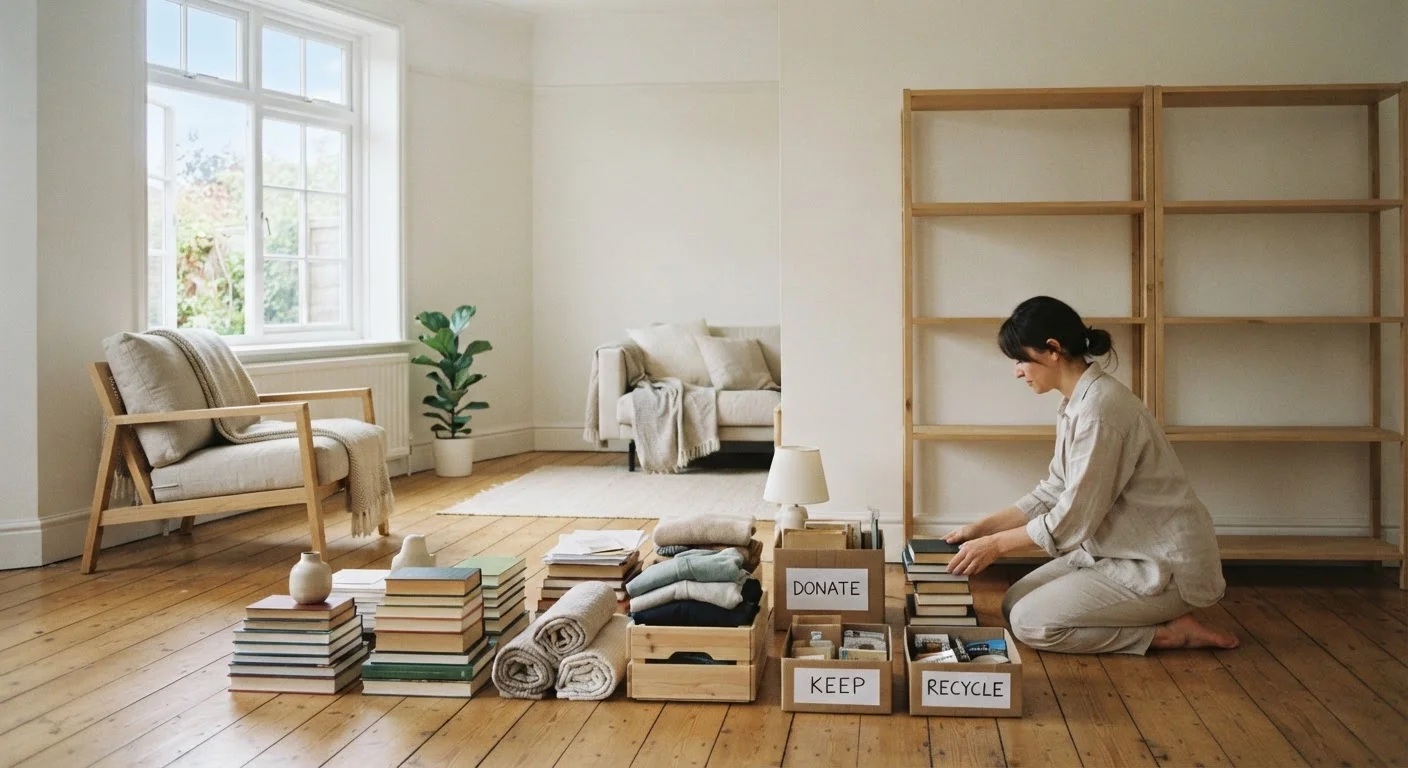
A genuine declutter begins before anything is moved. It starts with a category or zone - a wardrobe, a kitchen drawer, a bookshelf - and a clear question applied to each item: Does this belong in my home going forward? Items that do not earn a clear yes are candidates for removal.
The physical act of sorting is followed by the more important step: actually getting items out of the space. Bags of donations that sit in a hallway for three weeks, or boxes that migrate from room to room, are not decluttered items. Completion requires the item leaving your home.
Avoid Relocating Instead of Removing
One of the most common decluttering mistakes is moving items to storage areas - a basement, attic, or spare room - rather than out of the home entirely. This creates the feeling of progress without the functional benefit. Before an item is considered decluttered, it should have a clear path out of your home: donated, recycled, or discarded.
Decluttering does not require a marathon session. Working in short, focused increments - one drawer at a time, one shelf per evening - is a legitimate approach and often produces more durable results than a single overwhelming sweep. The goal is permanent reduction, not performative effort.
Shelf styling and visual arrangement are separate skills that become more effective after decluttering is done. If your shelves consistently look busy, the issue may be volume rather than styling. Why shelves always end up looking cluttered explores that distinction in depth.
If you are setting up a new space from scratch and want to build organizational habits before clutter accumulates, this guide to organizing a first flat covers where to begin with limited space and budget.
80%
Of clutter is from indecision, not lack of space
Professional organizers commonly cite indecision - not insufficient storage - as the primary driver of household clutter accumulation.
1 in 4
US households can't park in their own garage
The US Department of Energy has noted that a significant share of American two-car garages are too full of stored items to accommodate vehicles.