The Ingredient List: What Order Actually Means
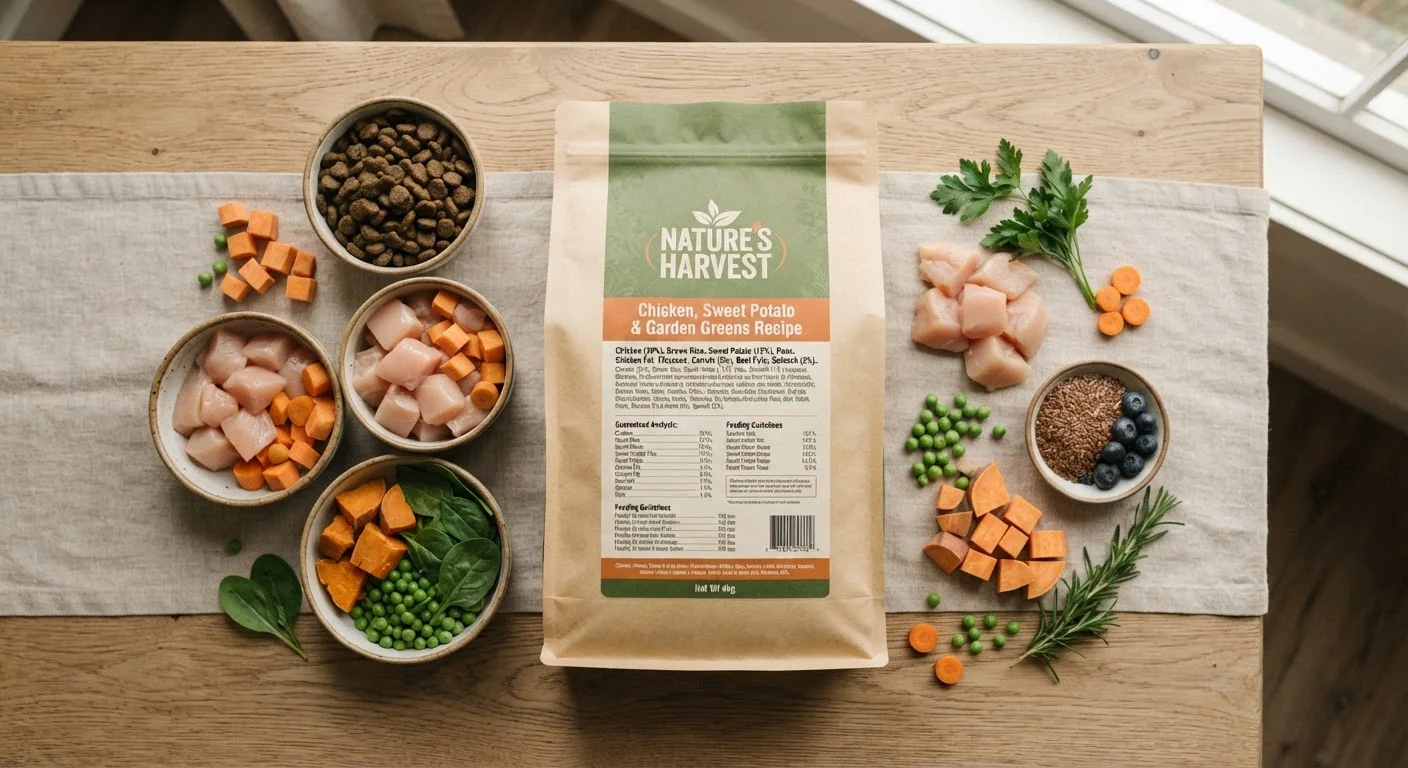
Ingredients on US pet food labels must be listed in descending order by pre-cooking weight - the same rule that governs human food labeling. This sounds straightforward until you account for moisture. Fresh chicken, for example, is roughly 70% water. After processing, its actual contribution to the finished product is considerably smaller than its top-of-the-list position suggests.
This is why ingredient splitting is worth understanding. Manufacturers sometimes separate a single ingredient into multiple forms - corn grain, corn gluten meal, and corn flour, for instance - each appearing lower on the list individually. Collectively, they may outweigh the first-listed protein. Scanning for the same base ingredient in multiple forms gives you a more accurate read on what's actually dominant in the formula.
Ingredient names themselves are regulated. Terms like chicken meal, beef by-products, and fish meal have AAFCO-defined meanings. By-products, often maligned in marketing, are AAFCO-defined as clean parts of slaughtered animals other than rendered meat - including organs like liver and kidney, which are nutritionally dense. The word by-product on a label doesn't automatically signal poor quality.
Check For Ingredient Splitting Before You Judge the List
Before concluding that a named protein is the dominant ingredient, scan the full list for the same base ingredient appearing under multiple names - such as corn grain, corn gluten, and corn bran listed separately. Adding those up mentally gives you a truer sense of what the formula is built around. This is a fast, practical check that takes less than a minute at the store or when ordering online.
For a deeper look at how grain-containing and grain-free formulas compare in ingredient composition, see our evidence-based breakdown of grain-free diets.
The Guaranteed Analysis: A Floor, Not a Ceiling
The guaranteed analysis panel lists minimum percentages of crude protein and crude fat, and maximum percentages of crude fiber and moisture. These are regulatory floors and ceilings - not precise nutritional targets. A food listing a minimum of 26% crude protein may contain significantly more; a maximum of 10% moisture may be considerably less in practice.
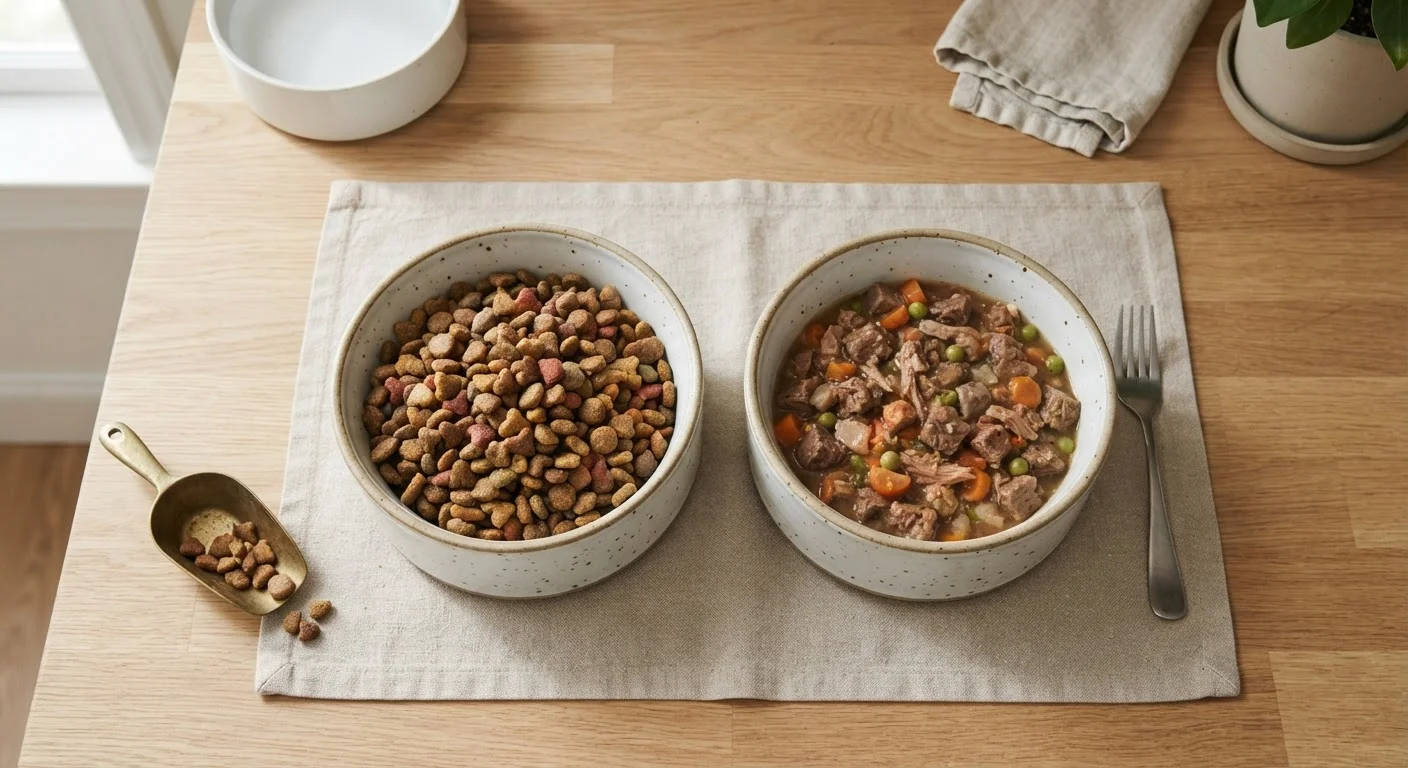
One important nuance: the guaranteed analysis is expressed on an as-fed basis, meaning it reflects the food as it comes out of the package - including all moisture. Comparing a dry kibble (roughly 10% moisture) to a canned food (roughly 75-80% moisture) using as-fed numbers is misleading. To compare them fairly, you'd need to convert both to a dry matter basis by removing the moisture from the calculation. A canned food showing 9% crude protein as-fed becomes approximately 40% protein on a dry matter basis - a very different picture.
~75-80%
Moisture content in typical canned pet food
AAFCO regulatory standards and standard pet food formulation data indicate canned pet foods commonly contain 75-80% moisture as-fed, compared to roughly 10% in dry kibble.
2 pathways
Ways a food earns AAFCO 'complete and balanced' status
Per AAFCO guidelines, manufacturers may either formulate to meet nutrient profiles or conduct structured animal feeding trials - two distinct routes to the same claim.
0
Separate AAFCO nutrient profiles for senior pets
AAFCO does not publish a dedicated senior life stage nutrient profile; foods labeled for seniors typically meet adult maintenance standards and vary in formulation.
The panel doesn't capture everything. Digestibility, amino acid profile, and micronutrient completeness aren't reflected here. That's where the AAFCO statement becomes critical. See also our comparison of dry and wet food nutritional trade-offs for how these differences play out across formats.
The AAFCO Statement and What It Confirms
The nutritional adequacy statement - sometimes called the AAFCO statement - is arguably the most consequential line on the entire label. It confirms whether a food is complete and balanced for a stated life stage and whether that claim is based on nutrient formulation or an actual feeding trial.
There are two pathways to this claim. Formulation-based statements mean the recipe was designed to meet AAFCO nutrient profiles on paper. Feeding trial statements mean the food was fed to animals under AAFCO protocols and assessed for health outcomes. Feeding trial validation is a higher bar, though formulation-based foods can still be nutritionally sound.
Life stage matters too. A food labeled for all life stages must meet the more demanding growth and reproduction nutrient profile - suitable for puppies, kittens, pregnant, and lactating animals. Foods labeled for adult maintenance are formulated to lower thresholds. Senior has no independent AAFCO standard; senior-labeled foods typically meet adult maintenance requirements and vary widely in their actual composition.
If a label carries no AAFCO statement, the food is not intended to be a complete diet on its own. This is common for treats and toppers - a distinction worth keeping in mind. For a structured approach to reviewing your pet's nutrition monthly, our monthly pet care checklist includes a nutrition review step.
Feeding Guidelines and Marketing Language
Feeding guidelines are population averages. They estimate daily portions based on body weight, but they don't account for your pet's individual metabolism, activity level, reproductive status, or health conditions. Use them as a starting point and adjust based on your pet's body condition - visible waist, palpable ribs without pressing, and consistent energy are more reliable indicators than hitting a specific gram target.
Marketing language is where label literacy pays off the most. Terms like natural, holistic, premium, and human-grade carry little or no regulatory weight in US pet food labeling. Natural has a loose AAFCO definition (no chemically synthetic ingredients, with some exceptions), but holistic and premium are entirely unregulated terms. A food using these words may be excellent - or it may simply have excellent packaging.
When evaluating moisture-sensitive intake, remember that diet type significantly affects your pet's daily water consumption. Understanding your pet's hydration needs alongside their food format is part of the full nutrition picture.
This article is for general informational purposes only and does not constitute veterinary or dietary advice. Consult a licensed veterinarian for guidance specific to your pet's health and nutritional needs.