
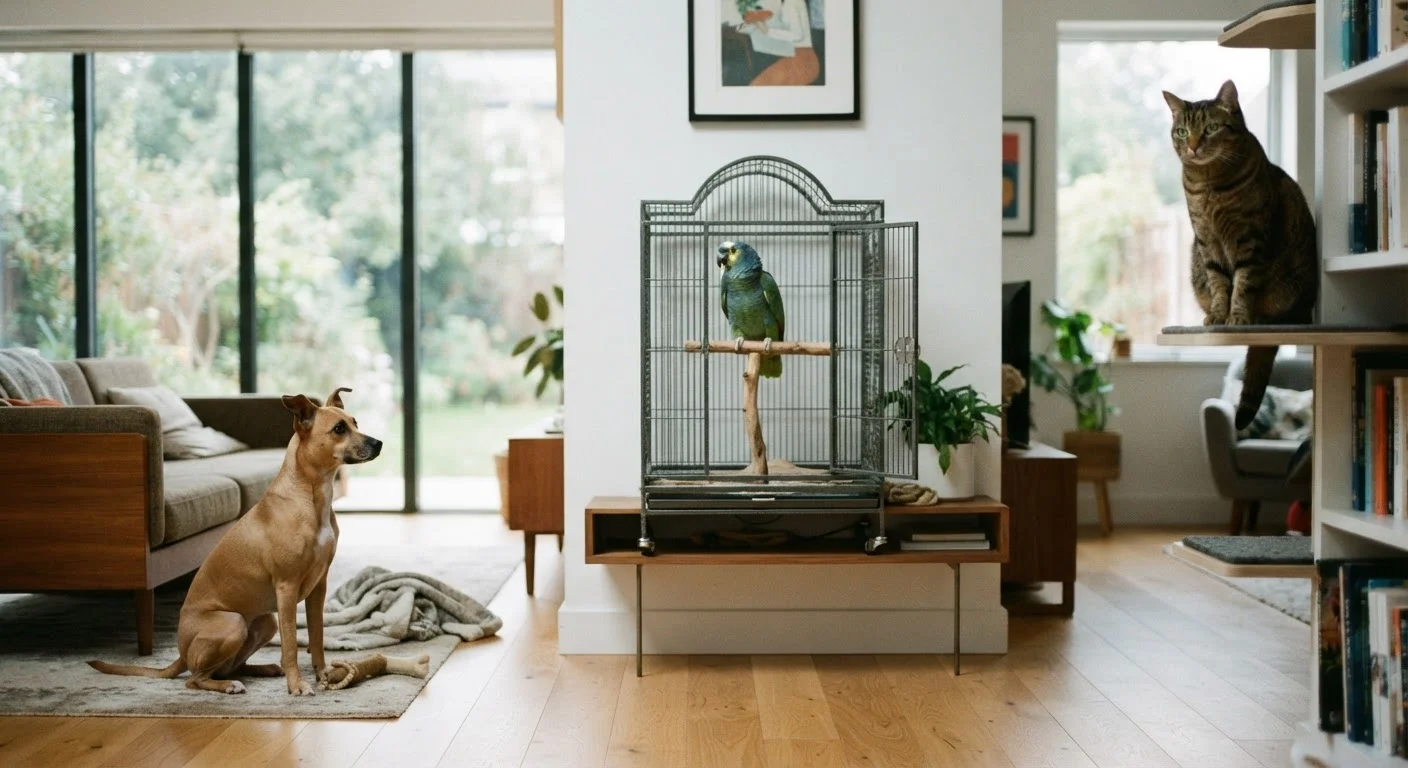
Why Animals Are Territorial: The Evolutionary Foundation
Territoriality - the defence of a defined space against conspecifics (members of the same species) or rival animals - is one of the most conserved behaviours across vertebrates. At its core, it exists to protect access to food, shelter, mates, and offspring. For domestic animals, these evolutionary pressures haven't disappeared; they've simply been filtered through thousands of years of life alongside humans.
Understanding why an animal defends space is the necessary starting point for interpreting how it does so. A dog barking at the fence isn't being disobedient - it's executing a deeply ingrained patrol-and-announce strategy shaped by pack-living ancestors. A cat rubbing against every corner of a room isn't being affectionate with the furniture - it's systematically depositing pheromones that communicate ownership. A parrot lunging at a hand near its cage isn't just being difficult - it's responding to a perceived incursion into a resource-rich site.
For a broader grounding in how these species signal their internal states, see our species-by-species body language reference.
How Dogs, Cats, and Birds Compare
| Dogs | Cats | Birds | |
|---|---|---|---|
| Territory size | Large, ranging patrol area | Small, densely defended core zone | Cage or perch-centred micro-territory |
| Primary marking method | Urine marking, scratching | Facial rubbing, urine spraying | Vocalisation, posturing, biting |
| Vocal defence | High - barking, howling | Moderate - hissing, yowling | High - screaming, alarm calls |
| Effect of sterilisation | Significantly reduces marking | Reduces spraying notably | Not applicable (not routinely done) |
| Trigger: new animal in home | High reactivity, patrol increases | Moderate to high, stress-marking | High, especially near cage |
| Seasonal variation | Mild in sterilised animals | Mild in sterilised animals | Pronounced during breeding season |
Dogs typically establish the largest territories, shaped by the ranging behaviour of their ancestors. Domestic dogs generally patrol a perimeter, use urine marking at boundaries, and rely heavily on vocalisation (barking, howling) to warn off intruders and signal occupancy to distant rivals. The territory is often defined socially as much as spatially - it encompasses wherever the dog's family group travels and rests.
Cats operate differently. Research into feral and free-roaming cat populations has shown that cats maintain smaller but more intensely defended core areas, typically centred on sleeping and feeding sites. They use a layered chemical communication system: facial pheromones deposited by rubbing signal familiarity and comfort, while urine spraying (more common in intact males) signals boundary warnings. Unlike dogs, cats rarely engage in overt vocal boundary defence beyond hissing and yowling when a rival is already close.
Birds, often overlooked in this conversation, can be among the most fiercely territorial of all domestic animals relative to body size. Parrots, cockatiels, and many finch species defend cage space, favoured perches, and bonded human companions with remarkable intensity. Cage layout and environmental design directly influences how territorial stress manifests in avian species.
Key Triggers and Common Misconceptions
Don't Punish Territorial Signals
Territorial displays like barking, hissing, or vocalising are communicative, not defiant. Punishing these signals can suppress warning behaviour without reducing the underlying anxiety - making future escalations harder to predict. Instead, work with a qualified behaviourist to address the environmental triggers driving the response.
Across all three species, certain conditions reliably escalate territorial behaviour:
- Resource scarcity: A dog with one food bowl in a multi-dog home, a cat whose litter box is contested, or a bird whose food dish is approached during feeding - all become more defensive when resources feel limited.
- Novel intrusions: A new pet, a visiting stranger, or even a new piece of furniture can register as a territorial challenge.
- Hormonal state: Intact (unneutered/unspayed) animals of all three species show significantly elevated territorial behaviour. Spaying and neutering reduces - though does not eliminate - these responses.
- Seasonal cycles: Birds in breeding condition become dramatically more defensive. Dogs and cats may show seasonal variation linked to hormonal cycling even after sterilisation in some cases.
A common misconception is that territorial behaviour equals aggression. In practice, most territorial displays are communicative - the animal is broadcasting its occupancy to avoid conflict, not actively seeking confrontation. Escalation to physical aggression typically occurs when those signals are ignored or when an animal feels cornered. Our article on interpreting pet aggression covers how to distinguish territorial warning signals from genuine threat responses.
Practical Implications for Multi-Species Households
90%
Reduction in urine spraying post-neutering in cats
Research consistently shows neutering reduces urine spraying in around 90% of male cats, according to veterinary behaviour literature.
3-5x
More territorial incidents near food resources
Animal behaviourists note that resource-guarding incidents - a form of territorial behaviour - cluster heavily around feeding sites in multi-pet homes.
Managing territorial behaviour isn't about suppressing instinct - it's about designing environments and routines that prevent the conditions that trigger conflict. A few evidence-informed principles apply across species:
- Separate core resource zones. Each pet should have feeding, sleeping, and retreat areas that other animals cannot access. This reduces the perceived need to defend.
- Gradual, scent-mediated introductions. When introducing a new animal, exchanging bedding before a physical meeting allows each animal to assess the other's presence chemically before a face-to-face encounter - significantly reducing the stress of the initial meeting.
- Vertical space for cats and birds. Both species use height as a territorial signal. Providing elevated perches, cat trees, or multi-level cage structures gives them options beyond ground-level confrontation.
- Predictable routines. Unpredictability is a stressor. Stable feeding, play, and sleep schedules reduce ambient anxiety and, with it, territorial reactivity.
For a deeper look at how your home's layout shapes these dynamics, see building a behaviour-aware environment for your pet. Understanding how animals communicate their territorial claims is also explored in our field reference for animal communication signals.