
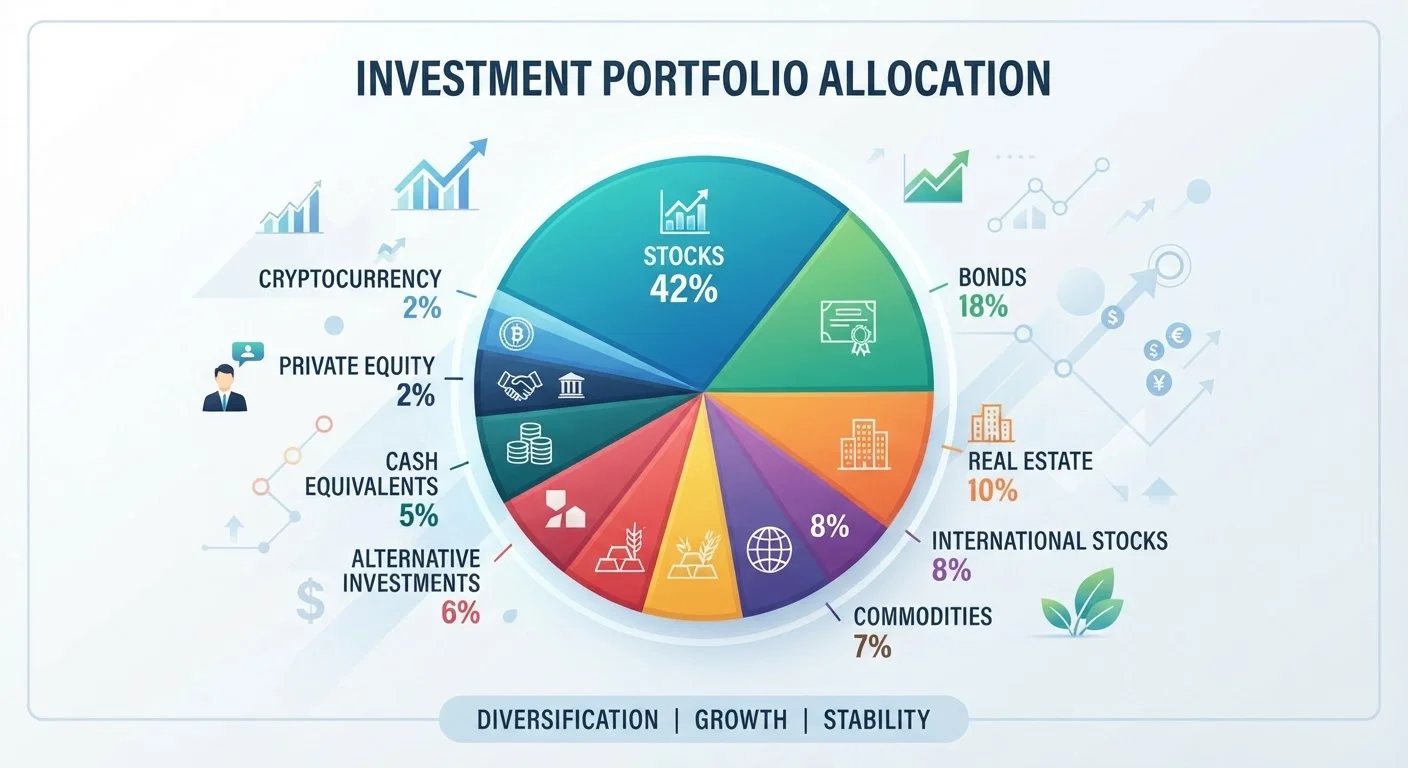
The Common Misconception: More Stocks Equals More Safety
Many investors take their first diversification step by buying a handful of different stocks - maybe a tech company, a retailer, and a bank. That feels spread out. But if all three fall sharply whenever the broader market dips, those holdings are more correlated than they look, and the diversification benefit is largely illusory.
The key insight is that diversification is about correlation, not quantity. Two assets are well-diversified relative to each other when their prices don't move in lockstep. Adding a tenth technology stock to a portfolio of nine technology stocks does almost nothing to reduce risk - they tend to respond to the same economic signals in the same way.
This is a distinction worth internalizing early. See our overview of common investing misconceptions for other foundational assumptions that can quietly cost new investors.
~20-30
Stocks needed to reduce most unsystematic risk
Academic research in portfolio theory has long suggested that most company-specific risk is eliminated with roughly 20-30 uncorrelated stocks, though the exact number varies by study and depends on sector spread.
40%+
Of world market cap outside the U.S.
International markets represent a substantial share of global investable assets, meaning a U.S.-only portfolio may miss significant portions of global economic growth.
What Genuine Diversification Actually Looks Like
Authentic diversification works across multiple dimensions simultaneously. Each layer targets a different source of risk.
Asset Class Diversification
The most foundational layer is spreading across distinct asset classes - stocks, bonds, cash, and potentially real assets like real estate investment trusts (REITs). These categories behave differently under various economic conditions. Bonds, for instance, have historically performed differently from equities during periods of economic stress, though the relationship is not constant. For a deeper grounding in how each class behaves, understanding the core building blocks of a portfolio is a useful starting point.
Sector Diversification
Within equities, spreading across sectors - technology, healthcare, consumer staples, energy, financials - reduces exposure to industry-specific downturns. Energy stocks may slump when oil prices drop while healthcare companies remain relatively unaffected.
Geographic Diversification
Holding only U.S. assets ties your portfolio tightly to the health of the American economy. International developed markets and emerging markets can perform on different cycles, offering meaningful diversification, though they carry their own distinct risks.
A Simple Way to Check Your Own Correlation
Look at how your holdings performed during the last major market downturn. If nearly every position declined by a similar percentage at the same time, your portfolio may be more correlated - and less diversified - than it appears on paper. Broad index funds spanning multiple sectors and asset classes can help address this without requiring you to research individual correlations manually.
Diversification Over Time: Why It Can't Be Set and Forgotten
Even a well-constructed diversified portfolio drifts over time. If stocks outperform bonds for several years, equities become a larger share of the portfolio than originally intended - shifting the risk profile whether you notice or not. This is why periodic rebalancing is an essential companion to diversification, not an optional extra.
Your target allocation should also evolve with your circumstances. A young professional with 30 years to retirement can typically hold a higher proportion of equities than someone approaching retirement, because there's more time to recover from downturns. Thinking about allocation across a working life helps frame this as a dynamic process rather than a one-time decision.
It's also worth distinguishing between how much risk you want to take and how much you can actually afford to absorb financially. Understanding both your risk tolerance and risk capacity before building a portfolio prevents a mismatch that only becomes apparent during a market downturn.
Practical Next Steps for Young Professionals
Diversification doesn't require complex strategies or large sums. Index funds and exchange-traded funds (ETFs) that track broad market indexes provide instant exposure to hundreds of companies across multiple sectors in a single purchase - making them a common starting point for building a diversified foundation.
Before investing, make sure your financial base is solid. A well-funded emergency reserve means you won't need to sell investments at a loss during a cash crunch. Our guide to building an emergency fund covers how to approach that foundation first.
Avoid the common mistake of treating portfolio activity as progress. Frequently buying and selling in search of better diversification can erode returns through transaction costs and taxes. Subtle early investing errors - including this one - are worth reviewing before making portfolio changes.
This article is for general informational and educational purposes only and does not constitute personalized financial, investment, tax, or legal advice. Consult a qualified, licensed financial professional before making decisions about your own investments.
“Diversification is the only free lunch in investing - but only when it's real diversification across genuinely different risks, not just a longer list of similar bets.”
— Harry Markowitz, Nobel laureate economist and founder of Modern Portfolio Theory