What Asset Allocation Actually Means
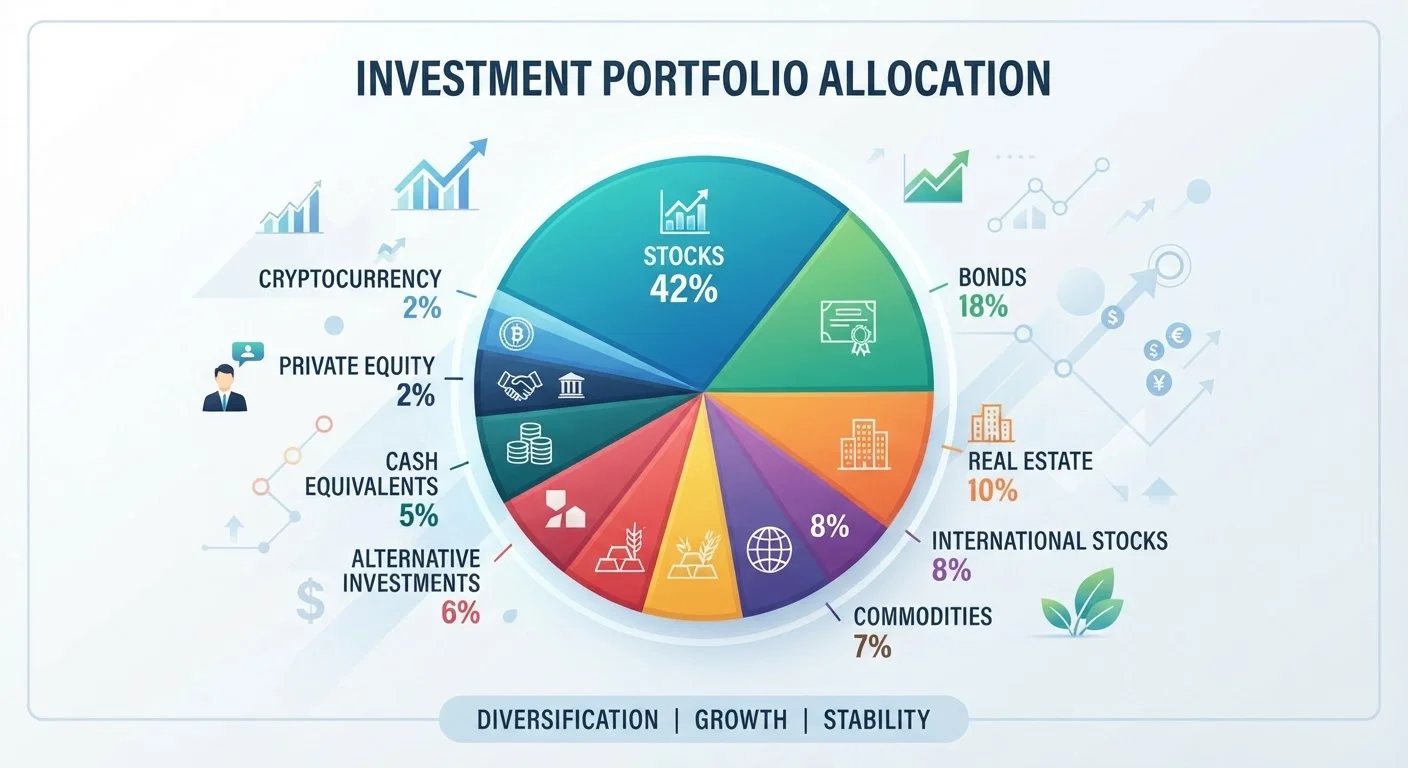
Asset allocation is the process of dividing a portfolio among different asset classes - most commonly equities (stocks), fixed income (bonds), and cash or cash equivalents - in proportions that reflect your goals, time horizon, and tolerance for risk. It is worth distinguishing this from stock selection: decades of academic research suggest that how you divide your money across asset classes explains the large majority of long-term portfolio variability, not which individual securities you pick.
For young professionals who already understand compounding and diversification, this is the next logical layer. If you want to go deeper on what genuine diversification means across asset types, see why diversification is more than just owning a lot of stocks.
The key insight is that allocation is not a one-time configuration. It should respond to changes in your financial situation, your proximity to spending goals, and your actual capacity to absorb losses - not just your emotional comfort with market swings.
Allocation Is Not the Same as Risk Tolerance
Risk tolerance describes how you feel about volatility. Risk capacity describes what your financial situation can actually absorb. Both matter - but conflating them leads to portfolios that either take on more risk than your finances can handle, or leave too much return on the table by being unnecessarily conservative. Always assess both dimensions before setting or changing your allocation.
The Role of Time Horizon in Setting Your Mix
Time horizon is the single most influential variable in asset allocation. The longer your money has to grow before you need it, the more short-term volatility you can absorb - and the more costly it becomes to hold overly conservative assets that sacrifice long-run growth.
Equities have historically offered higher long-term returns than bonds, but with considerably more short-term price swings. Over a 30-year horizon, the sequence and magnitude of those swings matter far less than over a 5-year one. This is why allocation frameworks almost universally prescribe a higher equity weight earlier in life.
~90%
Portfolio variability explained by asset allocation
A widely cited body of research, including work by Brinson, Hood, and Beebower, attributes roughly 90% of long-term portfolio return variability to asset allocation policy rather than individual security selection.
30+ years
Typical investment horizon from age 30
A 30-year-old investing for retirement at 65 has a 35-year horizon - long enough for equity-heavy portfolios to weather multiple full market cycles.
It also helps to think about human capital - the present value of your future earnings. Early in your career, your human capital is large relative to your financial capital. In effect, your future income is a bond-like asset: relatively predictable and recurring. This means your financial portfolio can afford to be equity-heavy without your total economic picture being unbalanced. As you age and draw down that human capital through earned wages, shifting more financial capital toward fixed income restores balance.
This is also why what changes - and what doesn't - between your twenties and thirties is worth understanding carefully before adjusting your allocation.
Early Career: Maximizing Growth Exposure
In your twenties and early thirties, the structural case for holding a significant equity allocation is strong. Decades of compounding lie ahead, and any market downturn has time to recover before you need to draw on the funds. This does not mean ignoring risk entirely - it means understanding that at this stage, the bigger risk is often insufficient growth, not short-term losses.
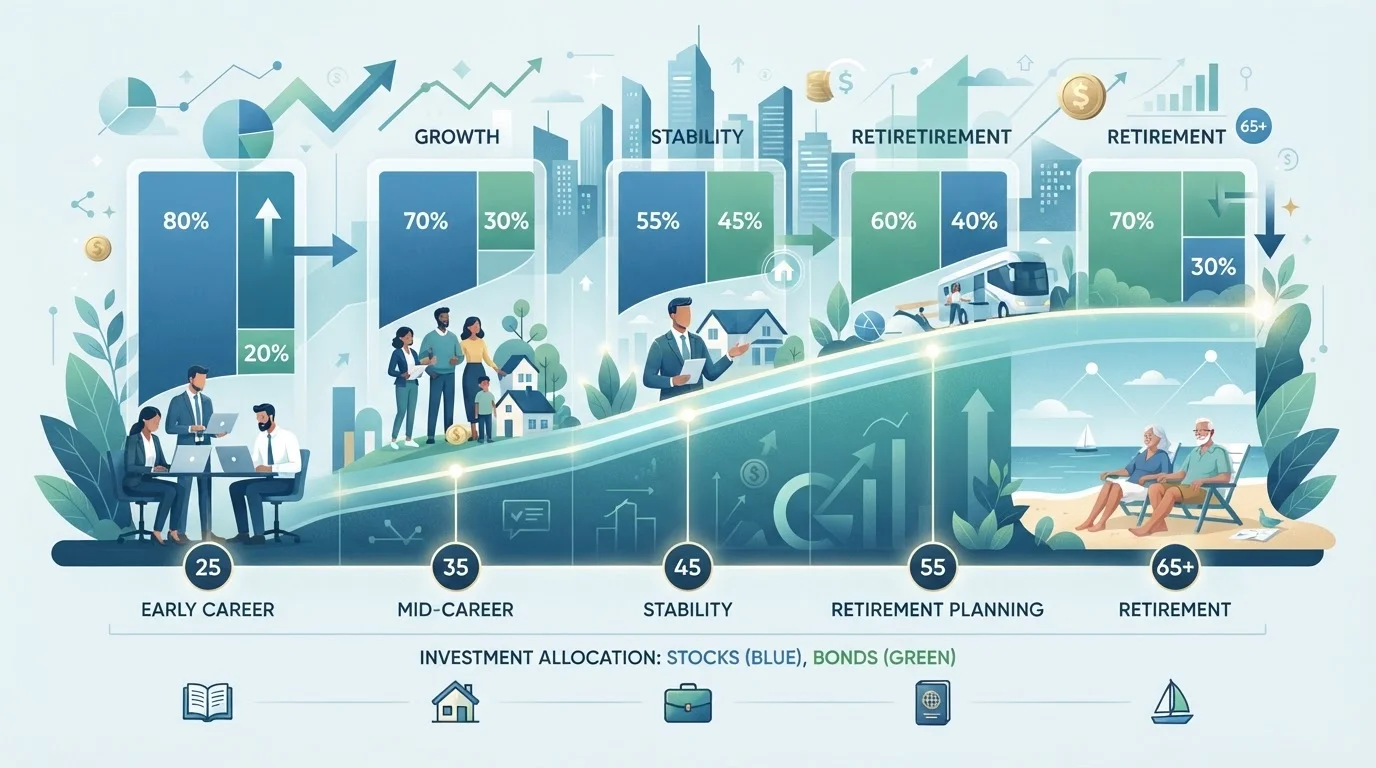
A common starting framework is an equity allocation in the range of 80-100% of long-term investment portfolios, with the remainder in bonds or other stabilizing assets. The appropriate mix within that equity exposure - domestic vs. international, large-cap vs. small-cap - is a separate question. For a grounding in how fund structures affect this, see index funds vs. actively managed funds.
Treat your early-career allocation as your highest-leverage financial decision: time in the market compounds, but only if you're actually invested in growth assets. A 25-year-old holding 40% bonds 'to be safe' may be taking on more long-term risk than one holding 90% equities.
The cost of under-investing in growth during high-compounding years is often greater than the cost of short-term volatility, because early losses have decades to recover while missed growth cannot be recaptured.
When you receive a salary increase or bonus, revisit your allocation before lifestyle inflation absorbs it. Incremental income is an ideal moment to increase contribution rates and assess whether your target allocation still fits your current risk capacity.
Income events are natural rebalancing triggers that many investors overlook, yet they offer a low-friction moment to improve portfolio positioning without requiring difficult sell decisions.
What matters most at this stage is consistency of contribution, not precision of allocation. See how regular investing removes emotion from the equation for the mechanics of systematic investing. Also, be alert to the subtle errors that erode early portfolios - common early investing mistakes are worth reviewing before you develop bad habits.
Mid-Career: Balancing Growth and Stability
By your late thirties and forties, the picture typically shifts. Financial responsibilities deepen - mortgages, dependents, competing savings goals - and your investment portfolio itself becomes a meaningful source of wealth, not just a side project. With roughly 20-25 years to retirement, there is still substantial time for growth, but volatility now carries more psychological and practical weight.
A gradual shift toward a more balanced allocation - often described as moving from roughly 80% equity toward 60-70% - makes sense for many people at this stage. The precise calibration depends on income stability, other assets (home equity, pension entitlements), and spending plans.
Trigger a Review at Major Life Events
Marriage, a new child, a home purchase, or a significant income change should each prompt an allocation review - not just an annual calendar reminder. Life events shift your risk capacity and time horizons more meaningfully than most market movements. Build this review into your financial planning calendar alongside other major milestones.
Mid-career is also when account structure deserves attention. How you hold assets across tax-advantaged and taxable accounts can matter as much as what you hold. The principles around account types - while written for a different regulatory context - are well illustrated in choosing the right investment account wrapper.
Periodically revisiting your allocation at this stage is essential, because portfolios drift from their intended mix as markets move. The mechanics and timing of that process are covered in rebalancing a portfolio.
Approaching Retirement: Shifting Toward Preservation
In the decade before retirement - roughly your mid-fifties to mid-sixties - sequence-of-returns risk becomes the dominant concern. A significant market decline just before or just after you stop drawing a salary can permanently impair your portfolio in a way that a similar decline at 35 cannot, because you have less time and fewer new contributions to recover.
This is why allocation frameworks traditionally call for a continued shift toward bonds, stable-value assets, and cash equivalents during this window. A portfolio weighted 40-50% in equities and 50-60% in fixed income is a common reference point, though individual circumstances vary considerably.
Don't Over-Correct Before Retirement
Moving entirely into bonds or cash in the five years before retirement is a common but potentially costly mistake. A retirement that may last 25-30 years still requires some growth assets to outpace inflation. Shifting too conservatively too early can result in a portfolio that preserves capital in the short term but slowly erodes in real purchasing power over decades.
It is worth noting that retirement is not the endpoint of the allocation question. A 65-year-old retiring today may have a 25-30 year investment horizon ahead. Over-conservative allocations at the start of retirement carry their own long-term risk: outliving your assets. The allocation framework continues to evolve in retirement itself, though that is a topic beyond this guide's scope.
Practical Steps for Reviewing Your Allocation
Allocation review should be triggered by life events - a significant income change, a new dependent, a major purchase, or a shift in retirement timeline - not only by calendar dates. That said, an annual review is a useful minimum to ensure your portfolio hasn't drifted significantly from its intended proportions.
- Define your goals and time horizons. Separate long-term retirement funds from medium-term goals (a home purchase in 7 years) and short-term needs. Each bucket warrants its own allocation logic.
- Assess your actual capacity for loss. Risk tolerance is partly emotional, but risk capacity is financial: how much of a loss could your portfolio sustain without derailing your plans? Be honest about this distinction.
- Compare current vs. target allocation. Market movements shift your actual weightings over time. If your equity allocation has grown from a target of 70% to 82% after a strong market run, that is meaningful drift worth addressing.
- Adjust gradually, not reactively. Reallocation driven by fear or greed tends to destroy value. Systematic, rules-based adjustments outperform reactive ones over time.
- Consult a qualified professional for complex situations. Tax implications, pension interactions, and estate planning considerations make professional financial advice valuable at key decision points.
For a solid foundation on what to build from, revisit building savings habits and emergency funds - a portfolio that rests on a stable cash foundation is far better positioned to stay invested through volatility.
This article is for general informational and educational purposes only. It does not constitute personalized financial, investment, or tax advice. Past performance of any asset class does not guarantee future results. Please consult a licensed financial adviser before making decisions about your own portfolio.