Why Charity Shops Are Only the Start
Secondhand shopping is a solid foundation, but it's rarely the whole answer. Items need to work together, gaps still appear, and without a guiding approach, thrift-store finds can pile up without ever feeling like a cohesive space. The strategies below go further - they're about working with what you have, understanding visual principles, and making targeted investments that punch above their weight.
If you're starting completely from scratch, our guide to styling a first flat covers the foundational layout and storage decisions worth tackling before decorating. And if budget management is the broader challenge, core budgeting strategies can help you carve out a realistic decorating fund.
Lead with a focal point, not the whole room
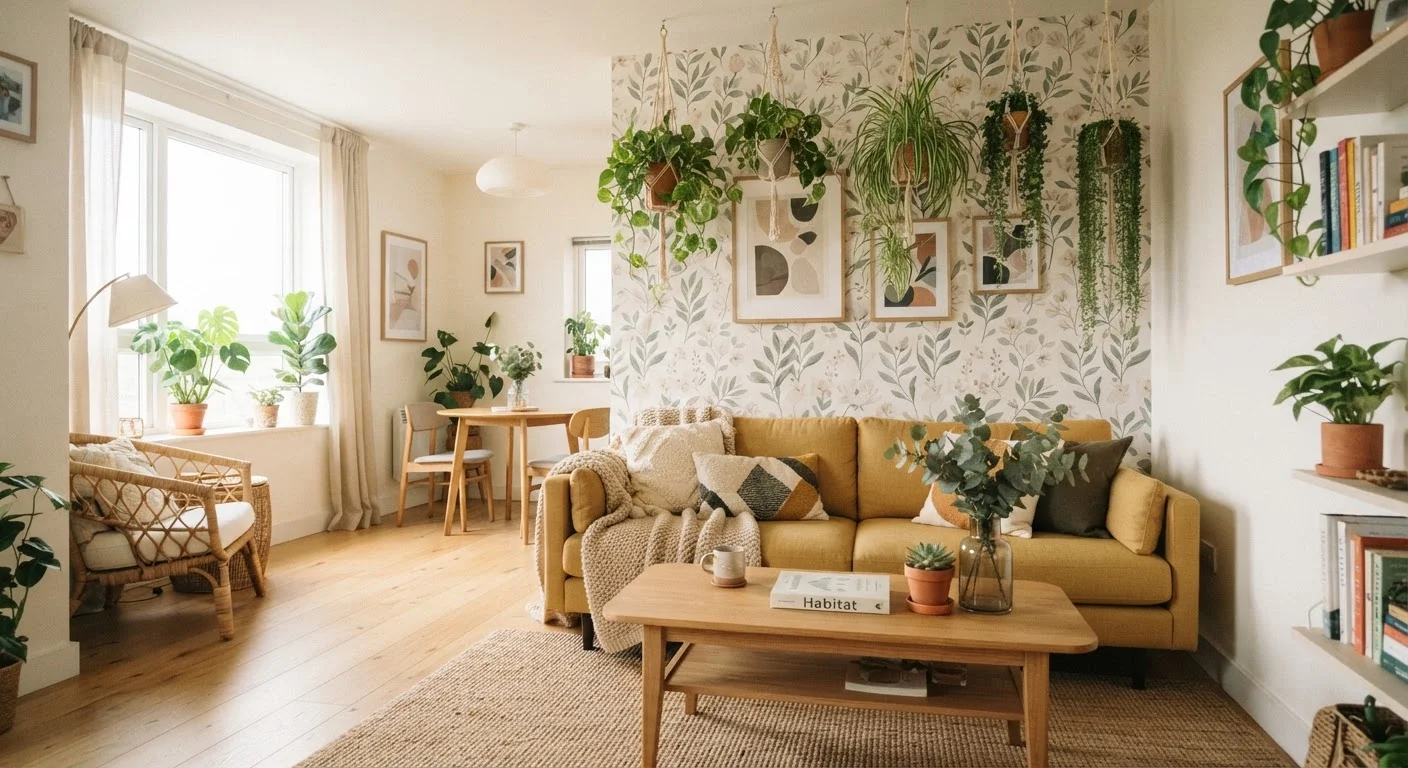
Trying to improve every corner at once spreads both money and attention too thin. Instead, identify the single element that draws the eye when you walk in - typically a wall behind a sofa, the bed headboard wall, or a fireplace - and concentrate your effort there first.
A large-format print, a cluster of smaller frames, or even a single oversized textile hung flat can anchor an entire room. Once the focal point is strong, surrounding furniture and accessories need less work to feel intentional. This approach also prevents the visual noise that comes from treating every surface as equally important.
A strong focal point makes the rest of the room feel more deliberate with far less effort.
Use colour theory shortcuts instead of full repaints
You don't need to repaint an entire room to change how it feels. A single contrasting or deeper-toned wall - sometimes called an accent wall - can introduce depth and visual weight without committing to a full colour change. Tonal layering through cushions, throws, and small objects (using shades from the same colour family) creates harmony without requiring paint at all.
A few principles worth knowing: cool colours (blues, greens, greys) tend to make a space feel larger and calmer; warm tones (terracotta, ochre, warm whites) make it feel cosier and more intimate. Understanding this before buying anything saves costly missteps. For a deeper look at how these effects work, see how colour, light, and scale interact.
Tonal layering through soft furnishings can shift a room's mood without any paint whatsoever.
Swap materials before replacing furniture
When a room feels dated or uninspiring, the instinct is to replace furniture. But often the issue is surface-level: fabric, hardware, or lighting. A sofa with tired cushion covers can be transformed with new fabric inserts or recovered cushions. A wooden side table with dated brass handles becomes contemporary with matte black or brushed nickel replacements - a change that costs a fraction of a new piece.
Lighting is particularly high-impact. Swapping a standard pendant shade or replacing bare bulbs with warm-toned alternatives changes the atmosphere at a very low cost. These material swaps also align well with a more sustainable approach to home organization, reducing what goes to landfill.
Replacing hardware or fabric rather than entire furniture pieces can modernise a room for very little.
Redistribute what you already own
Before spending anything, move things around. A lamp that feels unremarkable in a living room corner may become a statement piece on a bedroom nightstand. Books stacked horizontally and used as a plinth beneath a small object add height variation to a shelf. A mirror moved from a hallway to behind a dining table suddenly doubles perceived light.
Redistribution works because our eyes habituate - we stop seeing things in fixed positions. Moving objects resets attention and often reveals that a space was underusing what it already had. Do a full audit of every room before any purchase; the answers are frequently already there.
Moving familiar objects to new positions can make a home feel genuinely refreshed for free.
Understand scale before you buy anything
Scale mismatches are one of the most common and expensive decorating mistakes - and they're almost entirely preventable. A rug that's too small for a seating area makes furniture float disconnectedly. Artwork hung too high or too small for a wall looks accidental rather than considered.
The general rule: rugs should sit under the front legs of all key furniture pieces in a seating area, not float in the middle of the floor. Wall art should feel proportional to the wall or furniture beneath it - a single A4-sized print above a six-foot sofa rarely works. Measure and sketch before committing to any sizeable purchase. This single habit, combined with the planning approaches in budget home improvement planning, prevents the vast majority of costly regrets.
Measuring and sketching before buying eliminates the most common - and expensive - decorating mistakes.
Layer lighting rather than relying on overhead fixtures
Most rooms rely on a single overhead light source, which creates flat, unflattering illumination. Layering means introducing two or three light sources at different heights - a floor lamp, a table lamp, and perhaps a strip of warm-toned bulbs behind a shelf or television unit. This approach creates depth and changes the feel of a room dramatically after dark.
It doesn't require rewiring or expensive fixtures. A simple floor lamp from a secondhand source with a new bulb, combined with a small table lamp, can transform an evening atmosphere. This is one of the highest-return decorating changes available at low cost, and it works in every type of space, including rentals.
Layered lighting at different heights is one of the highest-impact, lowest-cost changes in any room.
Putting It All Together
The most effective budget decorating isn't about finding cheap versions of expensive things - it's about choosing fewer, more deliberate moves. Each strategy above works independently, but they compound. Nail your focal point first, layer in material swaps, then refine with colour. You'll spend less overall and feel more in control of the result.
Start with a room sketch and a wish list
Before spending anything, sketch your room to scale on paper and list what's bothering you most about the space. Often, the real issue is proportion, light, or clutter - not a lack of objects. A clear wish list also stops impulse purchases that feel exciting in a shop but don't solve the actual problem.
For renters concerned about what's permissible, renter-friendly upgrades outlines reversible changes that won't jeopardise a deposit. And if you're ready to go deeper on how rooms actually feel, colour, light, and scale is the natural next read.