Why Stopping Distance Is Bigger Than You Think
Most drivers dramatically underestimate how far their vehicle travels before coming to a complete stop. At 60 mph, a car covers 88 feet every single second. Factor in an average perception-reaction time of 1.5 seconds - the time between seeing a hazard and your foot actually reaching the brake - and you've already traveled 132 feet before braking even begins. Add the physical braking distance on dry pavement, and total stopping distance can exceed 270 feet.
That's nearly the length of a football field. If you're following the car ahead by two car lengths at highway speed, you have nowhere near enough room.
~29%
Share of all U.S. crashes that are rear-end collisions
According to NHTSA crash data, rear-end crashes are consistently one of the most common collision types on American roads.
270 ft
Typical stopping distance at 60 mph on dry pavement
This figure combines an average 1.5-second reaction distance with physical braking distance for a standard passenger vehicle on a dry road.
1.5 sec
Average driver perception-reaction time
The American Association of State Highway and Transportation Officials (AASHTO) uses 2.5 seconds for design purposes; real-world studies cluster around 1.5 seconds under alert conditions.
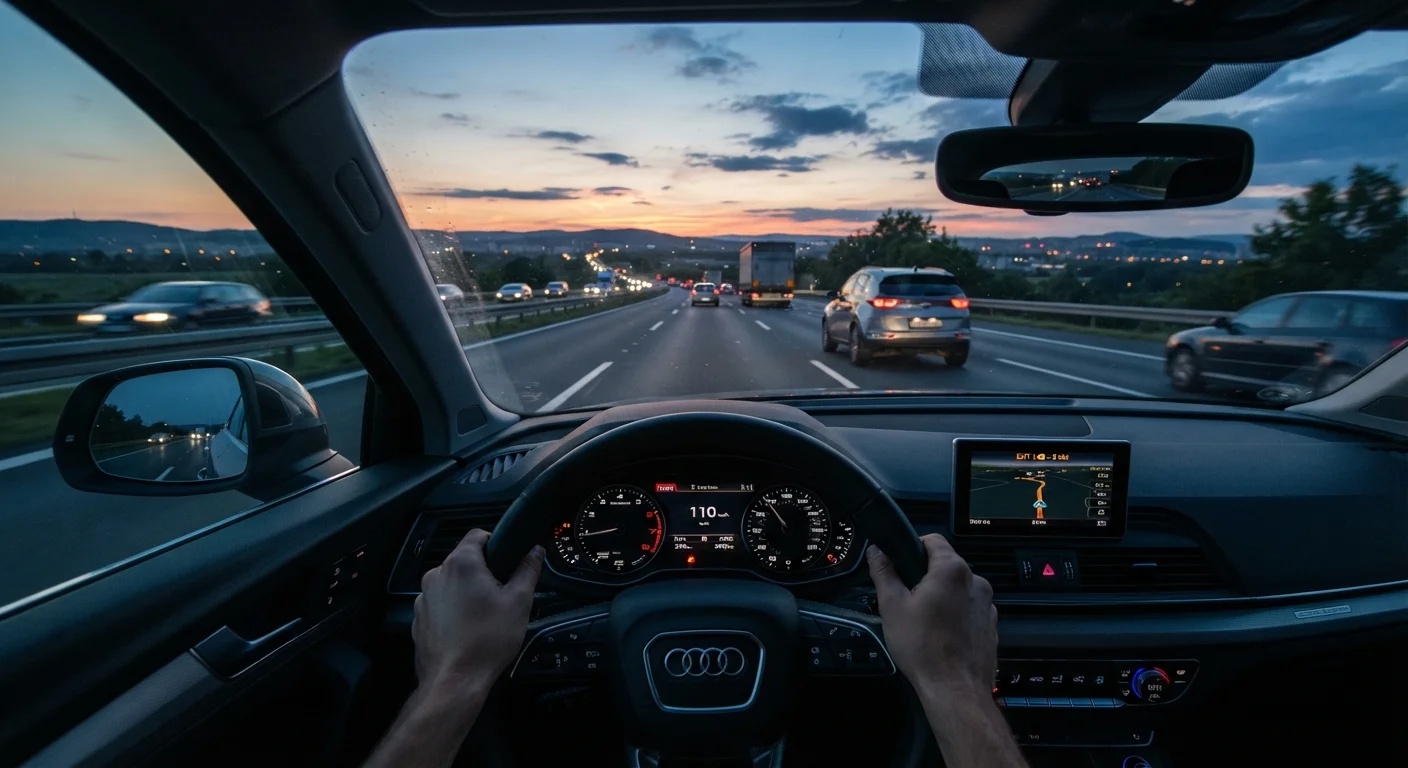
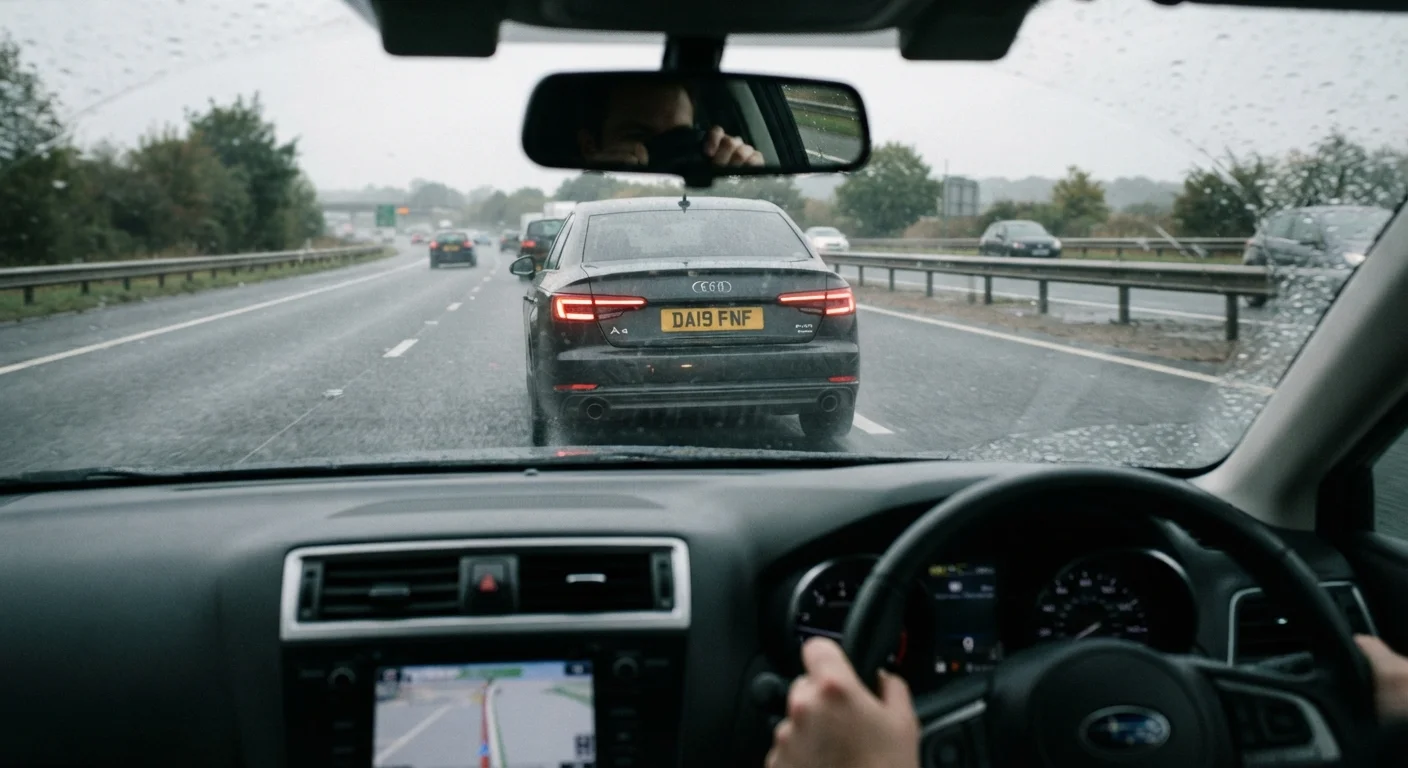
This is why the 3-second rule exists. Choose a stationary roadside marker - a sign, a bridge post, a shadow line. When the vehicle ahead passes it, count: one-one-thousand, two-one-thousand, three-one-thousand. If you reach that marker before finishing the count, you're too close. In rain, snow, or at night, the gap should extend to 4-6 seconds. See how reduced visibility compounds the challenge in our guide to night driving hazards.
The Real-World Consequences of Following Too Closely
Rear-end collisions account for a significant share of all U.S. traffic crashes each year, and following too closely is consistently identified as a primary contributing factor. These aren't just fender-benders: rear-end impacts at highway speeds cause whiplash injuries, airbag deployments, and fatalities - especially in multi-vehicle chain reactions triggered when one driver stops suddenly.
Beyond crash risk, tailgating has a secondary cost most drivers overlook: vehicle wear. Constant close-following means constant hard braking, which accelerates brake pad degradation and stresses rotors. It also produces choppy throttle inputs that lower fuel efficiency. These are habits worth breaking on purely economic grounds - but the safety case is far more compelling.
Understanding these risks fits into a broader framework of defensive versus reactive driving - anticipating hazards before they force a response is always safer than scrambling to react.
How to Maintain a Safe Following Distance Consistently
Knowing the 3-second rule is one thing; applying it consistently under real driving conditions is another. Traffic flow, impatient drivers behind you, and the pressure to keep pace on a busy freeway all create psychological friction that erodes safe habits over time.
Use the 3-Second Rule as a Floor, Not a Target
Three seconds is the widely cited minimum for ideal conditions - dry pavement, alert driver, standard passenger vehicle. Treat it as the lowest acceptable gap, not the goal. In rain, fog, darkness, or when driving a heavier vehicle, extend to 4-6 seconds. If you're unsure, more space is always the correct answer.
A few practical anchors help:
- Recalibrate after lane changes. Every time you change lanes, you're resetting your position relative to traffic. Consciously re-check your following gap rather than assuming it's adequate.
- Account for vehicle load. A fully loaded SUV or a vehicle towing a trailer requires significantly more stopping distance than an empty compact car. Adjust your gap accordingly.
- Watch the car two ahead. Experienced drivers monitor not just the car directly in front but the one ahead of it. Early visual cues - brake lights, swerving, traffic bunching - give you precious extra time to respond.
These habits are part of what separates consistently safe drivers from those who've simply been lucky. Speed is the multiplier that makes following distance non-negotiable - worth revisiting alongside speed limit rules most drivers misread.
“The only margin of safety a driver truly controls is the space in front of them. Everything else - the other driver's reactions, the road surface, the weather - is outside your control.”
— Traffic Safety Research Community, General principle cited across driver education and road safety literature