Why Destination Is Your Biggest Budget Lever
Most travel budget advice focuses on tactics: book flights six weeks out, use points, skip checked bags. These decisions matter, but they operate at the margins. The variable that shapes your entire budget - before any of those choices are made - is where you're going.
A week in Lisbon and a week in Zurich involve the same flight cost from New York and the same number of hotel nights. But the in-country daily spend can differ by a factor of three or four. That gap isn't explained by airline deals or coupon codes. It's explained by purchasing power parity (PPP) and the structure of local economies.
If you're serious about maximizing your travel experience on a fixed income, destination selection deserves more analytical attention than most young professionals give it. Winging your destination - or defaulting to wherever friends are going - routinely leads to avoidable overspending.
How Local Wages Drive What You Actually Pay
The price of a meal, a taxi ride, or a hotel room isn't arbitrary. In most economies, service prices are anchored to local wage levels. A restaurant owner in Bangkok prices their menu to attract local customers earning local wages. A restaurant in Amsterdam does the same for Dutch wage earners. When a US professional earning a US salary walks into either restaurant, the gap in their favor is enormous in Bangkok and negligible in Amsterdam.
This is the mechanism behind PPP. It's not just about exchange rates - it's about the structural relationship between local incomes and local prices. Countries with lower median wages generally offer lower prices for locally produced goods and services: food, transport, accommodation run by local operators, and guided experiences.
3-4×
Daily cost difference between cheap and expensive destinations
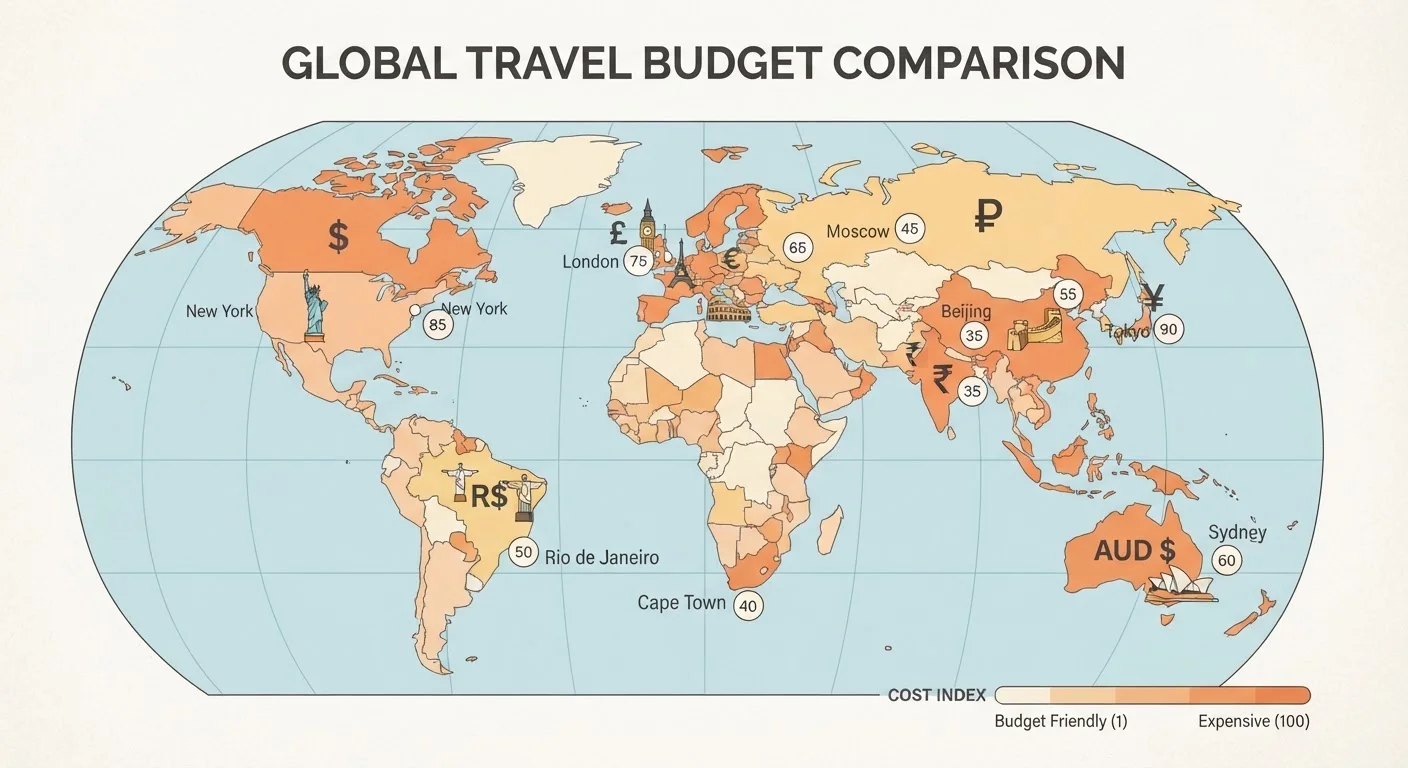
Numbeo data comparing Southeast Asian cities to Western European capitals consistently shows a 3-to-4 times gap in average daily spending for equivalent lifestyle categories.
~55%
Lower restaurant costs in Eastern Europe vs. Western Europe
Numbeo's restaurant price index shows cities like Warsaw and Budapest averaging roughly 50-60% lower restaurant costs than Paris or Amsterdam.
$40-$80
Comfortable daily budget in top high-PPP destinations
Independent travel communities and cost-tracking tools like Numbeo consistently report this daily range covering accommodation, food, and local transport in Southeast Asia and Eastern Europe.
Imported goods, internationally branded hotels, and tourist-trap restaurants tend to price closer to global norms regardless of location. Staying within locally oriented services is where the purchasing power advantage is actually realized.
Reading Cost-of-Living Indexes Like a Travel Planner
You don't need an economics degree to use this information. Several publicly maintained tools translate PPP concepts into practical numbers:
- Numbeo Cost of Living Index: Aggregates crowd-sourced price data for cities worldwide, broken into categories like groceries, restaurants, and rent. Useful for comparing specific cities rather than whole countries.
- The Economist's Big Mac Index: A simplified PPP comparison using the price of a McDonald's Big Mac as a proxy for currency over- or under-valuation relative to the US dollar.
- World Bank PPP data: More technical, but authoritative for broad country-level comparisons.
The practical approach: before committing to a destination, look up its Numbeo score relative to New York or another US city you know well. A city scoring 40% lower than New York on the restaurant index means your food budget goes roughly twice as far there. That single data point can shift your trip calculus significantly.
Use City-Level Data, Not Country Averages
Country-level cost averages can mislead. A country's capital may be twice as expensive as its secondary cities. Always look up the specific city you plan to base yourself in - Numbeo lets you search by city, which gives you far more actionable numbers than national averages. Tourist-heavy neighborhoods within any city also trend more expensive than local residential areas.
For a deeper look at what costs to account for once you've chosen a destination, see the full breakdown of overlooked travel expenses.
Putting It Into Practice: High-Value vs. High-Cost Regions
Broad generalizations have exceptions, but some regional patterns hold reliably for US travelers:
- High purchasing power regions
- Southeast Asia (Vietnam, Indonesia, Cambodia), Eastern Europe (Poland, Romania, Hungary), Central America (Guatemala, Honduras), and parts of South Asia (Nepal, India) consistently allow daily budgets of $40-$80 to cover comfortable accommodation, meals, and local transport.
- Moderate purchasing power regions
- Portugal, Spain, Mexico, Colombia, and parts of Southeast Asia's more developed economies (Thailand's tourist areas, Bali's resort zones) fall in the middle - still meaningfully cheaper than the US, but with more variability based on how tourist-oriented your choices are.
- Low purchasing power regions for US travelers
- Western Europe (Switzerland, Norway, Denmark, UK), Australia, New Zealand, and Japan (particularly post-2022 inflation) require substantially higher daily budgets for equivalent comfort levels.
If you're considering a multi-destination trip, the slow travel vs. country-hopping cost comparison is worth reading before you finalize your itinerary - how you move between destinations compounds these regional cost differences significantly.
Explore our destination guides for focused cost and logistics breakdowns by region.