
Why Accommodation Deserves More Strategic Attention
Accommodation typically accounts for 30-50% of a travel budget, yet most people default to whatever a search engine surfaces first. That's a costly habit. The range of legitimate options - hostels, guesthouses, home exchanges, house-sitting, and private rentals - varies enormously in price, privacy, and practical complexity. Understanding that spectrum is one of the fastest ways to stretch a travel budget without downgrading your experience.
Keep in mind that accommodation costs rarely exist in isolation. Overlooked expenses like airport transfers and tipping norms can quietly undercut savings made on lodging. Evaluate your full cost picture, not just the nightly rate.
| Hostels | Guesthouses | Private Rentals | Home Swaps | House-Sitting | |
|---|---|---|---|---|---|
| Typical nightly cost (US traveler) | $15-$60 | $30-$80 | $50-$120 | Near zero (membership fee) | Free |
| Privacy level | Low (dorms) to medium (private rooms) | Medium | High | High | High |
| Booking lead time needed | Days to weeks | Days to weeks | 1-4 weeks | 1-4 months | 2-6 weeks |
| Best trip length | 1-7 nights | 2-10 nights | 4+ nights | 1-3 weeks | 1-4 weeks |
| Kitchen access | Communal kitchen | Rare | Usually yes | Yes | Yes |
| Social opportunity | High | Low-medium | Low | Low | Low |
| Commitment / friction | Low | Low | Low-medium | High | High |
Hostels: More Than Dorm Rooms
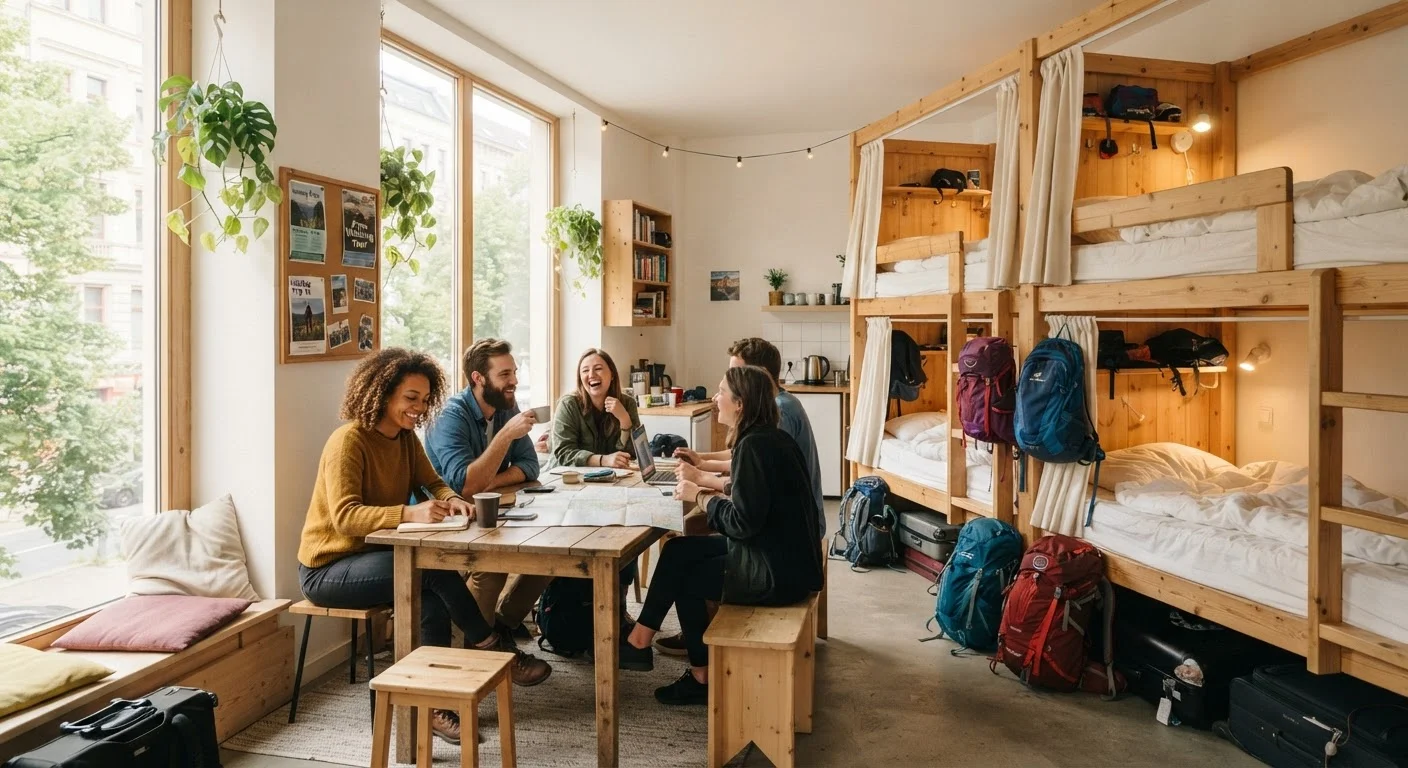
Modern hostels in major cities have evolved well beyond the six-bunk dorm. Many now offer private rooms at rates still well below comparable hotels, along with communal kitchens that make a real dent in food costs - an underrated advantage covered in more depth in strategies for eating affordably while traveling.
The practical trade-offs are real: shared bathrooms, variable noise levels, and lockers that often cost extra. Dorm beds in budget-friendly destinations can run $15-$30 per night; in Western Europe or major US cities, expect $40-$60. Social travelers - especially those on solo trips - often find hostels reduce both loneliness and per-night spend simultaneously.
Book Hostel Private Rooms Early
Many hostels offer private en-suite rooms at 40-60% of equivalent hotel rates. These fill faster than dorms, particularly in popular cities during shoulder season. Searching hostel platforms for private rooms - rather than hotel platforms - often surfaces options that don't appear in standard hotel searches. Check cancellation policies carefully, as these vary widely.
Guesthouses and Private Rentals: The Middle Ground
Family-run guesthouses occupy a practical middle ground: more privacy than a hostel dorm, more local character than a chain hotel, and often significantly cheaper than either. In Southeast Asia, Central America, and parts of Southern Europe, quality guesthouses can be found for $30-$60 per night including breakfast.
Private apartment rentals work best for stays of four or more nights, where weekly rates reduce the effective nightly cost substantially. A full kitchen also means lower food spend. The friction point: cleaning fees and service charges can erode savings on short stays, so always calculate total cost, not the headline nightly rate.
Home Swaps and House-Sitting: Near-Zero Accommodation Cost
Home exchanges - where you stay in someone's home while they stay in yours - can reduce accommodation costs to nearly zero, aside from membership fees on platforms that facilitate them. The model works best for homeowners with desirable locations and enough flexibility to coordinate timing. Lead times of two to four months are common for popular destinations.
House-sitting operates differently: you care for a property (and often pets) in exchange for free accommodation. The commitment is real - you're on a schedule, you can't leave the property unattended for long periods - but for remote workers or travelers on extended trips, it's a compelling arrangement. Both options reward patience and a verifiable profile with good references.
Budget travel isn't only for backpackers - home swaps in particular skew toward established professionals with homes worth offering. The stereotype doesn't match the reality.
Verify Home Swap and House-Sitting Platforms Carefully
The quality of vetting, dispute resolution, and identity verification varies significantly between platforms facilitating home exchanges and house-sitting. Before committing, confirm what protections exist if arrangements fall through - and independently verify reviews where possible. Never transfer funds or hand over keys outside of a platform's official process. Always verify entry requirements and local regulations independently via official government sources before finalizing arrangements.
How to Match the Option to Your Trip
The right accommodation type depends on four variables: trip length, destination cost level, your need for privacy, and how much planning friction you'll accept. Short city breaks favor hostels or guesthouses - low commitment, easy to book last-minute. Longer trips of two weeks or more make home swaps and house-sitting viable and genuinely worthwhile. Destinations with strong local guesthouse culture (much of Asia, Latin America, Eastern Europe) make that option especially competitive.
Where you travel shapes every budget line, and accommodation is no exception - a private room in Chiang Mai costs what a hostel dorm costs in Amsterdam. Destination choice amplifies or limits the impact of accommodation decisions, so consider both together.
~40%
Share of travel budget spent on lodging
Industry estimates consistently place accommodation at roughly 30-50% of total trip spend for independent travelers.
4+ nights
Break-even point for private rentals
Cleaning fees and service charges on short-term rental platforms typically make private apartments uncompetitive for stays under four nights.