
Why Most Island Guides Fail You
Search "best Greek islands" and you'll get the same ten names recycled endlessly. The problem isn't the islands - it's that generic rankings ignore how differently each cluster behaves for different travellers. The Cyclades and the Ionian Islands are both in Greece, but they deliver completely different experiences in terms of terrain, crowd density, ferry access, and nightlife. Treating them as interchangeable is the root cause of most disappointed Greek island trips.
This guide maps each major cluster against what it actually offers, so you can match your priorities to the right region rather than defaulting to wherever the algorithm sends you. Before you commit to any itinerary, it also helps to understand the full planning framework - see the anatomy of a well-planned trip for the broader structure.
The Five Clusters, Compared
Greek islands group into five main geographic clusters, each with a distinct personality. Here's how they stack up across the criteria that matter most for a working professional planning a 7-14 day trip.
| Cyclades | Crete | Dodecanese | Ionian Islands | Northern Aegean | |
|---|---|---|---|---|---|
| Scenery type | Volcanic, stark, coastal | Diverse - coast, gorge, mountain | Medieval towns, coastal | Green, lush, Venetian | Forested, traditional, quiet |
| Crowd density (peak) | Very high | High on north coast | High in Rhodes town | Moderate | Low |
| Ferry connectivity | Excellent | Good to Dodecanese | Good within cluster | Moderate | Limited |
| Minimum days recommended | 4-7 | 5-10 | 4-7 | 4-6 | 5-8 |
| Best for | Scenery, nightlife | Depth, culture, hiking | History, beach mix | Architecture, nature | Authenticity, food |
| Shoulder season ease | High | High | Moderate | High | Moderate |
A few clarifications: Ferry connectivity measures how easy it is to move between islands within the cluster. Crowd density reflects peak-season pressure specifically. The northern Aegean scores low on connectivity because inter-island routes are limited - you'll likely route back through Athens between islands.
Cyclades: The Famous and the Underrated
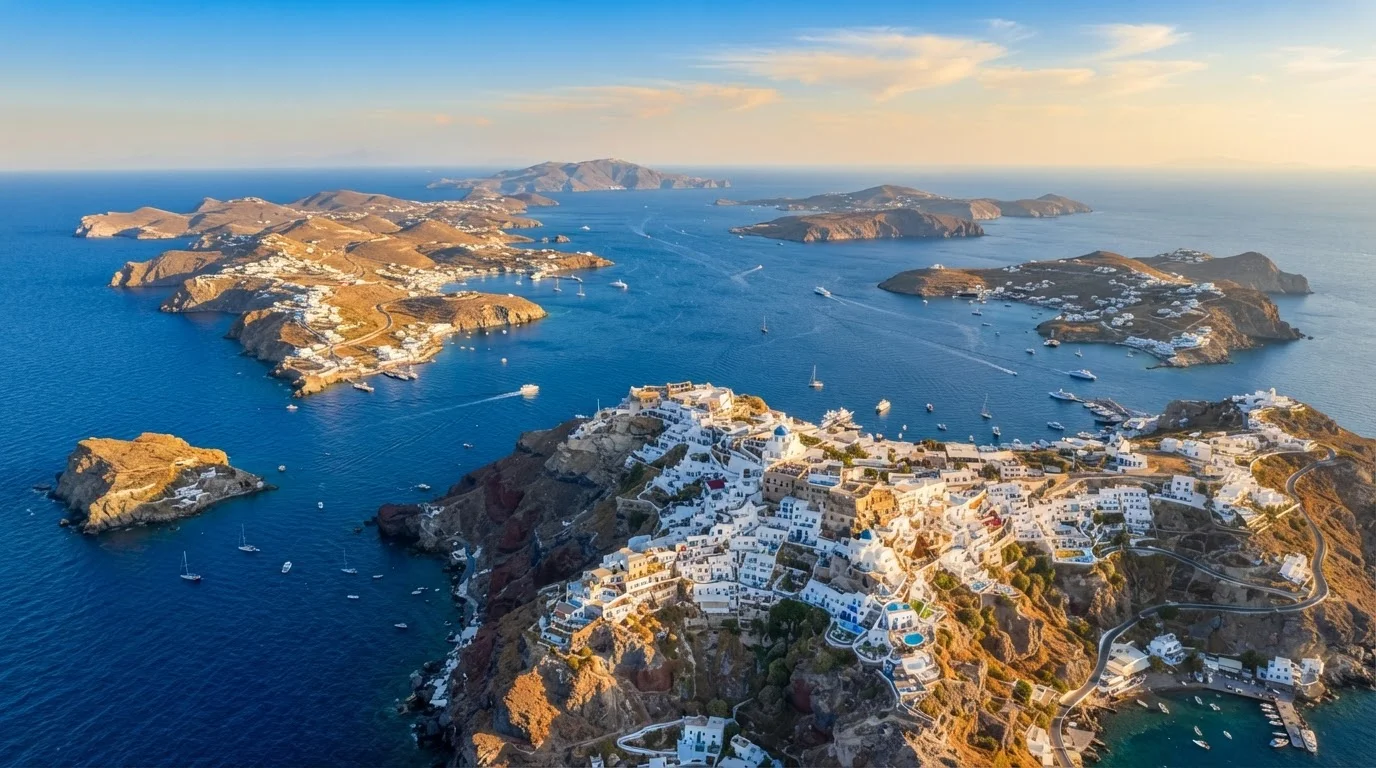
The Cyclades are what most people picture when they think of Greece - cubic white architecture, blue-domed churches, and clifftop sunsets. Santorini and Mykonos deliver exactly that, but in July and August they're genuinely overcrowded. Queues for restaurants, inflated pricing, and cruise-ship day-trippers are real friction points.
The smarter move for first-timers is to anchor on Paros or Naxos instead. Both sit on the same ferry routes, offer comparable beaches and villages, and run at a fraction of the crowd density. Naxos has the added advantage of being the largest Cycladic island with an interior worth exploring - a rarity in this cluster.
Book Ferries Before Flights
Ferry schedules - not flight schedules - should drive your Cyclades itinerary structure. High-speed catamaran seats on popular routes sell out weeks in advance in peak season. Lock in ferry times first, then build your accommodation around them. Verify schedules directly with operators or official port authority sources, as routes change seasonally.
If your group has mixed priorities, the Cyclades is also the easiest cluster to island-hop within - fast ferries connect the main islands in 30-90 minutes. For logistics on keeping a group aligned across multiple stops, group trip logistics covers the coordination side well.
Crete: Treat It as Its Own Destination
Crete is consistently underused as a standalone trip. Most visitors treat it as one stop on a larger itinerary and end up seeing almost nothing of consequence. The island is roughly the size of Delaware - it has gorges, mountain villages, Minoan ruins, and a north-south coastline that behaves like two different countries.
Five days is the minimum to form an honest impression. Fewer than that and you've only seen the airport-adjacent resort strip. Allocate time to drive the interior, and verify road conditions and seasonal closures with local sources before you go, as some mountain routes are weather-dependent.
Crete also pairs logically with a Rhodes add-on via the Dodecanese cluster - both have direct ferry and flight connections and together form a coherent eastern Mediterranean arc.
Ionian and Northern Aegean: For Travellers Who've Done the Obvious
The Ionian Islands - Corfu, Kefalonia, Zakynthos, Lefkada - sit off Greece's west coast and have a noticeably different feel: greener, more Venetian-influenced architecture, and a slightly cooler summer climate. Corfu Town is one of the most architecturally interesting settlements in all of Greece and often overlooked by travellers fixated on the Cyclades.
The northern Aegean (Lesbos, Chios, Samos) is genuinely off the main tourist circuit. Ferry links are less frequent, English is less universally spoken, and tourism infrastructure is thinner - which is either a selling point or a dealbreaker depending on your style. These islands have strong local food cultures and medieval architecture that rarely appear in mainstream travel content. If you're deciding how much flexibility to build in versus planning tightly, the trade-offs between rigid and open-ended travel is worth reading before committing to this cluster.
Once you've identified the right cluster, building an itinerary that actually works will help you structure daily movement without overpacking your schedule.