Why Roundabouts Still Confuse Drivers
Roundabouts are one of the safest intersection designs in use today. Research from the Insurance Institute for Highway Safety (IIHS) consistently shows they reduce fatal crashes by roughly 90% compared with traditional signalized intersections. Yet they remain a persistent source of driver confusion - hesitation on entry, incorrect lane choices, and missed yields create friction and near-misses every day.
Most of that confusion traces back to a handful of specific misconceptions. The yield rules are not complicated once stated clearly, but many drivers were never taught them explicitly or have picked up bad habits. The myth-and-fact pairs below address the most consequential errors, whether you've been driving for six months or sixteen years.
For broader context on anticipating hazards before they escalate, see our guide to defensive versus reactive driving.
Myth
The first car to arrive at the roundabout has the right of way and can enter without yielding.
Fact
Vehicles already circulating inside the roundabout always have priority. Entering drivers must yield, regardless of arrival order.
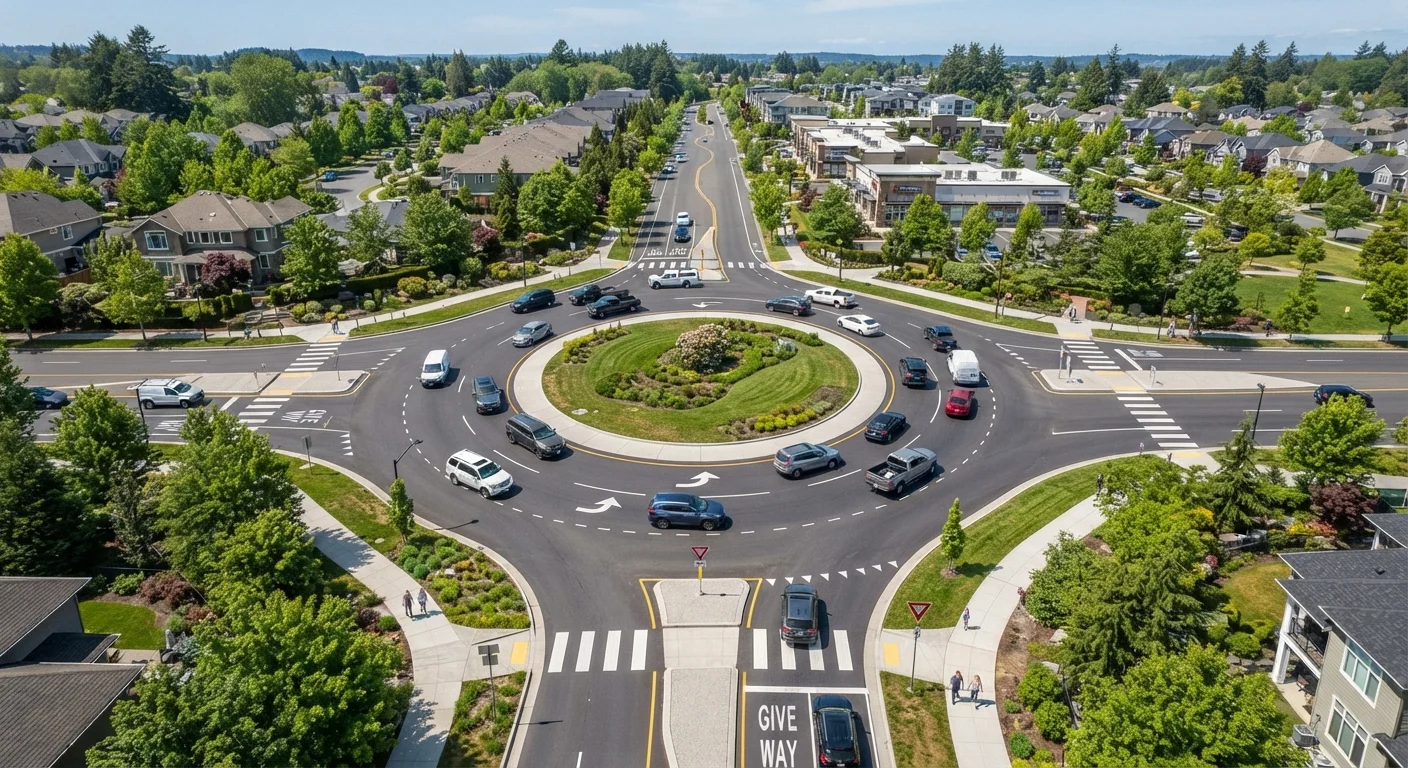
This is the single most dangerous misconception about roundabouts. The yield sign at every entry point applies universally - it doesn't matter if you arrived at the junction before anyone else or if the circulating vehicle appears to be moving slowly. Until there is a safe gap in circulating traffic, you wait. Treating arrival order as the determining factor causes broadside collisions, which are among the most injurious crash types at roundabouts.
Myth
You should stop and give way to vehicles entering the roundabout if they look like they're going to pull out.
Fact
Drivers inside the roundabout do not yield to entering vehicles. Stopping unnecessarily inside a roundabout creates rear-end collision risk.
This error typically comes from misapplied politeness or uncertainty. If you are already circulating, you have priority - slowing or stopping for an entering driver disrupts traffic flow and surprises the driver behind you. The entering driver is responsible for finding a safe gap. Maintaining consistent, predictable speed inside the roundabout is the correct and safer behavior.
Myth
At a multi-lane roundabout, you can freely change lanes while circulating to reach your desired exit.
Fact
Lane changes inside a multi-lane roundabout are extremely high-risk and should be avoided. Commit to a lane before entering.
Multi-lane roundabouts are designed so that the lane you enter in corresponds to the range of exits available to you. Attempting to change lanes while circulating puts you in a driver's blind spot at close range and with limited reaction time. The correct approach is to identify your exit before you reach the roundabout and select the appropriate entry lane accordingly. If you miss your exit, go around again rather than cutting across lanes.
Myth
Larger or heavier vehicles automatically have right of way in a roundabout.
Fact
Vehicle size confers no legal priority in a roundabout. The same yield rules apply to all vehicle types.
This myth likely stems from general road experience where large vehicles require more space and other drivers informally defer to them. In a roundabout, the rules are the same for every vehicle: entering traffic yields to circulating traffic. Some roundabouts have special provisions for long vehicles (such as truck aprons - raised center sections that larger axle vehicles can mount), but these are geometric accommodations, not priority rules. A semi-truck entering a roundabout must still yield to a compact car already circulating.
Myth
You need to signal when entering a roundabout to show other drivers which exit you plan to take.
Fact
Signaling on entry is not required and can mislead other drivers. Signal left only as you approach your intended exit.
Signaling on entry can confuse waiting drivers into thinking you're turning before you enter the circle. Standard practice in the U.S. is: no signal on entry, signal to indicate your exit as you pass the preceding one. This gives a clear, timely indication to both circulating drivers and pedestrians on the exit. Some jurisdictions have nuanced guidance on right-lane entry signals - always follow posted local rules and your state's driver handbook when they differ.
Lane Selection and Exit Signals: Getting the Details Right
Correct lane choice is the skill that separates confident roundabout users from hesitant ones. The general principle: if you're taking an early exit (typically the first or second), use the left lane of a two-lane approach. For later exits, use the right lane. At single-lane roundabouts this is straightforward; at multi-lane roundabouts it demands more attention because lanes inside the circle broadly correspond to your entry lane.
~90%
Reduction in fatal crashes at roundabouts
According to the Insurance Institute for Highway Safety (IIHS), roundabouts reduce fatal crashes by approximately 90% versus conventional signalized intersections.
75%
Reduction in injury crashes
The IIHS also reports that injury-producing crashes drop by around 75% when traditional intersections are converted to roundabouts.
Signaling is the other area where drivers frequently go wrong. You do not need to signal when entering - there is no turn being made at that point. However, once you've passed the exit before the one you want, you should signal left (in the U.S., this means right-turn signal in right-hand traffic contexts - apply the convention for your jurisdiction) to indicate your intent to exit. Failing to do so leaves following drivers guessing and increases the chance of a side-swipe.
Pedestrian crossings on roundabout exits are another overlooked hazard. Exiting vehicles must yield to pedestrians in marked crosswalks, just as they would at any other crossing. Speed on exit should reflect that obligation. Drivers new to these skills may also find value in reviewing common first-year driving errors for a broader picture of situational blind spots.
Never Reverse Inside a Roundabout
If you overshoot your exit or enter the wrong lane, do not reverse - other circulating drivers cannot anticipate backward movement and cannot stop in time. The correct action is to continue around the roundabout and re-approach. Reversing inside a roundabout is illegal in most U.S. jurisdictions and extremely hazardous.