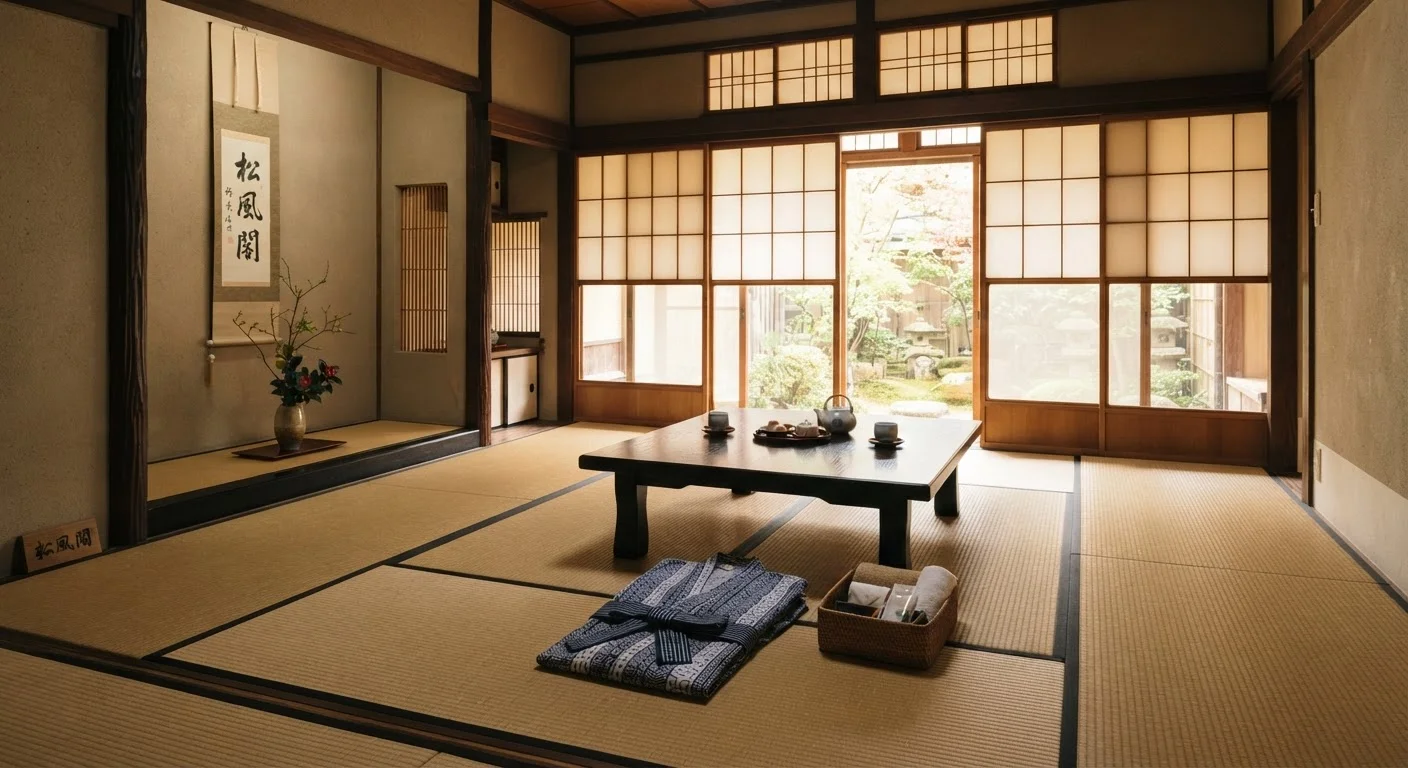
Staying at a ryokan involves rituals, etiquette, and a different pace of travel. Here's how to arrive prepared and leave with more.
Key Takeaways
Ryokans run on timing - meals, baths, and room preparation follow a set schedule you'll need to respect.
Shoes come off at the entrance; slippers stay out of tatami rooms - learn the layered footwear logic before you arrive.
Packing light and leaving bulky luggage elsewhere makes the ryokan experience significantly smoother.
The onsen (communal hot spring bath) has firm etiquette rules: wash thoroughly before entering, no swimwear, no phones.
Most ryokans include kaiseki dinner and breakfast - communicate dietary restrictions well in advance, not at check-in.
Why Ryokans Reward Preparation
A ryokan is not a hotel with Japanese aesthetics bolted on. It's a hospitality tradition with its own logic - one built around attentiveness, ritual, and a pace that most Western travelers aren't used to. Get that logic wrong and the stay becomes awkward. Get it right and it's one of the most distinctive travel experiences Japan offers.
The good news: the rules aren't complicated. They're just specific. Knowing what to expect before you walk through the noren (fabric divider at the entrance) means you spend your time absorbing the experience rather than second-guessing your behavior.
If you're building a broader Japan itinerary, our guide to Tokyo beyond the obvious pairs well with a ryokan stay - both reward travelers who slow down and pay attention.
Before You Arrive
Communicate dietary restrictions directly to the ryokan at least one week before arrival - kaiseki menus are prepared in advance and adjustments require notice.Must
Confirm check-in timing and communicate your expected arrival time; many ryokans hold dinner service and will adjust staffing based on your schedule.Must
Arrange luggage forwarding to the ryokan via a takuhaibin service so you arrive light and unencumbered.Should
Research whether your ryokan has a private onsen option if communal bathing is a concern - availability varies widely by property.Nice to have
Download an offline Japanese phrase guide covering basic greetings and meal appreciation - ryokan staff will genuinely notice the effort.Nice to have
Footwear and Room Etiquette
Remove outdoor shoes at the genkan (entrance foyer) and switch to the slippers provided - this transition is non-negotiable.Must
Remove slippers before stepping onto tatami flooring - tatami rooms are slipper-free zones; enter in socks or bare feet only.Must
Use the separate toilet slippers provided in the bathroom and return them before leaving - they stay in the bathroom.Must
Avoid sitting on the futon during daytime - it doubles as bedding and the expectation is that it's treated accordingly.Should
Onsen Bathing Rules
Shower and wash your entire body at the individual stations before entering the communal bath - entering the onsen without washing first is a serious breach of etiquette.Must
Leave swimwear out of the onsen entirely; communal bathing is done without clothing.Must
Keep your small towel out of the water - fold it on your head or set it aside at the bath's edge.Must
Leave your phone in your room; photography in onsen areas is universally prohibited.Must
Check posted signs for any medical advisories - soaking time and temperature can be intense, particularly for those with cardiovascular conditions.Should
Meals and Dining Conduct
Arrive at your meal time - kaiseki is a multi-course experience with precise pacing, not a buffet you wander into at your convenience.Must
Say 'itadakimasu' before eating and 'gochisousama deshita' after - these expressions acknowledge the meal and are expected, not optional.Should
Eat what you're served even if unfamiliar - declining dishes mid-meal creates difficulty for staff; inform of restrictions beforehand instead.Should
Avoid heavy outside food or alcohol in your room if not offered by the ryokan - it cuts against the curated experience they're managing.Nice to have
What to Pack
Pack only what fits in a carry-on or small backpack for the ryokan portion of your trip - keep heavy bags at a Tokyo or Kyoto hotel using storage services.Must
Bring any prescription medications clearly labeled; ryokans can't substitute or source them for you.Must
Include a small cash reserve - many traditional ryokans don't accept credit cards, and even those that do may prefer cash for incidentals.Should
Pack a compact, quick-dry travel towel if you plan multiple onsen sessions - the provided small towel is limited for multi-dip days.Nice to have
What to Pack (and What to Leave Behind)
Ryokans provide yukata (casual cotton robes), toiletries, and often a small towel for the bath. What they can't provide is the right mindset around luggage. Oversized suitcases are genuinely disruptive in these spaces - narrow corridors, low furniture, and tatami rooms aren't designed for rolling bags.
Send heavy luggage ahead using Japan's takuhaibin luggage forwarding services, widely available at airports, convenience stores, and larger hotels. Arrive with a bag you can carry easily. This isn't a nice-to-have - it's the practical move.
Required
Takuhaibin Luggage Forwarding
Ship bags directly to your ryokan from airports or hotels so you travel light on arrival.
Required
Offline Translation App
Read menus, posted onsen rules, and room instructions without needing a data connection.
Optional
IC Card (Suica or Pasmo)
Handle local transit and small convenience purchases without managing cash for every transaction.
Optional
Compact Waterproof Bag
Keep phone and wallet safe while walking between the onsen changing room and your room.
Visible Tattoos May Restrict Onsen Access
Many ryokan onsen - particularly at traditional properties - prohibit guests with visible tattoos from using communal baths. This is a longstanding policy at numerous establishments and is not universally changing. If this applies to you, verify the ryokan's policy before booking, and ask specifically about private bath options as an alternative. Don't assume the policy won't be enforced.
Understanding the Rhythm of a Ryokan Day
Check-in windows are narrow by design - typically 3-6 PM. Dinner is served at a set time, often in your room or a designated dining space, and breakfast follows the same structure. The communal onsen has peak and quiet hours; going early morning or late evening usually means you'll have it mostly to yourself.
Your room will be transformed while you're at dinner: the futon laid out, lights adjusted, the space reset for sleep. This isn't intrusive - it's the service model. Work with it, not around it.
Check-Out Timing Is Fixed - Plan Around It
Ryokan check-out is typically by 10 or 11 AM, and this is enforced. Unlike city hotels where late check-out is a negotiable amenity, ryokan schedules are structured around room preparation for the next guests and staff routines. Book onward transportation and any storage arrangements in advance. Showing up to breakfast at 9:30 AM and expecting a relaxed departure by noon is a common misread of how these stays work.
Travel Smarter Editorial Team is the collective byline for our editorial team and contributor network. Articles published under this byline or an editorial pen name are researched, written, and reviewed according to our editorial standards for clarity, consistency, and independence before publication.
The content provided on our blog site traverses numerous categories, offering readers valuable and practical information. Readers can use the editorial team’s research and data to gain more insights into their topics of interest. However, they are requested not to treat the articles as conclusive. The website team cannot be held responsible for differences in data or inaccuracies found across other platforms. Please also note that the site might also miss out on various schemes and offers available that the readers may find more beneficial than the ones we cover.