
Why This Decision Feels So Hard
Specialist or generalist - it's one of the most persistent career questions young professionals face, and the internet offers contradictory advice in equal measure. One article argues depth signals mastery; the next celebrates the "renaissance professional" who connects dots others miss. The real answer is that this is a context-dependent decision, not a permanent identity choice.
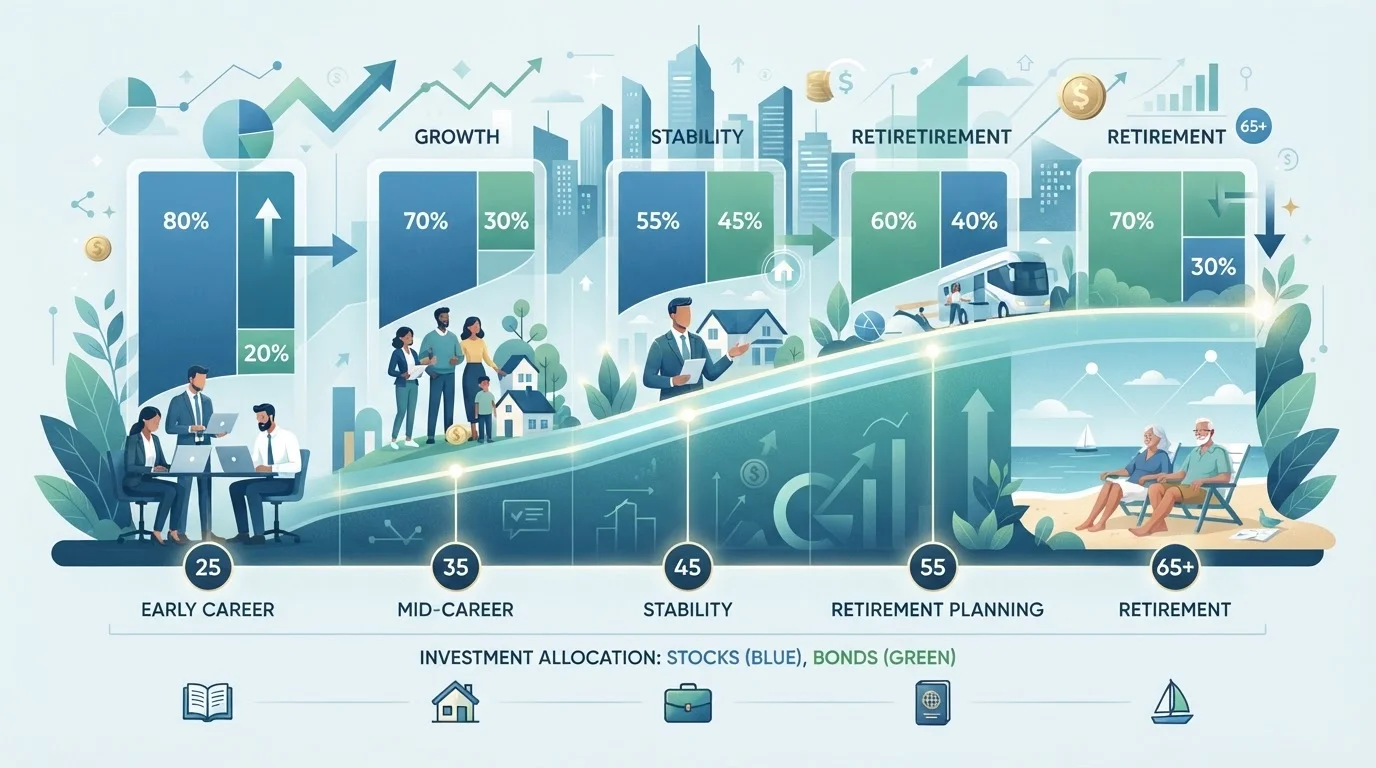
The most useful frame isn't "which is better?" but rather "which serves me right now, given my stage, my field, and my goals?" That reframe alone cuts through a lot of noise. Think of your career like a portfolio: the allocation that makes sense at 24 looks very different at 38. (For a parallel concept in financial planning, see how asset allocation shifts across a working life.)
Head-to-Head: Specialist vs. Generalist
Before applying any framework, it helps to see the key trade-offs clearly side by side.
| Criterion | Specialist | Generalist |
|---|---|---|
| Market positioning | Recognized authority in a niche | Versatile across functions or industries |
| Earning ceiling | High in technical/credentialed fields | High in leadership and strategy roles |
| Career flexibility | Narrower lateral options | Broader pivot opportunities |
| Obsolescence risk | Higher if domain shifts rapidly | Lower; transferable skills buffer disruption |
| Time to credibility | Faster within a defined domain | Slower; requires demonstrating synthesis |
| Ideal org context | Large orgs, consulting, research | Startups, leadership, cross-functional teams |
Neither column is a clear winner - the table reveals trade-offs, not a verdict. That verdict comes from context.
A Career-Stage Framework for Making the Call
Use this three-phase model as a starting point:
Phase 1 - Early Career (Years 0-5): Default to Breadth
Most people don't yet know which domain will hold their interest for a decade. Broad exploration in early roles helps you gather signal. Take stretch assignments. Say yes to cross-functional projects. You're building the foundation of the T-shape - the horizontal bar of awareness. This phase is also when affordable professional development pays outsized dividends, since you're still testing what's worth deepening.
Phase 2 - Mid Career (Years 5-15): Invest in a Spike
By now, patterns have emerged. Double down on the intersection of what you're genuinely good at and what the market rewards. Depth here builds credibility, opens premium opportunities, and creates the vertical bar of the T. This is also when a postgraduate qualification might accelerate the process - but only if it maps to a real market gap. Use this checklist before committing to that path.
Phase 3 - Senior Career (Years 15+): Re-broaden Strategically
Leadership, advisory, and executive roles demand systemic thinking. Many seasoned specialists deliberately re-broaden at this stage - adding business acumen, management skills, or cross-industry perspective - without abandoning their core expertise. The goal is depth that earns trust plus breadth that earns authority.
T-shaped
Skill model most hiring managers prioritize
Research cited by the Institute for the Future highlights T-shaped professionals - one deep skill plus broad literacy - as among the most adaptable and hireable profiles in knowledge-economy roles.
~5 years
Typical time to build marketable deep expertise
Deliberate practice research, including work associated with K. Anders Ericsson, suggests meaningful domain expertise generally requires sustained, focused effort over several years rather than months.
Industry Context Changes Everything
Your industry's rate of change is as important as your career stage. In stable, credentialed fields - law, medicine, academia, civil engineering - specialization compounds reliably over decades. In fast-moving sectors - consumer tech, digital marketing, early-stage venture - a narrow specialty can become obsolete before it fully pays off.
Ask yourself: Is the knowledge I'm deepening likely to be more or less valuable in ten years? If the honest answer is uncertain, invest in skills that transfer - communication, quantitative reasoning, systems thinking - alongside any technical depth.
Lateral moves can also serve as a low-risk way to test adjacent territory without abandoning hard-won expertise. Understanding when a lateral move serves your long-term trajectory is a useful complement to this framework.
The T-Shaped Model Is a Practical Middle Ground
Rather than forcing a binary choice, many career coaches and organizational researchers advocate for a T-shaped profile: one area of genuine depth (the vertical bar) combined with functional literacy across adjacent domains (the horizontal bar). This lets you contribute specialized value while still collaborating across teams. It's also a model you can shift - widening the horizontal or deepening the vertical - as your career evolves.
Building the Support Structure Around Your Decision
Whichever direction you lean, the quality of your decision improves dramatically with diverse input. A personal board of advisers - mentors from different functions, industries, and career stages - can surface blind spots that are nearly impossible to see from inside your own experience. Learn how to identify and sustain those relationships before a major inflection point, not after.
The specialist vs. generalist question is really a question about where to allocate your most finite resource: focused learning time. Treat it like an investment decision - with a thesis, a time horizon, and a willingness to revisit the allocation as conditions change.