
The Real Cost of Upskilling (It's Not Just Money)
When people talk about professional development on a budget, they focus almost entirely on course fees. But time is the more finite resource. A free 40-hour course that teaches skills tangential to your career goals costs more than a $99 focused workshop that accelerates your next promotion conversation.
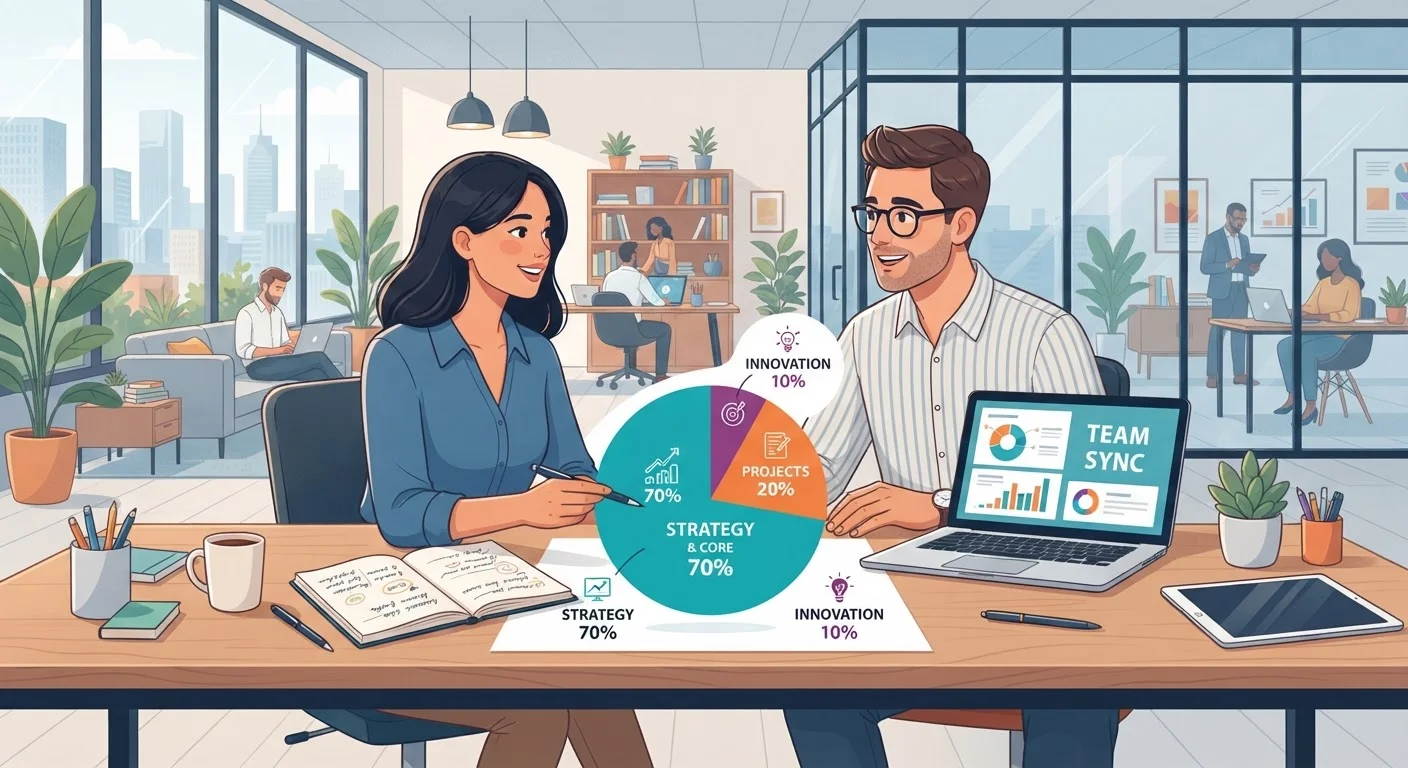
The framework that clarifies this trade-off is simple: relevance × depth ÷ time cost. Any learning investment - free or paid - should score well on all three dimensions before you commit. See how formal training fits into a broader development picture in our overview of the 70-20-10 learning model.
Before evaluating any pathway, answer two questions: What specific skill gap is holding back a concrete career outcome right now? And will a credential, a portfolio piece, or a new behavior change actually close that gap?
Your Employer May Already Fund This
Before purchasing any course or credential, check your employee benefits documentation for a learning stipend, tuition reimbursement policy, or access to a corporate learning platform. Many companies also allow employees to expense professional books, conference registrations, or industry memberships. These benefits are frequently unclaimed - particularly by early-career staff who assume they're only available to senior employees.
Free and Low-Cost Pathways: Pros and Cons
Public libraries, open courseware from universities, YouTube deep-dives, and community-run professional groups provide substantial learning at zero direct cost. Platforms offering free tiers often cover foundational and intermediate material that is genuinely employer-relevant in technical fields.
Free resources cover most foundational and intermediate skills
University open courseware, library databases, and practitioner-run YouTube channels provide rigorous content in many technical and business fields without any paywall.
Low financial risk encourages broader exploration
Trying a free introductory course before committing to a paid program reduces the chance of spending on content that turns out to be a poor fit for your learning style or career direction.
Employer stipends can make paid programs effectively free
Many organizations offer annual learning budgets or tuition reimbursement that employees underutilize - checking this before paying out-of-pocket is the highest-ROI first step.
Portfolio projects can substitute for credentials in many fields
In software development, design, and content strategy, a strong body of work often carries more hiring weight than a certificate - making self-directed, applied learning a cost-efficient path.
The limitations are real, though. Free content rarely offers structured feedback, peer accountability, or the kind of curated progression that moves a beginner to job-ready quickly. The habits that hold online learners back - passive consumption, skipped exercises, no accountability - are most common when there's no financial stake in the outcome.
Free content lacks structured feedback and accountability
Without an instructor, peer group, or financial stake, completion rates for free courses are substantially lower, and learners often plateau without knowing why.
Not all paid credentials carry market recognition
Certificates from lesser-known platforms may add clutter to a resume without influencing hiring decisions - market signal, not price, determines a credential's value.
Time cost of low-quality content is high
Lengthy courses padded with outdated or tangential material consume hours that could be spent on applied practice or mentorship, which often yield faster skill gains.
Credential accumulation can replace actual skill development
Collecting certificates without building demonstrable, applied competency is a common trap that looks productive on a profile but fails to impress in interviews or on the job.
Low-cost subscriptions (roughly $15-$50/month for broad course libraries) close some of these gaps by offering structured paths and completion tracking, but completion rates remain low industry-wide unless the learner pairs the content with a deliberate application project.
When Paid Credentials Actually Pay Off
Paid certificates and bootcamps are worth evaluating when three conditions are met: the credential is recognized by hiring managers or listed in job descriptions in your target role; the curriculum is current and taught by practitioners; and the cost is proportionate to the salary delta you're targeting.
94%
Employees who'd stay longer with learning investment
LinkedIn's 2023 Workplace Learning Report found 94% of employees said they would stay at a company longer if it invested in their career development.
~49%
Average MOOC completion rate
Research consistently shows that massive open online courses (MOOCs) see completion rates well below 50%, highlighting the accountability gap in free learning formats.
The clearest signal that a paid program is worthwhile is job posting language. If a certification appears repeatedly in the requirements or preferred qualifications of roles you want, it carries market signal. If it doesn't appear at all, it may carry more weight with you than with a recruiter.
For those weighing a more significant academic commitment, our checklist on when to pursue a postgraduate qualification is worth reviewing before spending on a degree program.
Also worth noting: many employers offer tuition reimbursement or learning stipends that go unclaimed. Check your benefits package before spending a dollar of personal income - this is the highest-ROI development budget available to most salaried professionals. If managing discretionary spending feels tight overall, the budgeting basics hub provides a useful foundation.
Building a Development Plan That Fits Your Budget
A practical budget allocation for early-career professionals might look like this: spend zero on content until you've exhausted free primary sources in your field; spend selectively on one credential that maps to your next role; spend consistently on books, paid communities, or mentorship where the feedback loop is direct.
Career stage matters here too. The skills worth investing in at entry level differ significantly from those at the senior level - see our full breakdown in career development from entry level to senior professional. Similarly, whether to build depth in one area or breadth across several is a strategic question covered in specialist vs. generalist career frameworks.
The single most effective development habit costs nothing: deliberate reflection after applying new knowledge. Writing a short summary of what you tried, what worked, and what you'd change next time creates durable learning that passive content consumption doesn't.