Why Parallel Parking Feels So Hard
Parallel parking triggers anxiety in drivers at every experience level - not because it's genuinely dangerous, but because it demands spatial reasoning in reverse, under time pressure, with other drivers watching. That social pressure distorts perception and turns a mechanical sequence into a mental obstacle.
The good news: parallel parking is almost entirely a procedural skill. Once you internalize a fixed set of reference points and a two-phase steering sequence, the maneuver becomes predictable regardless of the car you're driving. This guide breaks it down into exactly those repeatable steps.
If building overall situational awareness on the road is a priority, the principles of defensive driving apply directly here - anticipating the space you need before committing to a spot is the same cognitive habit.
What you will need
Setting Up the Maneuver: Choosing and Sizing the Space
Before any steering input happens, you need to assess whether the space is usable. A reliable rule of thumb: the gap should be at least 1.5 times the length of your vehicle. For a typical mid-size sedan, that means roughly 20-22 feet of open curb. Anything shorter requires an advanced level of vehicle control that most drivers won't need day-to-day.
Pull up alongside the car in front of the target space, positioning your vehicle parallel to it and about 2-3 feet away from its side. Align your rear bumper roughly with its rear bumper - this is your starting reference point. Signal your intention, check your mirrors, and check the blind spot over your right shoulder before shifting into reverse.
Rear-view and side mirrors
Monitor the positions of surrounding vehicles and the curb throughout the maneuver.
Parking sensors or rear camera
Provide supplemental distance feedback - useful but not a substitute for mirror checks.
Reference markers (cones or empty bottles)
Simulate parked cars during practice sessions in an empty lot.
The Two-Phase Steering Sequence
Parallel parking breaks into two distinct steering phases. Conflating them - or trying to do both simultaneously - is the most common source of error.
Align and signal
Pull alongside the car in front of the space, parallel and approximately 2-3 feet away. Match your rear bumpers. Apply your signal, check mirrors, and check your right blind spot. Shift into reverse.
Phase 1 - steer toward the curb
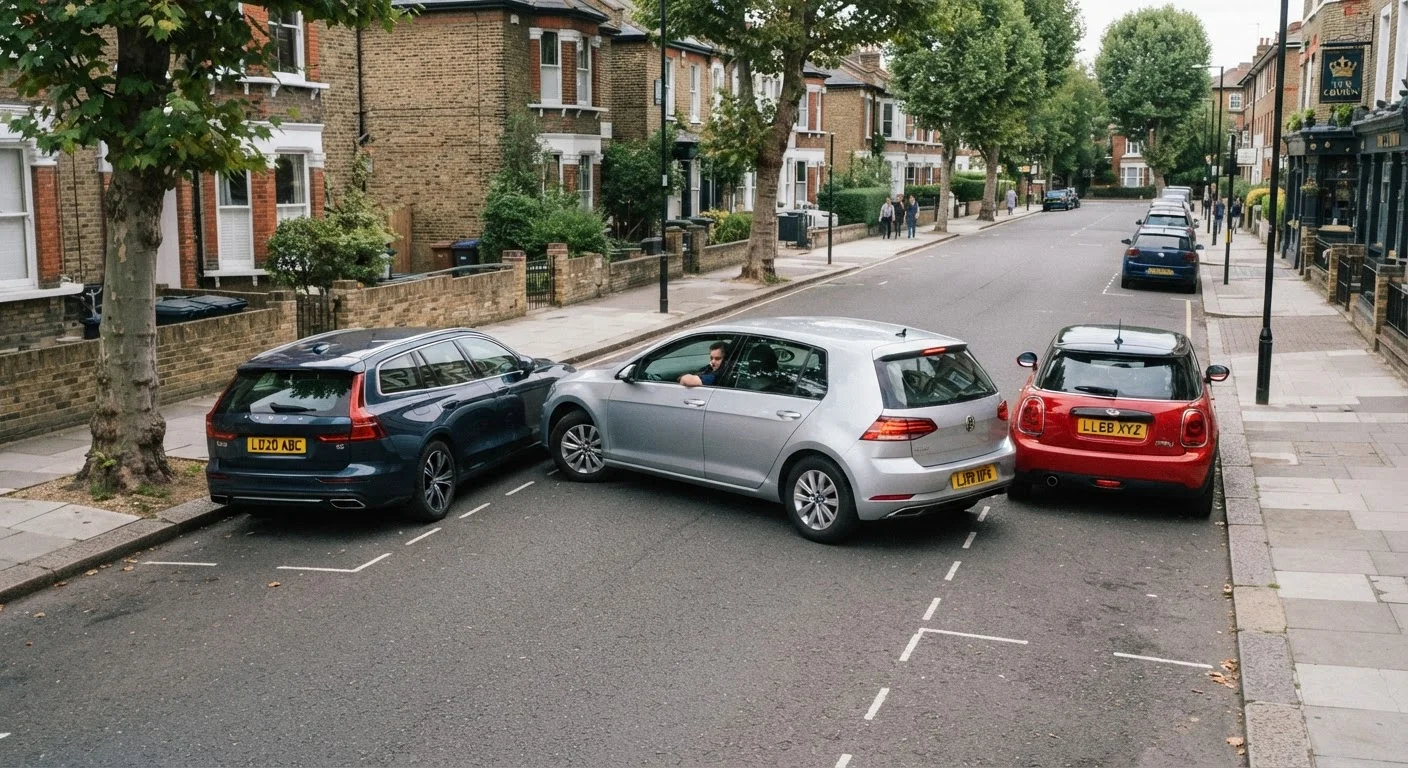
Begin reversing slowly. Turn the steering wheel toward the curb (right for right-side parking) approximately three-quarters of a full turn. Continue reversing until your car forms roughly a 45-degree angle with the curb. A useful reference: when you can see the rear car's full front end in your driver-side mirror, you've reached the turn point.
Phase 2 - steer away from the curb
Without stopping, smoothly counter-steer away from the curb (left for right-side parking). This swings the front of the car into the space and begins straightening your trajectory. Continue reversing until your car is roughly parallel with the curb - typically when you can see equal amounts of road ahead of and behind your vehicle in the mirrors.
Straighten and adjust
Straighten the wheel and ease back until you're centered in the space, leaving roughly equal gaps to the cars ahead and behind - aim for at least 12-18 inches on each end. If you've ended up at an angle or too far from the curb, pull forward with a small steering correction and re-reverse to straighten.
Secure the vehicle and exit safely
Apply the handbrake, shift to park (or first gear for a manual), and cancel your signal. Before opening your door, check the mirror and blind spot for cyclists and passing traffic. On a hill, turn your front wheels toward the curb when facing downhill, and away from it when facing uphill, to prevent roll.
Practice in an Empty Lot First
Before attempting parallel parking in a busy street, replicate the maneuver in an empty parking lot using cones or markers set 1.5 car-lengths apart. This lets you rehearse the reference points and steering sequence without the pressure of live traffic or waiting drivers. Ten focused repetitions in a controlled environment transfer directly to real-world confidence.
Common Errors and How to Correct Them
Even when the sequence is understood, two problems appear most often in practice:
- Ending up too far from the curb: Usually caused by straightening the wheel too early in Phase 2, or by starting Phase 1 before the rear of your car has cleared the front car's bumper. Pull out slightly and re-enter.
- Cutting into the front car: This happens when Phase 1 begins too soon - before rear bumper alignment is established. The fix is to delay the first steering input until your reference point is correct.
If you're ever uncertain mid-maneuver, stop, pull forward to reset, and start again. There's no rule requiring you to complete a park in one uninterrupted arc. Pulling forward and adjusting is entirely normal and preferable to forcing the car into a tight spot. For related spatial challenges on high-speed roads, the guide to motorway driving for the first time covers how lane positioning and vehicle awareness translate at speed.
Don't Rely Solely on Parking Sensors
Parking sensors and rear cameras are useful tools, but they have detection limits and can miss low obstacles, cyclists, or unusual curb heights. Always cross-reference sensor feedback with direct mirror checks. Developing mirror-based spatial awareness makes you a more capable driver in any vehicle, including rentals or older models without assisted parking technology.