
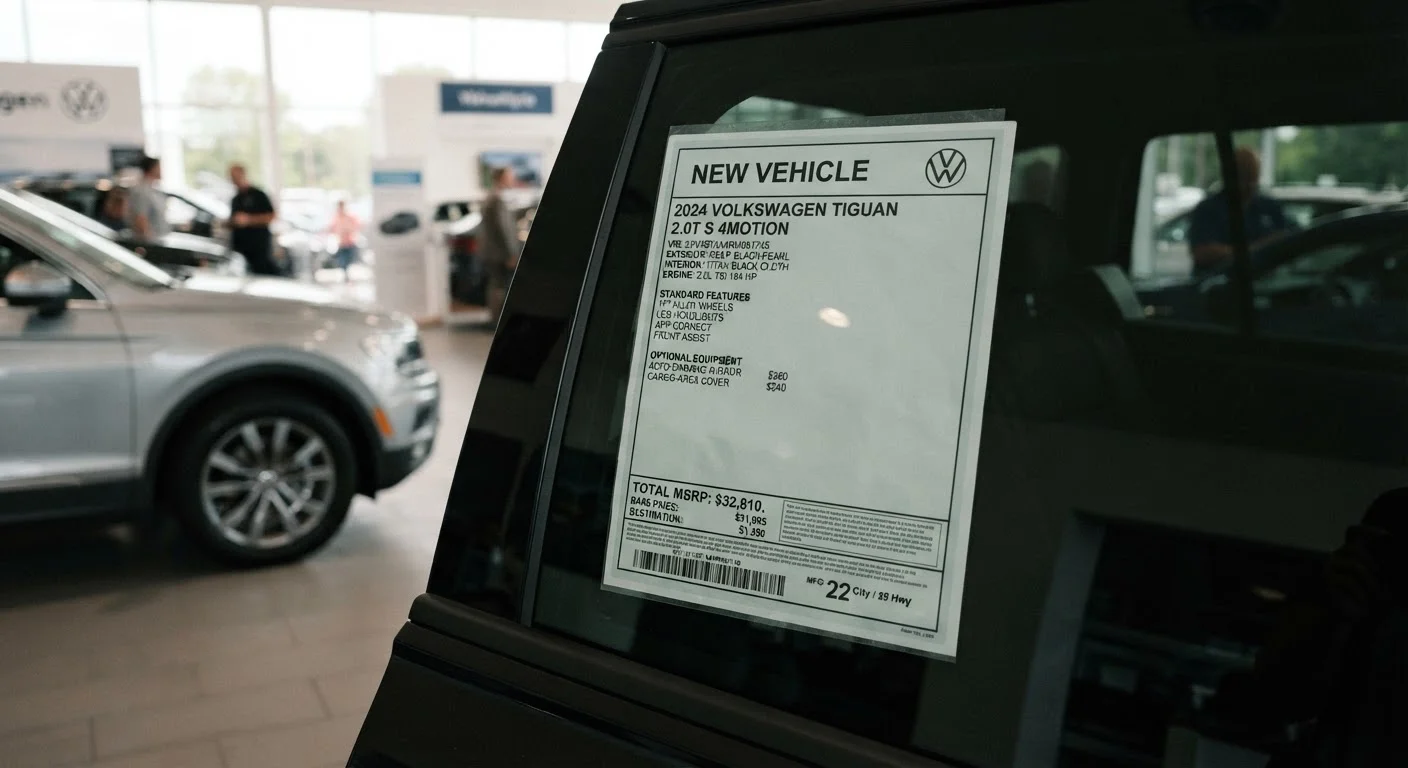
What Is a Monroney Sticker?
The window sticker you see on every new car at a dealership has an official name: the Monroney label, named after the federal legislation - the Automobile Information Disclosure Act of 1958 - that made it mandatory. Dealers are legally required to display it, and only the buyer can remove it. Its purpose is straightforward: give shoppers a standardized, comparable snapshot of what they're actually buying and what it costs before any negotiation begins.
Understanding each line item prevents dealers from burying charges in a number you assumed was the car's base price. Here's what every section means.
| Legal name | Monroney Label (Automobile Information Disclosure Act, 1958) |
| Who sets destination charges | The manufacturer - not the dealer |
| Fuel economy figures set by | U.S. Environmental Protection Agency (EPA) |
| Dealer add-ons appear on | A separate addendum sticker, not the Monroney |
| Who can remove the sticker | Only the buyer - removal by the dealer is a federal violation (Automobile Information Disclosure Act) |
Line by Line: What Every Number Means
Base MSRP
The Manufacturer's Suggested Retail Price (MSRP) is the automaker's recommended selling price for the vehicle in its standard trim level, without options. The word "suggested" matters - it's a starting point, not a fixed rule. Dealers can and do sell above or below this figure depending on demand and inventory. See our guide to car negotiation myths for context on how that plays out in practice.
Optional Equipment & Packages
Below the base MSRP, the sticker lists any factory-installed options added to that specific vehicle - things like a sunroof, upgraded audio, or a towing package. Each item carries its own price, and they add to your total. These are manufacturer options, distinct from dealer add-ons (covered below).
Destination & Delivery Charge
This is the fixed fee the automaker charges to transport the vehicle from the factory to the dealership. It's set by the manufacturer, not the dealer, and is non-negotiable. It applies to every buyer of that model, regardless of how close the dealership is to the assembly plant.
Total MSRP
This is the sum of the base MSRP, all options, and the destination charge. It's the number the sticker presents as the vehicle's full price before dealer markups or discounts enter the picture.
Fuel Economy Estimates
EPA fuel economy figures - city, highway, and combined mpg - appear prominently on the sticker. These estimates are generated under controlled test conditions and represent an average; real-world results vary based on driving habits, climate, and load. The sticker also includes an estimated annual fuel cost, calculated using a standardized price-per-gallon assumption, which changes periodically.
Safety Ratings
If the vehicle has been rated, NHTSA (National Highway Traffic Safety Administration) or IIHS (Insurance Institute for Highway Safety) scores may appear. A five-star NHTSA overall rating indicates strong crash-test performance, though it's worth checking the subcategory scores - frontal, side, and rollover - individually.
Safety Ratings Come from Two Sources
NHTSA and IIHS use different testing methodologies, so a vehicle can score differently between them. NHTSA uses a five-star system; IIHS uses ratings like Good, Acceptable, Marginal, and Poor across multiple crash scenarios. Checking both provides a more complete picture of a vehicle's safety performance.
Dealer-Installed Accessories & Add-Ons
Watch for a second sticker - sometimes called an addendum sticker - placed next to or over the Monroney. This lists items the dealer added after the car arrived: paint sealant, nitrogen-filled tires, wheel locks, window tinting. Unlike factory options, these are frequently negotiable or removable from the deal, even if they've already been installed. Never assume these charges are mandatory. For more on financing the total purchase price, see car finance terminology explained.
Using the Sticker as a Negotiation Tool
The Monroney sticker is a reference document, not an invoice. The dealer's actual cost - what they paid the manufacturer - is reflected in the invoice price, which is separate and not printed on the sticker. The gap between invoice and MSRP is one lever in any price discussion.
When comparing vehicles across dealerships, always use the sticker's total MSRP as your baseline, and note which options are factory-installed versus dealer-added. Two cars that look identically priced at the lot can have very different actual values based on that distinction. If you're also weighing what your current vehicle is worth, our piece on trade-in valuation differences explains why offers vary so widely.
MSRP
Manufacturer's Suggested Retail Price - the automaker's recommended selling price for a vehicle. It is a suggestion, not a fixed requirement, and dealers may sell above or below it.
Destination charge
A fixed fee set by the manufacturer to cover shipping the vehicle from the factory to the dealership. It is the same for all buyers of that model and is non-negotiable.
Invoice price
The price the dealer paid the manufacturer for the vehicle. It is typically lower than MSRP and is not shown on the Monroney sticker, though it can often be researched independently.
Addendum sticker
A secondary sticker placed by the dealer listing items added after the car arrived at the lot. These charges are often negotiable, unlike factory-installed options.
EPA fuel economy estimate
Standardized miles-per-gallon figures produced by the Environmental Protection Agency under controlled test conditions. Real-world results typically differ based on driving style and conditions.
Monroney label
The federally mandated window sticker required on all new cars sold in the United States, providing standardized pricing, features, fuel economy, and safety information.