
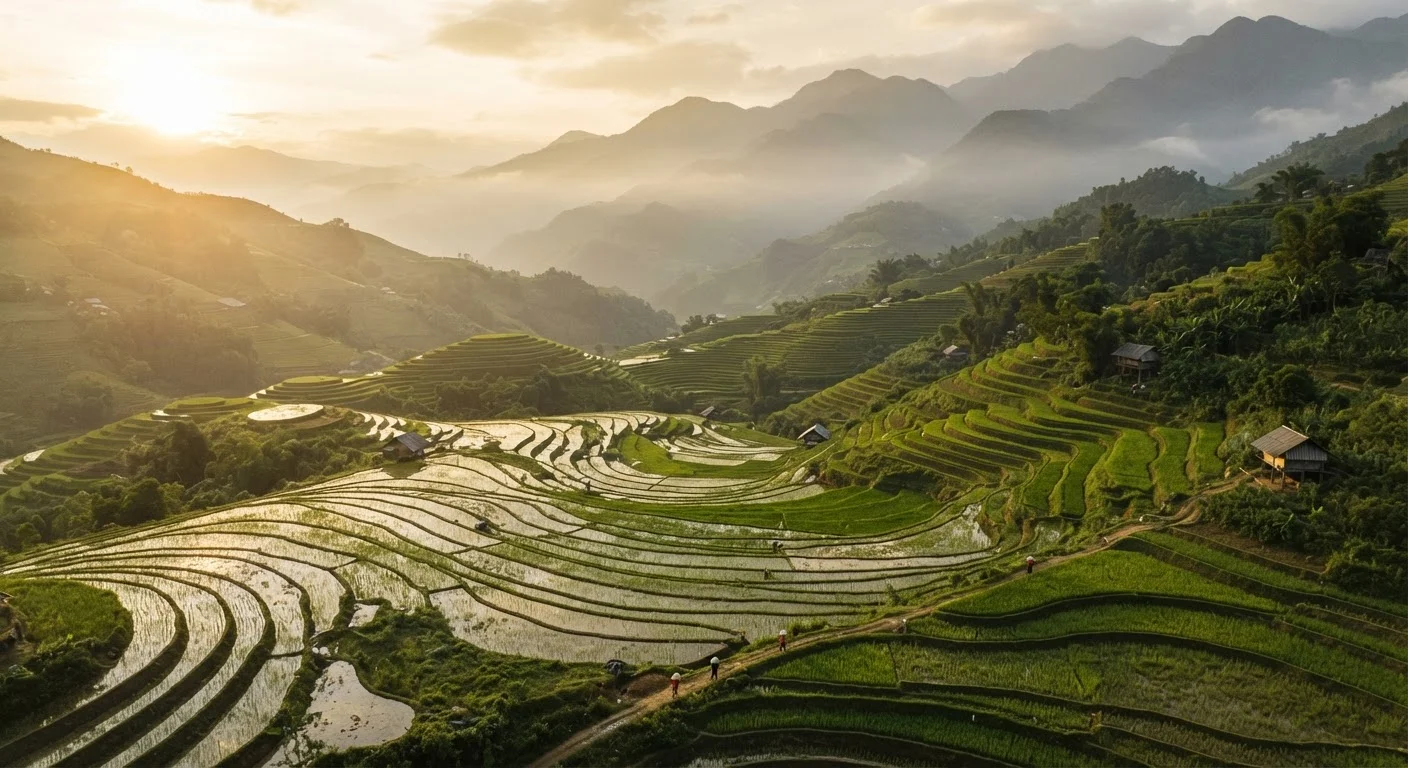
The North: Tradition, Terrain, and Cooler Temperatures
Northern Vietnam - anchored by Hanoi and stretching up through Sapa and Ha Giang - is where the country's cultural and political identity runs deepest. The landscape is defined by dramatic karst mountains, terraced rice fields, and the Red River Delta. This is Vietnam's historical core, home to imperial history and the largest concentration of ethnic minority groups outside the cities.
The climate is the most variable in the country. Hanoi has four distinct seasons - including a genuine, sometimes chilly winter from December through February. Pack a layer if you're visiting outside of April through October.
Northern cuisine reflects the region's restraint and tradition. Pho here is a simpler, cleaner dish - precise broth, minimal toppings. Bun cha (grilled pork with noodles and dipping broth) and cha ca (turmeric fish with dill) are distinctly Northern and worth seeking out. Flavors lean savory and less sweet than the South.
| Total length (north to south) | ~1,650 km (1,025 miles) (General geographic reference) |
| Official regions | 3 - North, Central, South (Vietnamese government administrative classification) |
| North's major city | Hanoi |
| Central's major city | Da Nang (gateway to Hoi An and Hue) |
| South's major city | Ho Chi Minh City (Saigon) |
| Best time to visit all three regions | No single window - seasons are staggered (Vietnam National Administration of Tourism general guidance) |
Central Vietnam: History, Heat, and the Country's Spiciest Food
Central Vietnam is the country's narrowest and most historically layered region. Hue served as the imperial capital under the Nguyen dynasty, and its walled citadel, royal tombs, and elaborate cuisine all reflect centuries of court culture. Hoi An, just south, is one of Southeast Asia's best-preserved ancient trading ports - compact, walkable, and genuinely worth multiple days.
The weather here is the most unpredictable. Da Nang and Hoi An can be sweltering and sunny from May through August, but central Vietnam absorbs the brunt of typhoon season from September through December. Plan accordingly - or consider this region as a shoulder-season destination in February or March.
Central Vietnamese food is widely regarded as the most complex in the country. Hue's royal cuisine tradition produced small, intensely flavored dishes, and the region's cooking is noticeably spicier than either north or south. Banh mi got its foothold here before spreading nationwide. Cao lau - a noodle dish unique to Hoi An - is something you won't find prepared authentically anywhere else.
Verify Entry Requirements Before You Go
Visa rules, health requirements, and travel advisories for Vietnam can change. Always confirm current entry conditions through official government sources - your home country's foreign affairs website and Vietnam's official immigration portal - before booking or departing.
The South: Commerce, Warmth, and a More Open Table
Southern Vietnam operates at a different pace - faster economically, more relaxed culturally, and uniformly hot year-round. Ho Chi Minh City (still widely called Saigon) is the country's commercial engine and feels categorically different from Hanoi: younger, louder, more international. The Mekong Delta spreads south and west, a flat, river-threaded landscape built around rice, fruit, and floating markets.
The climate is essentially binary: wet season (May-November) and dry season (December-April). Unlike the north, there's no cold weather to plan around - but the wet season brings daily afternoon downpours that are usually short-lived and manageable.
Southern cuisine is the most accessible to international palates - sweeter, herb-heavy, and generously garnished. Southern pho comes loaded with bean sprouts, fresh basil, and sauces on the side. Street food culture here is relentless and diverse, reflecting the region's history as a trading hub with Chinese, Khmer, and French influences all present in the food.
54
Recognized ethnic groups in Vietnam
According to the Vietnamese government, the Kinh majority coexists with 53 other ethnic groups, heavily concentrated in the northern highlands.
~3,260 km
Length of Vietnam's coastline
Vietnam's extended coastline means coastal climate, cuisine, and culture vary significantly by latitude.
Planning Across All Three: What You Actually Need to Know
The practical implication of Vietnam's regional variation is this: a single trip itinerary that moves north to south (or reverse) requires real seasonal planning - you can't optimize every region's weather simultaneously. A rough heuristic: the north is most pleasant February-April and September-November; central Vietnam shines February-August; the south is driest December-April.
Culturally, the differences are real but not jarring. Vietnamese is spoken nationwide, the currency (dong) is universal, and the infrastructure for visitors has improved significantly across all three regions. That said, pace and social norms do shift - Hanoi is more formal, Ho Chi Minh City moves faster and more entrepreneurially, and smaller central towns like Hoi An operate on a gentler rhythm that many travelers find the easiest to settle into.
If your time is limited to one region, match the region to your purpose: Hanoi and the north for history and trekking; central Vietnam for culture, cuisine, and beach access; the south for urban energy and river delta landscapes. Each region is genuinely distinct - this isn't a case where any one stop gives you the whole picture.
Banh mi
A Vietnamese sandwich served on a French baguette with a variety of fillings. The Southern version tends to be more loaded with fresh herbs and pickled vegetables than its Northern counterpart.
Pho
A Vietnamese noodle soup made with broth, rice noodles, and meat - typically beef or chicken. Northern pho is plainer and more broth-forward; Southern pho is sweeter and served with more toppings.
Ao dai
Vietnam's traditional long tunic worn over trousers, considered the national dress. Its styling and prominence in daily life vary noticeably by region.
Monsoon season
A seasonal shift in wind patterns that brings heavy rainfall to a region. Vietnam's three regions experience their monsoon seasons at different times of year, making national trip timing complex.