
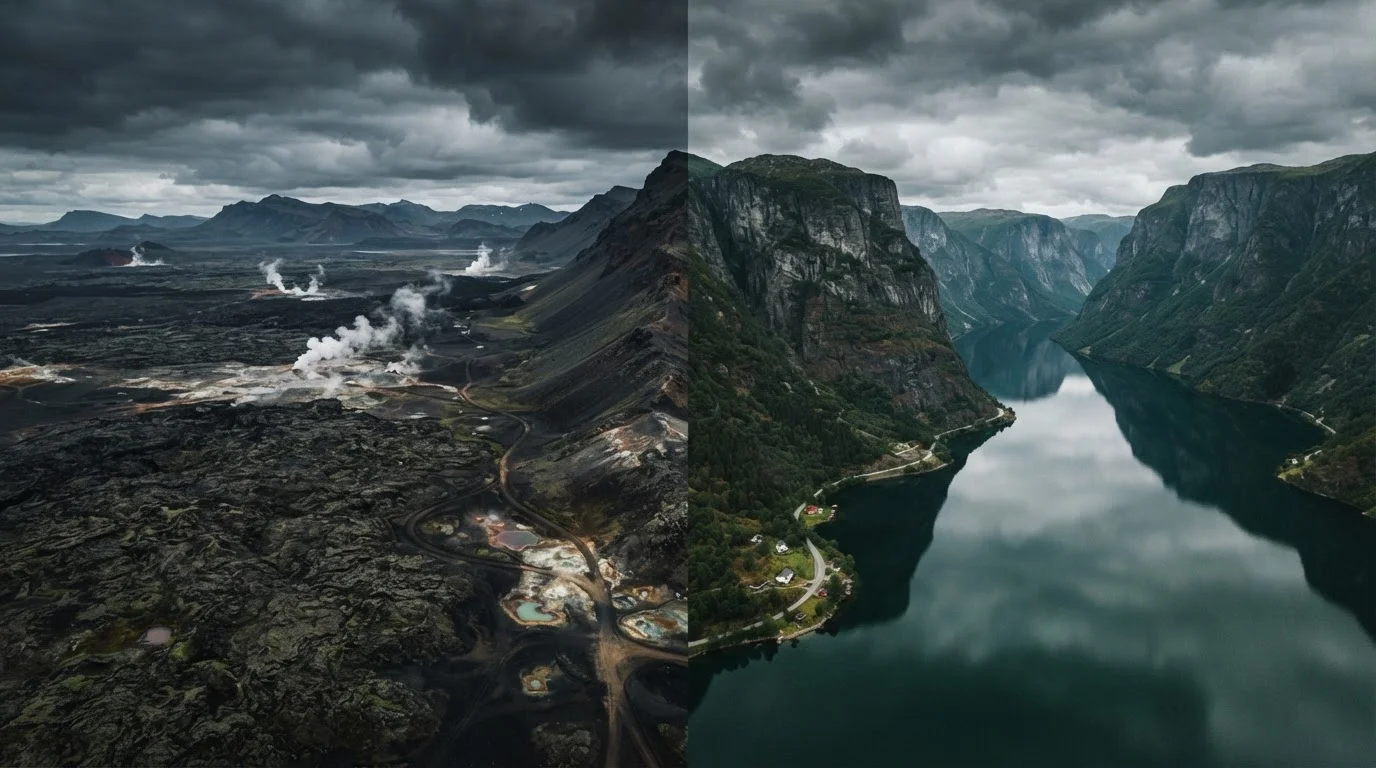
The Core Difference: Volcanic Island vs. Fjord-Carved Mainland
Iceland and Norway are often mentioned in the same breath - dramatic landscapes, northern lights, expensive beer - but they deliver fundamentally different travel experiences. Iceland is compact and volcanic, a 40,000-square-mile island where geothermal activity shapes everything from the terrain to the heating systems. Norway is a long, fjord-indented country stretching from southern Scandinavia to above the Arctic Circle, with a land area roughly nine times larger and a regional diversity that rewards extended exploration.
That difference in scale is the most practical factor for trip planning. In Iceland, the famous Ring Road (Route 1) circles the entire island at roughly 830 miles - a logical, manageable framework for a 10-day self-drive. Norway has no equivalent shortcut. Planning a Norwegian itinerary means choosing regions deliberately: the western fjords, the Lofoten Islands, the Arctic north, and the cities each require separate routing decisions.
| Criterion | Iceland | Norway |
|---|---|---|
| Land area | ~40,000 sq miles | ~148,000 sq miles |
| Self-drive logistics | Ring Road loop, straightforward | Regional planning required |
| Relative food costs | Very high | High, but more variation |
| Hiking infrastructure | Good, especially in south | Extensive, well-maintained |
| Northern lights access | Nationwide, Sep-Mar | Best above Arctic Circle |
| Ideal trip length | 7-10 days | 10-14+ days |
| Unique landscape feature | Active volcanoes, geothermal | Fjords, coastal islands |
| Winter road access | F-roads closed seasonally | Most routes open year-round |
Cost and Logistics: Both Are Expensive, But Differently
Both countries sit at the higher end of the global travel cost spectrum, but Iceland consistently ranks among the most expensive destinations worldwide for accommodation, dining, and car rental. Reykjavik's restaurant scene has matured significantly, but a sit-down dinner for two can easily exceed $100 before drinks. Outside the capital, food options thin out - many travelers rely on supermarket staples and guesthouses with self-catering kitchens to manage costs.
Norway is also expensive, particularly in Oslo and Bergen. However, travelers who move through smaller towns and rural areas - especially in northern Norway - often find that costs moderate. The Norwegian supermarket network is reliable and widespread, making self-catering a practical strategy. Ferry crossings between fjord towns add cost but are generally well-organized and scenic in their own right.
~$350
Average daily travel spend in Iceland
Iceland consistently ranks among the world's most expensive destinations; budget travelers report daily costs of $200-$350+ excluding flights.
830 miles
Length of Iceland's Ring Road
Route 1 circles the entire island and passes near most of Iceland's major natural attractions, making it the default self-drive itinerary.
1,190+
Fjords in Norway
Norway's coastline is indented by over a thousand fjords, contributing to a coastline length - including islands - estimated at over 50,000 miles.
Rental car logistics differ meaningfully. In Iceland, a 4WD vehicle is strongly advisable if you plan to access highland roads (F-roads), which are only open in summer. In Norway, standard vehicles handle most tourist routes year-round, with winter tires required in cold months - a requirement enforced, not optional.
Seasonal Strategy: When You Go Changes Everything
Both destinations have genuine appeal across all seasons, but the experience shifts dramatically. Iceland in June and July offers near-continuous daylight - the midnight sun means you can hike at 11 p.m. - but that same period draws peak tourist volumes and peak prices. Winter visits (November through February) bring the northern lights and snow-covered landscapes, but shorter daylight hours and potentially closed highland roads require adjusted expectations.
Norway's season calculus is more regionally specific. The fjord region is most accessible and visually dramatic from May through September. Lofoten, paradoxically, has a devoted winter following: the combination of snow, dramatic peaks, and aurora activity creates a visual intensity that summer's green palette can't replicate. Tromsø in northern Norway is purpose-built for winter aurora tourism and functions well as a base regardless of conditions.
Verify Entry and Travel Requirements Before You Book
Entry requirements, visa rules, and any travel advisories for both Iceland and Norway can change. Iceland is part of the Schengen Area; Norway is not an EU member but participates in the Schengen Agreement. US passport holders should verify current requirements through the U.S. Department of State and each country's official immigration authority before travel.
One honest caveat for both destinations: northern lights are never guaranteed. They depend on solar activity, cloud cover, and light pollution - factors beyond anyone's control. Both Iceland and Norway provide good geographic positioning for aurora viewing, but chasing them requires flexibility in your schedule.
Which One Should You Book?
For a time-pressed professional taking a first trip to the Nordic region, Iceland's efficiency is hard to beat. The self-drive loop, the density of geological spectacle, and the straightforward English-language infrastructure make it a high-reward destination with relatively low planning overhead. If you have 10 days and want a single coherent experience, Iceland delivers it cleanly.
Norway rewards travelers who are willing to invest more time and planning effort. It offers more variety, a stronger hiking culture, and - outside Oslo - a travel pace that feels less dominated by mass tourism infrastructure. If you're planning two weeks or more, or returning to the Nordic region for a second trip, Norway has more layers to unpack.
Neither is a compromise. They're just answers to different questions about how you want to spend your time outdoors.