Why Work Style Shapes - But Doesn't Determine - Productivity
The fundamentals of productive work - focused attention, intentional scheduling, and recovery time - don't change depending on where you open your laptop. What changes is the friction around applying them. Your environment determines which habits come naturally and which require deliberate effort to sustain.
Research in cognitive psychology consistently shows that context cues shape behavior. The physical space you're in, the social signals around you, and the boundaries (or lack thereof) between roles all influence how easily your brain shifts into focused work mode. Understanding these forces lets you design routines that work with your setting rather than against it.
If your current habits feel like a constant upstream battle, it may be less about willpower and more about a mismatch between your routines and your environment. Use this comparison as a diagnostic tool - and check out the Productivity Habit Audit to evaluate whether your existing setup is helping or quietly draining you.
Comparing Key Habits Across Remote, Hybrid, and Office Settings
The table below maps five core productivity habits against each work setting, highlighting where each style creates natural support - and where it introduces friction.
| Habit | Remote | Hybrid | Office | |
|---|---|---|---|---|
| Time-blocking | High autonomy; easy to implement | Requires pre-planning by location | Disrupted by meetings and drop-ins | |
| Deep focus windows | Achievable; self-enforced | Best done on home days | Hard without calendar protection | |
| Work-life boundaries | Weakest; must be built deliberately | Moderate; switching helps signal shift | Strongest; commute acts as buffer | |
| Movement & breaks | Requires intentional scheduling | Varies by location that day | Easier with ambient social cues | |
| Social accountability | Low; must create externally | Mixed; present on office days | High; naturally embedded |
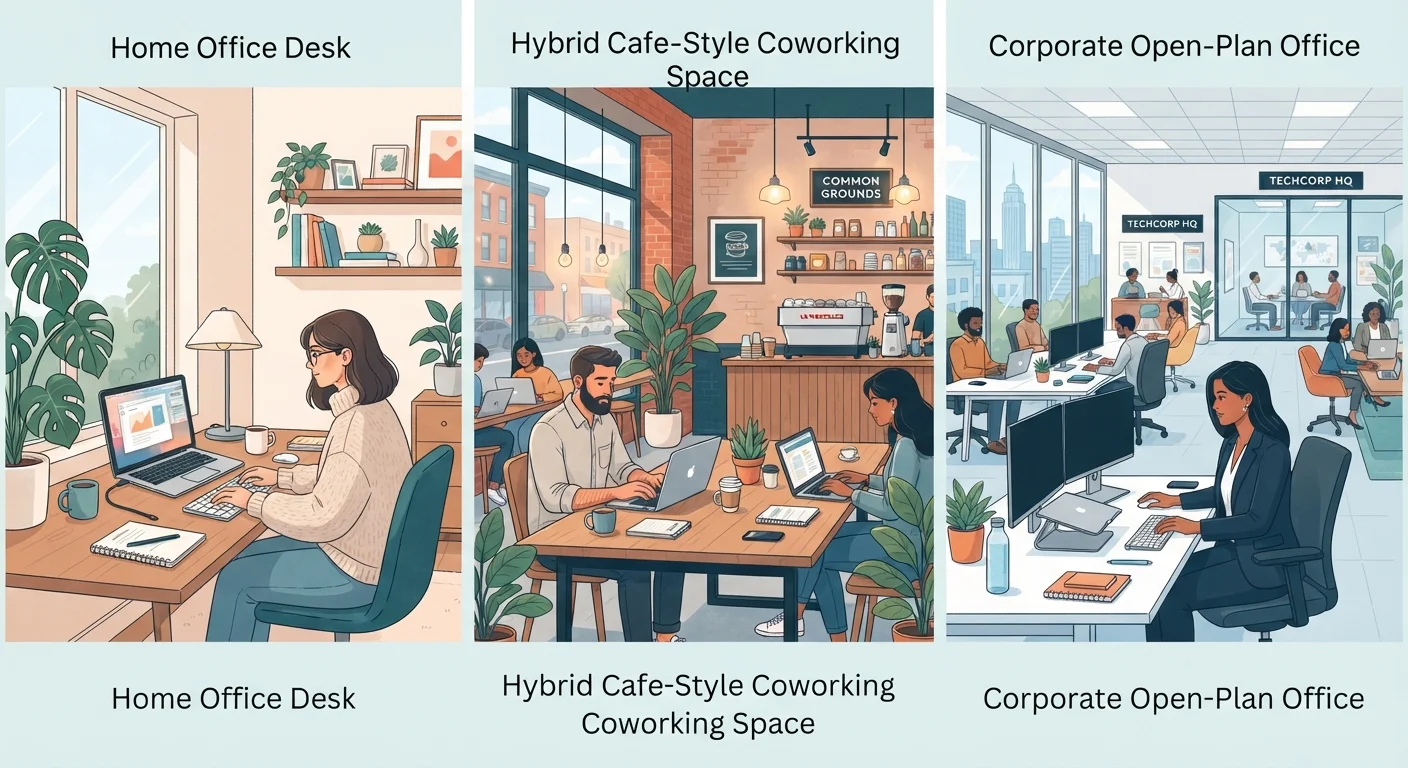
A few patterns stand out immediately. Remote workers have maximum schedule flexibility but must manufacture the structure that office environments provide automatically. Hybrid workers get the best of both worlds on paper, but the cognitive cost of switching between environments is often underestimated. Office workers benefit from ambient accountability but frequently struggle to carve out the uninterrupted blocks that deep work requires.
Routines That Work: Environment-Specific Strategies
Remote
The biggest risk in remote work isn't distraction - it's boundary erosion. Without a physical commute acting as a psychological transition, work and rest blur together. Two habits anchor remote productivity above all others: a consistent start ritual (a short walk, a dedicated workspace, a set login time) and a hard shutdown routine that signals the end of the workday. These create the psychological bookends your environment won't supply on its own.
Also critical: protecting your workspace from visual clutter. The cognitive science behind tidy spaces confirms that organized environments reduce mental load - a significant edge when your office is also your living space.
Use a 'Shutdown Phrase' to End the Remote Workday
Behavioral research suggests that brief rituals help the brain shift out of task-focused mode. Try writing a two-sentence end-of-day note summarizing what you finished and your top priority for tomorrow, then physically close your laptop. This small routine acts as a psychological transition that a commute would otherwise provide. Consistency matters more than the specific ritual you choose.
Hybrid
Hybrid workers need routines that travel. Rather than building habits tied to a specific location, anchor them to actions: opening a specific app signals deep-focus time; putting on headphones signals no-interruption mode. These portable cues work whether you're at home or in the office. The key planning discipline here is deciding before the week starts which type of work belongs to which setting - deep focus at home, collaboration and meetings in office.
Office
Open-plan environments are built for collaboration, not concentration. Office-based professionals often need to actively reclaim focus time - using calendar blocking, early-morning arrival before the floor fills up, or designated quiet hours. Movement habits are also easier to build here: structured movement habits like walking to a colleague's desk or taking the stairs are low-effort wins that remote workers have to engineer deliberately.
Building a Routine You Can Actually Sustain
Sustainable productivity is less about optimizing every hour and more about reducing the daily decisions that drain cognitive energy. Across all three work styles, the highest-leverage move is the same: decide your system once, then run it on autopilot.
Start by identifying the two or three habits that matter most in your specific setting - focus protection, energy management, or clear work-life transitions - and design those first. Add complexity only after the core is solid. Reviewing and refining those routines periodically is equally important; see the Career Growth hub for frameworks that support long-term professional development alongside day-to-day productivity.
Don't Copy Routines Designed for a Different Setting
Productivity advice online is heavily skewed toward either fully remote or traditional office contexts. Applying remote-worker time-blocking advice to a hybrid schedule - or office-centric accountability tactics to a solo home setup - often backfires. Always filter recommendations through the lens of your actual work environment before adopting them.
Finally, resist benchmarking your output against colleagues in a different work style. A remote worker and an office worker doing the same role face structurally different challenges. The goal isn't to replicate someone else's routine - it's to build one that fits the environment you're actually in.