
Why Your Note-Taking Method Matters
Most professionals learned to take notes by imitation - copying whatever the teacher wrote on the board. That default approach rarely accounts for how memory actually works. Research in cognitive science consistently shows that how you record information affects how deeply you process it, not just how legible your notes look later.
The four methods compared here - Cornell, Outline, Mind Map, and Sentence - represent meaningfully different cognitive strategies. Understanding their trade-offs helps you stop defaulting and start choosing. If you suspect your current approach may already be working against you, see signs your study habits are undermining retention before going deeper here.
| Cornell | Outline | Mind Map | Sentence | |
|---|---|---|---|---|
| Capture speed | Moderate | Fast | Slow | Fastest |
| Works for unstructured content | Moderate | Poor | Good | Best |
| Built-in review mechanism | Yes - cue column | No | Partial | No |
| Supports retrieval practice | Strong | Weak | Moderate | Weak |
| Cognitive load during capture | Moderate | Low | High | Lowest |
| Suits visual/relational thinking | Low | Low | High | Low |
| Best review format post-session | Self-testing | Scanning | Re-drawing | Restructuring |
Cornell Method: Built-In Retrieval Practice
Developed at Cornell University in the 1950s, this method divides a page into three zones: a narrow left column for cue questions, a wide right column for notes, and a summary box at the bottom. The design isn't aesthetic - it's functional. After a session, you cover the right column and use the cues to test yourself, which creates a built-in retrieval practice loop.
Retrieval practice - the act of recalling information rather than re-reading it - is one of the most robust findings in memory research. Studies on the "testing effect" suggest that self-testing after learning substantially outperforms passive review for long-term retention. The Cornell format makes this almost automatic.
Best for: Structured courses, certification prep, and any context where recall matters. It requires slightly more setup time but pays back during review. Less suited for fast-moving, unstructured environments.
Make the Cue Column Work Harder
When using the Cornell Method, write your cue questions immediately after the session - not days later. The act of formulating a question from your own notes is itself a recall exercise. Aim for questions that require explanation, not just single-word answers, to maximize the depth of processing during self-testing.
Outline Method: Speed and Hierarchy
The Outline Method organizes information into a hierarchy of main points, sub-points, and details using indentation. It's the closest to how most people already take notes, but done deliberately it can be powerful for content that has a clear structure - like a project debrief, a textbook chapter, or a well-organized talk.
Its main advantage is speed. Because you're mirroring an existing structure rather than imposing one, you can keep pace with a speaker more easily. The limitation is that it reinforces the source's organization rather than your own understanding. If the lecture is disorganized, your outline will be too.
Best for: Structured presentations, hierarchical material, and when you need to build a reference document quickly. Pair with a post-session review pass to add your own synthesis.
Mind Mapping: Connections Over Sequence
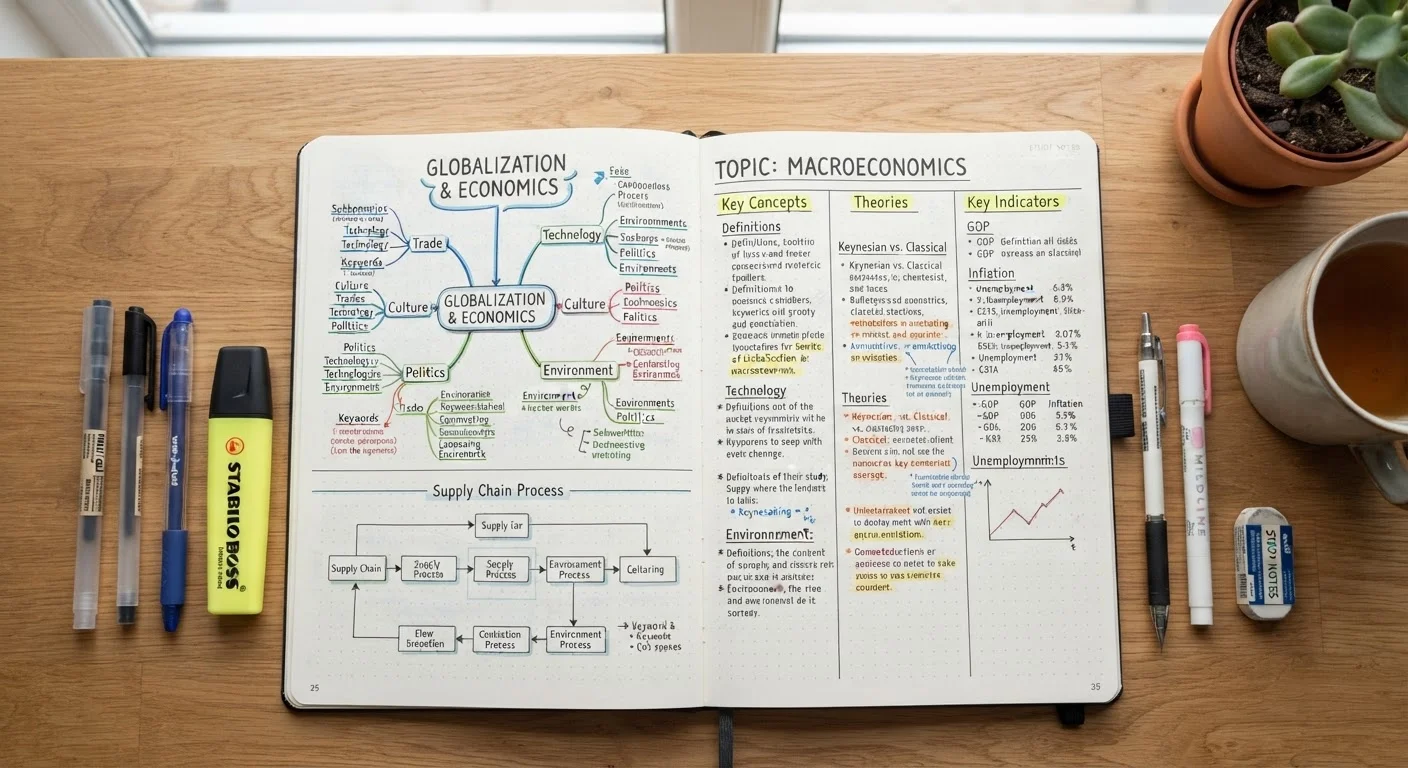
Mind mapping places a central concept at the center of the page and branches outward into related ideas, sub-topics, and connections. Unlike linear methods, it mirrors associative thinking - the way ideas actually link in memory rather than how they appear on a slide deck.
This makes mind mapping particularly effective for brainstorming, planning projects, or making sense of complex systems where relationships between ideas matter as much as the ideas themselves. However, it demands more cognitive overhead during capture: you need to decide where each new idea belongs in real time.
Best for: Conceptual learning, creative work, strategic planning, and synthesizing content after an initial notes pass. Less practical when information is dense and sequential.
For professionals who use writing as a thinking tool more broadly, structured journaling formats can complement mind mapping for reflection and synthesis.
Sentence Method: Fast Capture, Slower Review
The Sentence Method is the simplest approach: write each new thought or piece of information as a separate, numbered sentence. No hierarchy, no structure, no visual organization - just sequential capture. It keeps pace well in fast, unpredictable environments where you can't organize on the fly.
The cost is paid at review time. Sentence notes have no built-in retrieval cues, no visual hierarchy to aid scanning, and no summary layer. Without a deliberate post-session restructuring step, they often function as a transcript rather than a learning tool.
Best for: A fallback method when content is rapid or unpredictable. To get more out of it, convert your sentence notes into a Cornell or Outline format within 24 hours while the material is still fresh.
Choosing the right method starts before you sit down to learn. A pre-learning checklist can help you assess the material format and set the right capture strategy in advance.
~50%
Forgetting within 24 hours without review
The 'forgetting curve,' described by Hermann Ebbinghaus in the 19th century, suggests roughly half of new information is lost within a day without any review activity.
~1.5x
Retention advantage of retrieval practice over re-reading
A meta-analysis published in Psychological Science in the Public Interest found retrieval practice produced substantially better long-term retention than passive review strategies like re-reading.
How to Choose in Practice
Matching method to context is a learnable habit. Before any learning session, ask two questions: How structured is the source material? And what will I need to do with this information later?
- Structured content + future recall needed: Cornell
- Structured content + reference document needed: Outline
- Conceptual or relational content: Mind Map
- Fast, unpredictable content: Sentence, then convert later
Many skilled learners combine methods - using an outline during capture, then converting key sections into a Cornell layout for review. The goal isn't methodological purity; it's reducing the gap between writing something down and actually understanding it.
If you're also thinking about how to structure your learning time, not just your notes, comparing time blocking with task lists is a useful adjacent skill to develop alongside your note-taking practice.