Why Nighttime Is When the Brain Turns on Itself
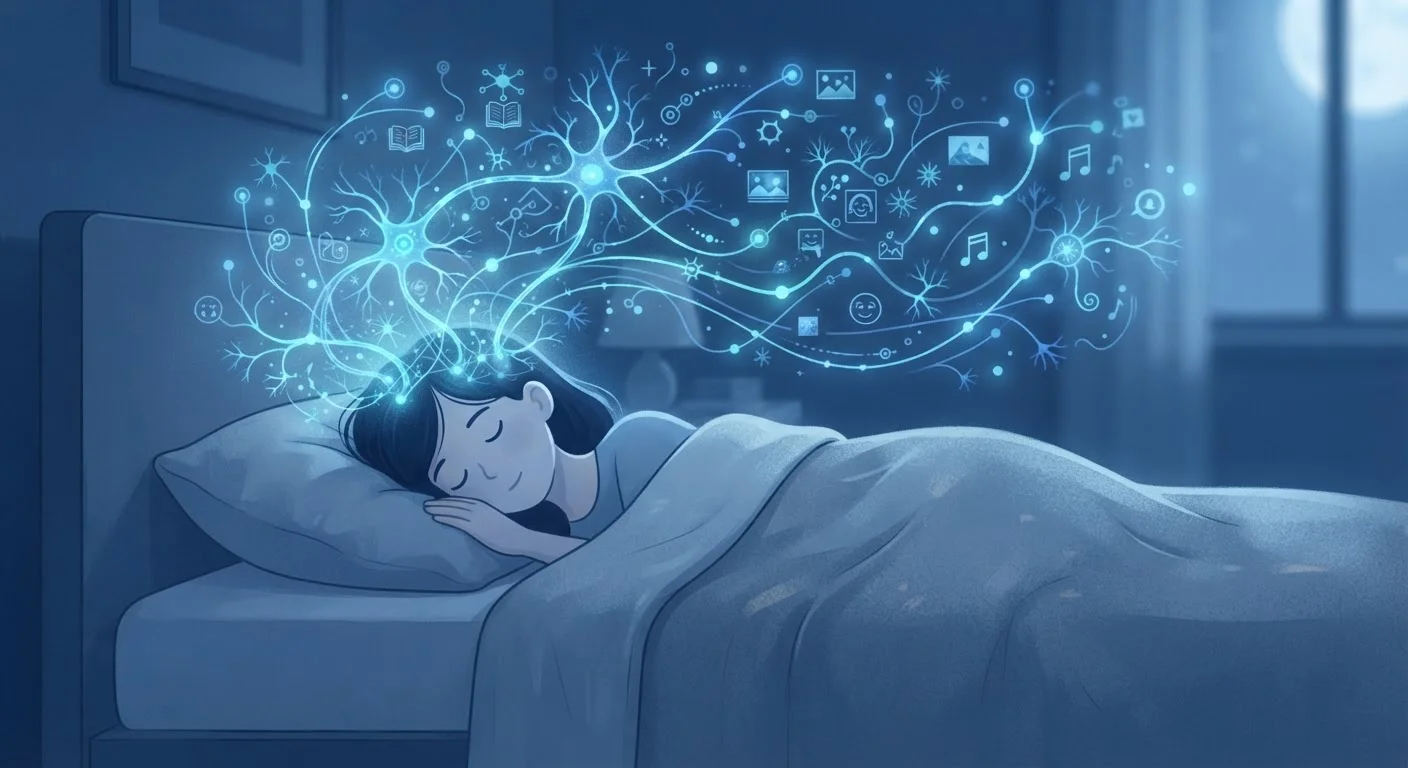
During the day, your attention is pulled outward - meetings, tasks, conversations. That external load keeps your brain's default mode network (DMN) - a set of interconnected regions associated with self-referential thinking and mental simulation - relatively suppressed. When the lights go off and the stimulation stops, the DMN becomes dominant. For many people, that shift is when worst-case scenarios begin to feel urgent.
This isn't a design flaw. The brain's threat-detection systems evolved to use downtime for scanning unresolved problems. In a modern context, those "threats" are often professional anxieties, relationship worries, or tomorrow's calendar. Because memory consolidation is also active during the transition to sleep - as explored in our overview of sleep and learning - emotionally charged material can feel especially vivid and pressing at this hour.
Catastrophising specifically refers to a cognitive distortion in which the mind automatically jumps to the most severe possible interpretation of a situation, then treats it as probable. Research in cognitive behavioral therapy (CBT) frames this not as irrationality, but as a habituated thinking pattern - one reinforced each time it goes unchallenged. Understanding this distinction matters: the goal isn't to stop the thoughts from appearing, but to change your relationship with them.
The Brain Isn't Broken - It's Overcautious
Reframing catastrophising as an overactive protective mechanism rather than a weakness can reduce the shame that often accompanies it. Research in self-compassion suggests that harsh self-judgment about anxious thinking can itself increase arousal and extend wakefulness. Approaching the pattern with curiosity rather than frustration is not just emotionally kinder - it's functionally more effective.
What You Need Before You Start
The techniques below draw from CBT, Acceptance and Commitment Therapy (ACT), and behavioral sleep medicine. No specialized equipment is needed, but a few conditions make the steps more effective.
What you will need
Step-by-Step: Interrupting the Loop
These steps are designed to be used sequentially when you catch yourself in a nighttime spiral. With practice, the sequence becomes faster and more automatic - consistent with how behavioral loops are restructured over time, a process detailed in our guide to habit formation science.
Label the pattern out loud or in writing
When you notice a spiral starting, name it explicitly: "This is catastrophising." This act of labeling - sometimes called cognitive defusion in ACT - creates a small but meaningful distance between you and the thought. You shift from being inside the thought to observing it. Write down the core worry in one sentence if you can; vague anxiety tends to feel more threatening than a named concern on paper.
Postpone the worry with a scheduled time
Tell yourself - and mean it - that you will think about this concern tomorrow at a specific time (e.g., 9 a.m. for 10 minutes). This is the scheduled worry technique, supported by research in cognitive behavioral frameworks. It doesn't suppress the thought; it relocates it. When the thought returns tonight, remind yourself: "I have a time set for this." Over days, this trains the brain to stop treating bedtime as the appropriate processing window.
Challenge the probability, not the possibility
Catastrophising conflates possible with probable. Ask yourself two grounding questions: "What is the realistic likelihood this happens?" and "What would I actually do if it did?" The second question is particularly effective - catastrophising typically stops at the feared outcome and never models the coping response. Walking through a concrete response plan deflates the sense of helplessness that fuels the spiral.
Use a sensory grounding anchor
After working through the thought cognitively, redirect attention to the physical present using a simple grounding technique. A widely used approach is the 5-4-3-2-1 method: notice five things you can feel (sheets, temperature, pillow), four sounds, three things you could see if your eyes were open, two smells, and one taste. This activates the sensory cortex and draws processing resources away from the DMN, making it physiologically harder to sustain abstract rumination.
Return to a neutral, non-stimulating focal point
Once grounded, anchor your attention to something deliberately boring and repetitive - slow breath counting, a mental body scan from head to feet, or a simple visual image like a calm, unchanging scene. The goal is not forced relaxation but attentional occupancy: keeping the mind just engaged enough that it cannot easily reload the worry loop. If thoughts return, gently redirect without frustration - each redirection is the practice, not a failure.
These Steps Have Clear Limits
The techniques above are evidence-informed general strategies, not clinical interventions. If nighttime anxiety is accompanied by panic attacks, chronic sleep deprivation, or significant daytime impairment, please seek support from a licensed mental health professional. Self-directed tools are a starting point, not a ceiling.
Building a Longer-Term Defense
Single-night techniques work better when they sit inside a sustainable pre-sleep routine. A consistent wind-down window - even 20 minutes - signals to the nervous system that the evaluative, problem-solving mode of the day is closing. This is especially relevant for professionals whose work and rest environments overlap, a pattern that can quietly deepen stress responses over time. Our article on common stress management traps covers related patterns worth reviewing.
If catastrophic thinking at night is frequent, severe, or significantly impairing your sleep most nights of the week, that pattern warrants more than self-directed strategies. A licensed therapist trained in CBT-I (Cognitive Behavioral Therapy for Insomnia) or anxiety disorders can offer structured, personalized support. The steps here are general educational tools, not a substitute for clinical care.
This article is for general informational and educational purposes only and does not constitute medical or psychological advice. If you are experiencing persistent anxiety, sleep disruption, or mental health concerns, please consult a qualified healthcare professional.